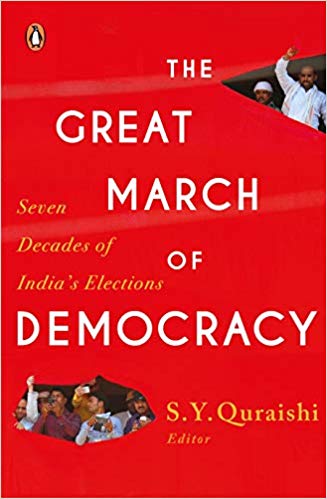
Sukumar Muralidharan

This is a fascinating book on contemporary media studies comprising eight chapters focusing on the existing debate on speech and freedom, nationalism, the state, civil society, satire, media, market, advertising and journalism.


Reviewed by: Manoj Jena
Bernard D’Mello

Maoism in India has evoked the interest of and intrigued social scientists and scribes in India and across the world of all persuasions for over seven decades. Though generally chronicled from the uprising in Naxalbari in 1967, its history goes back to the Communist Party of India-led uprising in Telangana in 1946 with the same intent, ideology and strategy. The Naxalbari movement of 1967 in West Bengal has a historical continuity with Telangana.


Reviewed by: Ajay K Mehra
Walter K. Andersen

The Rashtriya Swayamsevak Sangh (RSS) is ideologically driven, has a strong and complex organizational structure and is demonstrably the most powerful non-government organization in present-day India, with a determining influence in cultural and political life. In terms of its appeal and reach across social and geographical boundaries, both its growth and expansion have been phenomenal. Yet, it remains inexplicably mystifying and beyond the reach of those who wish to understand its unfolding strength objectively.


Reviewed by: Rabi Prakash
Nilanjan Mukhopadhyay

Nilanjan Mukhopadhyay is better known as a prolific columnist and author. Quite often his journalism is considerably informed by modern Indian history, more particularly Hindu-Muslim relations. Besides, he has also authored a few books which include a biographical account of Narendra Modi and also a detailed account of the anti-Sikh pogrom which was unleashed after the assassination of the then Prime Minister Indira Gandhi in 1984.


Reviewed by: Mohammad Sajjad
Alf Gunvald Nilsen

In the post-liberalization era the tribal communities are facing two contradictory situations. On the one hand, neo-liberalization has enhanced the processes of dispossession and marginalization and on the other hand, tribal organizations have compelled the Indian state in recent years to introduce various national laws like the FRA and MNREGA, which give tribal and other marginalized communities ownership and livelihood rights.


Reviewed by: Kamal Nayan Choubey
Amir Ali

This book is a necessary compilation that comes from an embattled republic of letters in a nation slowly being desiccated by the philistinism of its politics. The great merit of the book is its comprehensive nature as it focuses expansively on many themes. There is the question of the economy being roiled by adverse global headwinds that the ruling dispensation seems to be gloriously inept at handling.


Reviewed by: Amir Ali