There were more than 1.5 million émigrés, stateless persons who had become refugees, deprived of citizenship, denaturalized and denationalized. (The 2025 figure is nearly 120 million; 43 million refugees and 68 million internally displaced.) The next year, in 1921, the League of Nations High Commissioner for Refugees, the Norwegian Fridtjof Nansen, a zoologist and oceanographer, Nobel Peace Prize winner, proposed a supranational passport. The eponymous Nansen passport offered a lifeline to those thus cut loose. Marc Chagall, Igor Stravinsky and Vladimir Nabokov were among countless other celebrities who were beneficiaries. The passports could not be cancelled; the holder was protected from deportation; but it did not automatically confer the right to work and notice for travel had to be given in advance. Refugee law emerged. Alongside came intolerance,
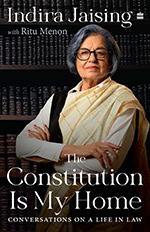
Running through the later chapters is a profound anxiety about the fate of constitutional democracy in contemporary India. Jaising writes about citizenship, secularism, civil liberties, judicial accountability and the treatment of dissenters with the urgency of someone who believes that foundational constitutional commitments are under strain. Her discussions of the Citizenship Amendment Act, the National Register of Citizens,
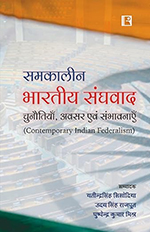
Vijay Shankar Choudhry has evaluated the journey of the idea and practice of federalism in postcolonial India. The idea of federalism faced different stages and challenges, and after diverse experiences now scholars and policy makers have accepted the idea of cooperative federalism. Sweety Sinha differentiates between competitive and cooperative federalism and argues that in recent times one can find the existence of competitive-cooperative federalism in India, where the Centre and different States are competing for foreign investment and also cooperating on different aspects of governance and welfare. However, another contributor,
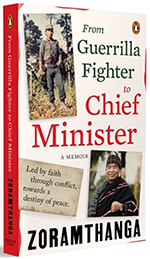
He sheds light on its planning and the major sites of conflict, besides making a realistic assessment of its successes and failures. He also dwells on the counter-insurgency operation of the Indian army. It was to suppress this very uprising that the Indian Air Force launched an attack within its own territory, the only such instance to date. The author mentions many of the places where the air force struck. The army’s strategy of grouping villages into guarded enclaves is also critically discussed. While its purported objective was to shield villagers from the conflict, according to him the real reason was to cut off supplies and information to the rebels.
‘It is, of course, fashionable to blame a stepmother for most of the misfortunes of the world, but Frenchman Claude Martin’s stepmother appears to have inspired in him a veritable obsession.’ This opening statement of one of the chapters should give the reader an idea of the delightful prose that characterizes The Lion and the…
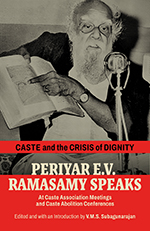
‘Annihilating Caste in Caste Associations’ and ‘Periyar at Caste Abolition Conferences’. At first glance, talking about annihilating caste at caste association meetings might seem paradoxical, but Periyar’s praxis becomes clear once we understand how he strategically utilizes the pre-existing caste forums for his own end of furthering the anti-caste agenda.
In every one of the caste meetings of the Sengunthars, Nadars, Adi Dravidas, and Chettiars, Periyar unfailingly emphasizes, ‘No one is above you. No one is below you,’