Bruce King

Bruce King’s Rewriting India charts new grounds in the study of Indian English writing. Any discussion on Indian English writing is bound to fall into the familiar trap of postcolonialism and the writers’ complicity in furthering the imperial discourse.


Reviewed by: Sanju Thomas
Bhagwandass Morwal

Bhagwandas Morwal is one of those rare Hindi writers who have consciously and continuously striven to extend the limits of their socio-creative oeuvre. He had burst on the Hindi literary scene with Kala Pahar and has, over the years, consolidated his position as a novelist with Babal Tere Desh Mein and Ret.


Reviewed by: Anup Beniwal
A.N. Sharma

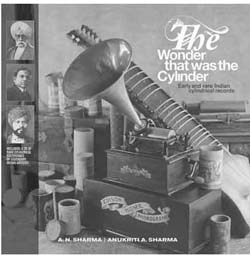
This is a remarkable story. The author, his wife and daughter (the book has been authored by the father-daughter duo)—all enthusiasts, music lovers, avid collectors are rummaging through a kabadi shop when Abha (wife) stumbles across dusty cartons of cylinders which the shopkeeper tells her are textile yarn winding accessories. They bring the cartons home. Some of the cylinders are labelled and dated.


Reviewed by: Partho Datta
A. Banerjee

Although this is yet another volume on dalit writing which adds to the burgeoning dalit discourse, it is welcome because dalit literature constitutes an important segment of postmodern literature in India in particular and is a prominent literary site in the South Asian context in general.


Reviewed by: A. Gangatharan
Yogendra Singh

‘Nearly every book’, George Orwell famously wrote in 1946, ‘is capable of arousing passionate feeling’—feeling which may range from ‘passionate dislike’ to equally passionate admiration—in the mind of the reader (George Packer [Comp.] George Orwell: Critical Essays, London, 2009, p. 290).


Reviewed by: Nabanipa Bhattacharjee