A. Banerjee

Each age has poets and poems circumscribed by environmental pressures and the politics of the emotions of the age. It is not just the manner in which feelings are expressed but these feelings—the very impact of a situation, seems to be different in every age. But a poet or poets…


Reviewed by: Monika Varma
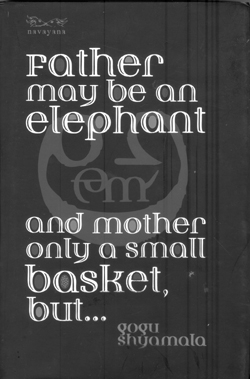
Gogu Shyamala

Gogu Shyamala paints a world in rural Andhra Pradesh where human lives are not separate from nature. They inhabit a vast space, feet planted in the ‘moist mud’ and faces touching in the sky. That these human lives are also segregated by society as ‘untouchable’ means that certain pleasures, such as ‘the scent of new rice’, the taste of jowar sap, the power to invoke the goddess, are theirs to enjoy; joys perhaps unknown to the upper castes.


Reviewed by: Tulsi Badrinath
Pritish Nandy

Indians writing poetry in English and not in their mother-tongue, Indo-Anglian poetry as it is fashionably known, has become quite a cult today. A cult particu­larly among the generation still suffering from the colo­nial hangover, the generation without any roots any­where…


Reviewed by: Rudrangshu Mukherjee
Sarah Joseph

This is a brilliant collection of stories,personally chosen by J. Devika, Associate Professor at CDS, Trivandrum, and Mini Krishnan, the well known editor particularly of translated works, at OUP. As a result, there is a quality of the unusual, the comic, the macabre and the holy, in an odd sense of equivalence.


Reviewed by: Susan Visvanathan
Mohammad A. Quayum

Recently, in a talk given by Professor Nigel Leask at the University of Delhi on Scotland’s national poet, Robert Burns, he struck a comparison between Burns and Rabindranath Tagore. He mentioned how both appropriated Scottish ballads and folk music in their respective compositions and therefore, how both could be aptly titled ‘people’s poet’ or ‘poet of the soil’.


Reviewed by: Nilanjana Mukherjee
Rabindranath Tagore

Referring to the craft of translation and its difficulties, J.M. Coetzee had commented in his rather well-known essay, ‘Roads to Translation’ that ‘Translation seems to me a craft in a way that cabinet-making is a craft. There is no substantial theory of cabinet-making, and no philosophy of cabinet-making except the ideal of being a good cabinet-maker, plus a handful of precepts relating to tools and to types of wood’ (Coetzee 151).


Reviewed by: Sanjukta Dasgupta