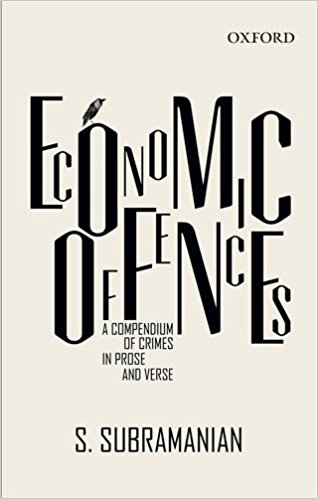
The back page write up on this book reads thus: ‘A compendium in Prose and Verse of Crimes perpetrated after office hours on sundry aspects of economy and society by a lapsed social scientist in the cause of expanding the horizons and shaping the values of young and unpromising scholars.’
2014
The book under review opens with a con- ceptual framework for understanding local governance as it flows through the regions of good governance, decentralization and reforms in India. He has reiterated the fact that there is a vital need to shift the focus from ‘government’ to ‘governance’, there-by, emphasizing decentralization rather than delegation.
The book under review is fascinating and disappointing at the same time. It is a masterly survey of the developmental and economic history literature on the significant changes that have taken place in the global economy over a long historical period stretching into many centuries.
Long before the city became trendy, there was the Indian city. It existed in our colourful and incredible mythology. It existed when the first of human civilization took root on the subcontinent. It was central to the multiple kingdoms that flourished from corner to corner in this vast land for centuries.
Among the recent works on Bihar, men- tion may be made of Vinita Damodaran (Broken Promises, 1992), Papiya Ghosh (Community and Nation, 2008), Hitendra Patel (Communalism and the Intelligentsia, 2011), Narendra Jha (The Making of Bihar, 2012), Lata Singh (Popular Translations of Nationalism, 2012).
The postmodernist invasion has not only pushed certain traditional histories out of circulation but also relegated the extremely useful analysis of class and movements that Indian history was used to.