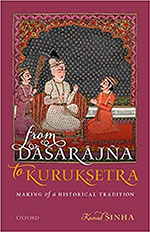
Kanad Sinha

A young and yet, already an acclaimed academic, Kanad Sinha has brought out a stunning book entitled From Dasarajna to Kuruksetra. The very utterance on Kurukshetra immediately connects one to the Mahabharata. On the other hand, Dasarajna, literally the battle of ten chiefs who were defeated by another powerful chief, Sudas, on the banks of the river Parushni (modern Ravi) refers to the outstanding political event in the Rigvedic clan society. The book seeks to establish connections between these two battles fought in separate historical epochs.


Reviewed by: Ranabir Chakravarti
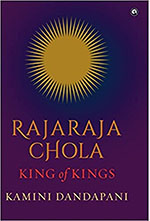
Kamini Dandapani

Growing interest in the history of peninsular India has sparked a series of excellent books of value to the specialist and lay reader alike.  Kamini Dandapani disavows being either a historian or a writer by profession, but her Rajajraja Chola, King of Kings does long-delayed justice to a ruler who is among the greats of the world and to a dynasty that for several hundred years was the shining light of India with a legacy that stretches to this day.


Reviewed by: Govindan Nair
Khwaja Hasan Nizami

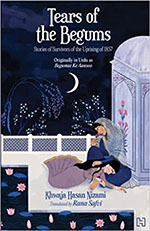
Tears of the Begums is the first-ever English translation by Rana Safvi of Begumat ke Aansoo, originally written in Urdu by Khwaja Hasan Nizami, a follower of the Sufi order Chishti-Nizamiya and a descendant of Hazrat Nizamuddin Auliya. Born almost twenty years after the revolt of 1857, Hasan Nizami’s spiritual pursuits led him to investigate the events of 1857, the encounters of the Mughal Emperor Bahadur Shah Zafar, the cruelties meted out to the royal family and the plight of royal family members, many of them women, who survived the revolt.


Reviewed by: Meena Bhargava
Mary E. John

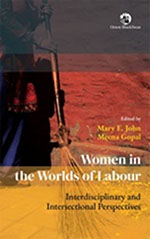
Women in the Worlds of Labour, originating in a conference on the same theme in 2014, brings wide-ranging critical and theoretical approaches into conversation with one another. While not claiming to be comprehensive, the editors lay out the analytical and historical importance of an interdisciplinary and intersectional perspective on the subject.


Reviewed by: Trina Nileena Banerjee
Zoya Hasan

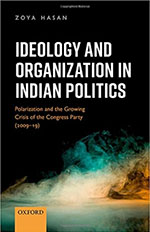
This timely study of the Indian National Congress of  yore, now widely referred to as the Congress Party, in the context of political processes in the post-sixteenth general elections in India in 2014, comes at a time when Rahul Gandhi, a scion of the Nehru-Gandhi dynasty, disparaged as ‘Pappu’ (immature and naïve) by the BJP, has recently completed the ‘Bharat Jodo Yatra’ that began on  7 September 2022 to traverse 3,570 kilometres to reach Srinagar after a 150-day journey.


Reviewed by: Ajay K Mehra
Bhanwar Meghwanshi

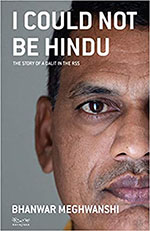
I Could Not Be Hindu: The Story of a Dalit in the RSS by Bhanwar Meghwanshi, an autobiographical note of his political genesis, where he shares his experiences with the RSS and the reasons he quit, is the narrative of an agonized author. Unlike other autobiographies which focus on different aspects of life, this book premises Meghwanshi’s metamorphosis of political career and varied  discourses of political engagement.


Reviewed by: Kanchan Biswas