Koral Dasgupta’s Kunti is not the willful mother who apportioned a common wife to her five sons. She is the young, vibrant, beauteous and superbly intellectual woman who is wooed by the Gods. The book swings along the path of a celestial love triangle: Surya, Indra and Kunti. The offerings match every expectation of such an imperial romance—peevishness, jealousy, wile, guile, manoeuvrings and manipulations—melting the boundaries between the humans and the devas.
As the blurb on the attractive book cover says, Sonal Kohli grew up in Delhi and lives in Washington DC; she studied at the Sri Ram College of Commerce, University of Delhi and went on to do her MA in Creative Writing from the University of East Anglia, UK and The House Next to the Factory is her first book. These details are important because they help readers understand not just her writing style as a trained creative writer, but also her ability to capture a Delhi, and a world beyond, that we may all know and yet we get to know all over again when we encounter it in her simple yet evocative prose.
Early 2021 saw the Aleph Book Company bring out a dark hued hardcover with a centrally placed Mughal motif in sandy gold. Raza Mir’s novel Murder at the Mushaira felt pleasantly hefty on store shelves.The nicely produced volume looked rich and piqued curiosity. The excerpt at the back promised it to be the forerunner of a seriously good read
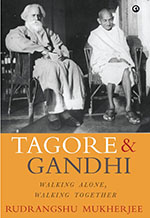
Rudrangshu Mukherjee’s Tagore & Gandhi: Walking Alone, Walking Together is an arresting book laced with fresh insights and perspectives, notwithstanding that it is about a subject that is well-trodden in the annals of academia. Tagore and Gandhi both bestrode the Indian firmament like two towering Colossuses. Attempting a book on either of them is fraught with danger.
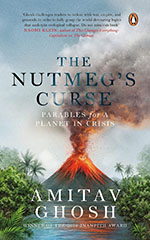
Amitav Ghosh’s The Nutmeg’s Curse is a work of post-genre literature. It is at once story, scholarly treatise, history, anthropology, folklore, memoir, diary, manifesto, and prose poetry. To call it a text would be unfair, for its very polemical and philosophical axis is agency. Moreover, it has been crafted with that rare artistry which, concealing itself as spontaneity, confers on the work a complex organic wholeness.
One of the aspects studied by scholars of globalization is its antiquity. Questions have been asked about whether globalization is a novel phenomenon from the 20th century, or merely varying manifestations of an old pattern over periods of time. Convincing arguments have been made on either side. One pattern that is undeniable is the search for products, profits and resources, all contingent upon control of people and territory.