By Appupen and Laurent Daudet

Dream Machine’s menacing quality lends itself to the realization of Hugo’s potential to tread an ethical path. He meticulously considers the implications of his actions, even at the expense of time with Anna. At this juncture, AiDA becomes more of a constant in his life than his wife. His reliance on AiDA correlates closely to his own sucking into the world of power and a willing dependence on machines while ‘Realeyes’ might be keeping a watch on him. But all is not lost yet as Hugo turns out to be a multidimensional character.


Reviewed by: Pranavi Sharma
Translated from the original Bengali by Lopamudra Maitra

A notable feature of Maitra’s translation is that most of the animals and birds acquire the names of their species in Bangla as a proper name, e.g., Tuntuni (tailor bird), Beral (cat), Chhagolchhana (baby goat), Bagh (tiger), Kumir (crocodile). These improvised proper names give an immediacy to the context and contribute to a fluent reading. But why are only the buffalo and the cow referred to by the common English names of their species?


Reviewed by: Nivedita Sen
By Arti Sonthalia. Illustrations by Tasneem Amiruddin

The illustrations in the book are contextual, but in my view, they could have been better. For a book that is about an artist, the illustrations are bland. They could have further extended and enriched the theme of the book. Mehar’s illustrations should have found more place.


Reviewed by: Neera Jain
By Lissa Coffey. Illustrations by Rajesh Nagulakonda. Edited by Sarita Saraf

Arjuna’s question is wisely tackled by Krishna. Another natural feeling that Arjuna expresses is about the winning team’s happiness in getting the trophy and the other team’s sadness in losing it. Here, too, the child-comprehensible words spoken by Krishna are commendable. They showcase the philosophy of the Gita in a simple way.
Meaningful words in rhyme,


Reviewed by: Indira Ananthakrishnan
By Aparna Kapur. Illlustrations by Ogin Nayam

At the end of the book, the author writes a coda in which she talks about why she wrote the story of Divya. In her childhood, she had not washed her hair for ten days. In this period, she made many imaginary friends. This experience has kept the narrative alive in her mind, giving her the conviction that telling it is critical.


Reviewed by: Nidhi Gulati and Shivi

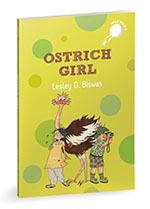
Ostrich Girl opens up with a bird call. ‘CHA-KE-KE-A-KE-KE-AAAAAA….’ echoes through the pages of this irregular narrative. Biswas tries to look at worldly issues through the lens of children. What Ostrich Girl deals with is the ask of the century; the question that environmentalists have seldom answers to. Integral to children’s literature, the author provides ample agency to the characters of her narrative.


Editorial