Because she lived on her own terms, her poetry was reduced to autobiographical confession. The patriarchs of Hindi criticism systematically sidelined her achievement. Ramchandra Shukla allocated her a scant half-page in his history, mocking her ‘addiction’ to pain and confining her to the realm of spiritual mysticism. Hazari Prasad Dwivedi found a different route to the same patriarchal condescension, judging her talent inferior to Jaishankar Prasad’s by claiming she lacked his intellectual constitution.
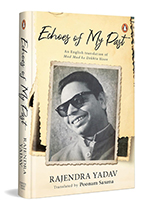
While growing up, the entire locality basically acted as the perimeter of her house but now, as she rightly points out, the flat culture has made us all ‘illiberal, lonely and insecure’. Unlike Yadav’s memoir which seems like a vignette of fleeting moments trying to latch on to some significant event of his life and instead tends to seem like a quest to impose self-importance, Bhandari’s words are rooted and lay down her life bare for all of us to witness. She talks of how she got married to Yadav while studying in Calcutta but soon realized that she had to single-handedly take care of their household as he had already declared that he had dedicated his life to writing. While both of them went on to become celebrated writers, they struggled financially. She talks about writing but also yearning to write more.
2026
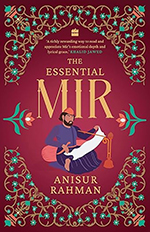
Though the possibilities of mazmoons are endless—as Wali, Mir’s predecessor, so evocatively said, raah-e mazmoon-e taaza band nahin/ ta qayaamat khulaa hai baab-e sukhan—certain kind of mazmoons were admissible to this discourse, others were not. He argued that classical Indo-Persian and Urdu poetry should be evaluated by its internal, formalist poetics rather than Western standards of raw emotional realism. The genre of ghazal should be appreciated for its impersonal, stylized artistry, its structural ingenuity and depth rather than its adherence to literal truth or some facile notions of realism. This is amply illustrated in the commentary section of The Essential Mir where one can see infinite variations on some common themes and the ingenuity with which those themes have been treated from different angles.
The poems induce intellectual contemplation, and perhaps even an emotional engagement. Even after the poems have been read and the book laid down, certain lines linger, for in these uncertain times, like Anju, we too ‘are no longer surprised/ By the tyranny of tyrants, and the betrayal of liars’. Along with her, we mourn our own lack of surprise in a world where headlines scream of doom and disaster, and ‘what was once habit has become a disease./ Reading the newspaper is a disease’, as Dhirjyu Basumatary laments.
2026
‘A Day’s Work’ is a son’s letter to a prospective nurse for his aged mother’s 24×7 care. It is a neurotic’s over-detailed checklist, which incidentally also reflects his meticulous concern as it does the extreme demands of a nurse’s vocation. The exactness and clarity of the minute-to-minute routine, put down without apparent emotion and as if mechanically, is like a clock face that hides the force wound up in the spring.
For the teacher is one of those whose education and exposure to the wider world have kept his caste consciousness from diminishing his self-confidence. A place name for him is just an address. Not so for the girl, who is one of the few in her community to have made it to that middle school full of ‘other’ children from ‘other’ villages. Ironically, her name turns out to be Arivoli—the Light of Wisdom. Her parents have given her the name of the literacy movement—Arivoli Iyakkam—of the 90s, which drew people from every nook and corner of Tamil Nadu to raise the literacy level to 85.5 per cent. But Arivoli did not do away with the caste system. On the contrary,