Its greatest strength lies in its comparative and class-based approach. Vakulabharanam is successful in using comparative political economy frameworks while managing to avoid the problems associated with Methodological nationalisms. By placing class at the centre of his analysis, he effectively questions mainstream economic theories that reduce inequality to mere income or consumption gaps. The integration of global capitalist forces into national inequality trends contribute significantly to his analysis, as well as to the broader literature. In terms of structure, clear chapterization, periodization, and the use of both primary and secondary data enhance the flow of arguments as well as the credibility of the author’s findings.
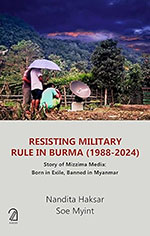
Structurally, the book adopts an unusual and effective format. After an introductory chapter that offers a concise overview of Myanmar’s military since 1962 for the benefit of unfamiliar readers, the volume consists of fifteen chapters presented as personal narratives by five different voices. In addition to the two authors, three Mizzima associates contribute their accounts.
The two sides came to a patrolling agreement in October 2024 for Depsang and Demchok areas in Ladakh. As per the Indian External Affairs Minister S Jaishankar, ‘(India and China) reached an agreement on patrolling, and with that we have gone back to where the situation was in 2020 and we can say … the disengagement process with China has been completed.’
Editorial
This is one of the motifs they use to comment on the decay and failure of Western approaches to the business of war-fighting and peace making. The book also finds that 21st century wars take place in already unstable geopolitical conditions. The backdrop of global disorder, evolving multipolarity, Western decline, and diminishing reliability of alliances have several negative—and some potentially advantageous—ramifications.
Towards the 1980s, Gaza emerged as the fulcrum of Palestinian resistance and in 1987, the first Palestinian Intifada started here. In 1994, the Palestinian Authority (PA) established its first headquarters in the Strip. From the beginning of the 21st century, Gaza’s politics of resilience underwent a fathomable transformation with the advent of political Islam which later overpowered Arab and Palestinian nationalisms
After conquering South Asia in the 19th century, the British decided to retain precolonial personnel, like qazis, while designing structures to meet their requirements. In 1864, however, Act XI abolished the position of qazi, as they were considered superfluous. This led to operational difficulties in Muslim legal practices and the British were forced to re-establish this position a decade later.