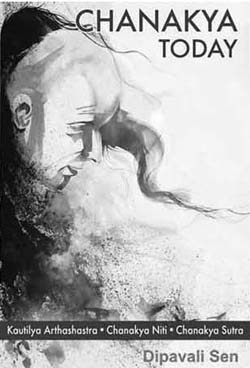
by Dipavali Sen

We have all read stories about Vikram and Vetal, in various forms and versions, and more specially, in the Amar Chitra Katha. Dipavali’s book, based on the same stories, might have given the feeling that it is the same old stuff once again. But the refreshing way in which she has handled the subject makes the book a real pleasure to read. She has treated the familiar mythology by ‘both abridging and expanding’ the original, and writing it in a modern style while staying close to its Sanskrit text. The Sanskrit names are always followed by words that explain the meaning of the names. For example the meaning of the names Gunashekhara, Indulekha, Dharmadhavaja, Abhayachandra are given as ‘virtuous’, ‘crescent moon’, ‘super-righteous, and ‘unafraid’, respectively. The explanations add a colourful touch and provide a better understanding of the character’s personality.


Reviewed by: Nilima Sinha
by Devdutt Pattanaik

In line with Devdutt Pattanaik’s philosophy which portrays myth as a subjective truth, he essentially tries to tell a story that has been told innumerable times in history as a more flexible and consequencedriven recount of events. He takes on the Ramayana by delving into Sita’s psyche while breaking the epic into five seamlessly knit together chapters, each one unfolding as one of her choices. It is his perception on the reasons behind a character’s actions which makes it an original account. For a young mind, these justify the behaviour and choices of the various characters and highlighting their contrasting characteristics clearly.


Reviewed by: Hansika Chhabra
By Subhadra Sen Gupta

I have heard and read a hundred times stories about Ganesha, and thought I knew them all: how he refused Shiva entry following Ma Parvati’s instructions, which enraged Shiva so much he cut off the child’s head, and then repented and got him an elephant’s head Anju Virmani THE STORY OF HANUMAN Text by Mala Dayal. Illustrated by Taposhi Ghoshal Red Turtle/Rupa & Co., New Delhi, 2016, pp. 74, R395.00 GANESH By Subhadra Sen Gupta. Illustrated by Tapas Guha Rupa & Co., New Delhi, 2016, pp. 42, R295.00 instead; how he broke off a tusk so that the writing of the Mahabharata was seamless; how he encircled his parents three times to win the race against his brother Kartikeya. So it came as a bit of a shock that there are other versions of the familiar, conventional tales.


Reviewed by: Anju Virmani
By Mala Dayal

The stories of Hanuman, son of Vasu and Anjana, his adven- tures as a child, his role in the Ramayana, and then in the Mahabharata, are a cornerstone of Hindu mythology. Hanuman’s life is like an adventure movie—filled with acts of great strength and courage, in- terspersed with evidence of his learn- ing and wisdom—so that it can be as exciting for the youngest child as it can be profound for an adult. In ear- lier generations, children had the fa- cility of grandmothers and grandfathers to tell them stories from our rich and varied mythology. With ever shrinking families, the child must have access to other sources. In her book The Story of Hanuman, Maya Dayal introduces very young children to some of these tales. Told simply, the book touches upon many events he is famous for: swallowing Surya, then persuading him to be his teacher; becoming Sugriva’s minister as guru-dakshina, and then helping him and Rama get together.


Reviewed by: Anju Virmani
By Arshia Sattar

The Rama story has been around for a long time. It has been a part of people’s life and thought for generations in this country. An inspiration for both saints and savants over the ages, its longstanding and continued appeal for common folk too has been no less clear to many observers of this land. Its spread has also been documented by eminent scholars in modern times. About three decades ago, this was done in fascinating detail, with India as the background, by A.K. Ramanujan in his acclaimed dissertation Three Hundred Ramayanas.


Reviewed by: A.N.D. Haksar
Geetanjali Shree. Translated from the original Hindi by Daisy Rockwell

Reading Ret Samadhi and Tomb of Sand is exhilarating, challenging, even exasperating; such is its span and scope, its playful exuberance and idiosyncratic originality of style, playing out differently in the two versions. Given its more recent American/English avatar, one may evoke Whitman: it is vast, it contains multitudes. Given its incontrovertible rootedness in its Indian-subcontinental milieu, however, one must invoke the Mahabharata, the grand epic that it references at the very outset.


Reviewed by: Maya Joshi