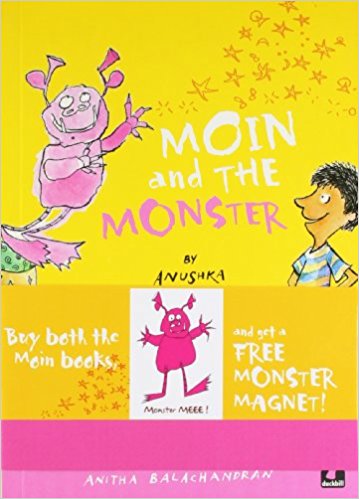
Writer Anushka Ravishankar strikes again, with a novel little book—and this time, it’s about a little girl who goes to the market, with a little money from her mother, but so captivating are the strange sights that she spends her time, lost in the wonderful world. Flowers, bangles, toys and fish … the list is endless as she skips along the narrow lanes, peers at the colourful stalls, gapes at sellers and buyers, and loses all track of time.
2013
If ever there was a book that captured every nuance that might appeal to a child, then this is probably it. Not for nothing is Anushka Ravishankar dubbed India’s Dr Seuss; her words are bright, appealing, and flavoured with such spirit and energy that even a word like Papayaaaaaaaa! is transformed into a long-drawn out horrified scream—uttered by Falguni Fruitseller, who stumbles upon a crocodile in a ditch—and reduces you to excited giggles.
Professor Carstairs is best known in India for his study of personality formation in a traditional Hindu society—The Twice Born. That study dealt with the social determinants of a ‘normal’ personality and relied mostly on an imaginative use of the clinical method.
‘Are you Woodward or Bernstein?’‘Neither, they are both in America’, replied John, thus killing, once and for all, an altogether inappropriate comparison between the Watergate reporters and the authors of Delhi Under Emergency. It was perhaps inevitable that this superb piece of investigative journalism, a rare specimen in India, by two young and relatively unknown journalists, would be compared to the Watergate story…
As a little child my mother told me the story of the founding of Panja Saheb: Guru Nanak once came into wilderness with his disciple. It was hot. The disciple thirsted for water. But water was nowhere except on top of a hill where a dervish lived.
The political appropriation of Mahatma Gandhi’s legacy has been going on for decades. Now the trend has spread to unlikely quarters. Gandhi peersat us from posters, sharing space with his ideological opponents. Even artifacts associated with him, like his spectacles, have been used as logo in government propaganda. Commercialization has been a parallel process, initially for marketing products purportedly of cottage industries, and then for a whole range ofother things. The powers that be appreciate the brand value of the
name Gandhi.