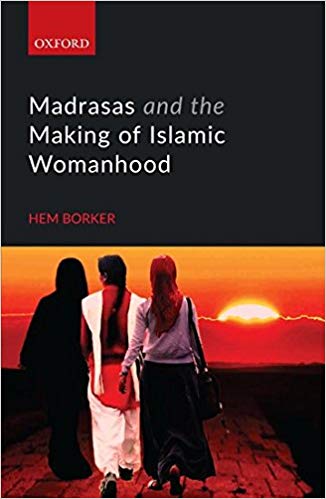
Hem Borker

This book is a study of madrasas and the role they play in educational attainment and construction of Muslim identity in modern India. It is unique in focusing on the educational journey of Muslim girls where much attention has been paid to boys and young men. It looks beyond madrasas as institutions of religious learning and instead focuses on the role they play in addressing Muslim girls’ educational aspirations.


Reviewed by: Qudsiya Contractor

Nandita Haksar

Nandita Haksar book, The Flavours of Nationalism, reminds us that food is not just a personal affair, it is also politically charged. In this brilliantly composed memoir Haksar writes about how food shaped her ideas about politics and culture and at the same time introduced her to the notions of communalism, patriarchy and nationalism which were all embedded in the way that food was prepared, shared and consumed.


Reviewed by: Ananya Pathak
Ghulam Murshid

Authored, translated and about to be reviewed by a Bengali (a curious coincidence, indeed), this book by Ghulam Murshid, a well-known Britain based academic of Bangladeshi origin, is yet another addition to the large corpus of writings on the Bengalis. It offers, as Murshid says, ‘a general idea of Bengali culture’. But this thousand years old culture has neither been uniform nor unchanging; all cultures, for that matter, show exactly the same traits.


Reviewed by: Nabanipa Bhattacharjee
Divya Vaid

The importance of a book on social mobility in India can hardly be over-emphasized when nearly three decades of economic reforms are to be completed. A crucial premise of ‘economic liberalization’ was that deregulation of various aspects of the economy would create new opportunities, which were hitherto chained by the nexus of the traditional capitalists with the bureaucracy on one hand and government monopolies in certain areas apparently restricting dynamism on the other.


Reviewed by: Arindam Banerji
Sarbeswar Sahoo

Sarbeswar Sahoo’s Pentecostalism and Politics of Conversion in India is a significant study of one of the most sensitive issues in the politics of religion in India. Barring the limitation that usually goes with ethnographic studies—the exclusive focus on a limited location in studying what is a pan-Indian issue—this book is a must read for those interested in knowing the truth about conversion and re-conversion in India.


Reviewed by: Valson Thampu
Irfan Ahmad

Irfan Ahmad asks the reader to look for something in Islam which we all believed never existed, i.e. critique. He explores critique in Islam, when we understood that Islam was actually hostile to critique. In this book Ahmad has two main arguments; first being that ‘reason, critique, and reflexivity’ did not begin with the Enlightenment or with Kant. Rather, it can be traced back to prophets and savants of the axial age, some of whom we know as founders of major world’s religions.


Reviewed by: Mirza Asmer Beg