
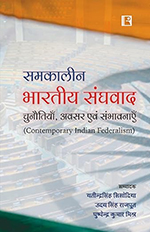
Federalism is one of the most crucial facets of the Indian constitutional system, which gives different federal units crucial powers to manage their diverse governance related issues. There has been consensus among scholars that the provisions of the Indian Constitution present it as a ‘quasi-federal’ system, where the Centre has more power than the States. However, the nature of the Indian federal system has always changed according to the changing political scenario of the country. It has been underlined that in the post-1990 era till 2014, the Indian political system was more federal because in coalition governments regional parties played a crucial role. However, post-2014, the nature of Indian federalism has again presented certain features of centralization of power and practical curtailment of the influence of the States. The edited volume, Samkaleen Bhartiya Sanghvaad: Chunautiyan, Avsar Evam Sambhavanayen (Contemporary Indian Federalism: Challenges, Opportunities and Possibilities) presents an extensive discussion on various contemporary features and emerging trends of the Indian federal system. Apart from a comprehensive Introduction, the book is divided into four sections: the ideational basis of federalism and contemporary trends, cooperative federalism and decentralization, Centre-State relations and fiscal federalism. The first section of the book consists of five chapters, and four chapters are included in each of the other three sections. In the Introduction of the book the editors have discussed the emergence and relevance of the idea of Indian federalism and presented the outline of the different chapters of the book.
The four chapters in the first section of the book discuss the foundational ideas behind federalism in India and focus on the changes in the Indian federal system in the contemporary period. Rekha Saxena presents a wide-ranging analysis of continuity and changes in Indian federalism. She argues that the elements of both cooperation and competition exist between the Centre and the States in India, and only cooperation can create a federal, democratic system to face different kinds of problems and challenges of the Indian nation-state. Uday Singh Chauhan has underlined that the core concern of Indian federalism is the accommodation of diversities, security, economic development and enhancement of democratic values. He emphasizes on creating a balance between parliamentary centralization and federal decentralization. Yatindra Singh Sisodiya and Madhav Prasad Gupta focus on the changes in the nature of Indian federalism after the 2014 General Election and argue that one can find the emergence of one party (Bharatiya Janata Party) dominance at the central level, which resulted in diminishing the federal features, including allocation of central funds. The authors stress that in the current scenario the Centre should take a comprehensive initiative to create a conducive environment for cooperative federalism. In his chapter, Anurag Ratna discusses the various phases of Indian federalism and also emphasizes the increasing centralization after the 2014 elections due to diminution in the political influence of regional parties.
The second section of the book discusses different aspects of cooperative federalism and decentralization in the Indian federal system. It is noteworthy that most of the scholars of federalism have accepted that the idea of cooperative federalism is a normative ideal for the countries which have adopted the federal system. Vijay Shankar Choudhry has evaluated the journey of the idea and practice of federalism in postcolonial India. The idea of federalism faced different stages and challenges, and after diverse experiences now scholars and policy makers have accepted the idea of cooperative federalism. Sweety Sinha differentiates between competitive and cooperative federalism and argues that in recent times one can find the existence of competitive-cooperative federalism in India, where the Centre and different States are competing for foreign investment and also cooperating on different aspects of governance and welfare. However, another contributor, Uma Yadav, underlines cooperative federalism as an inevitable factor to ensure a balanced development of all the States. She argues that competitive federalism has created some rich States, but many States are backward, which creates inequality among them. Nalin Singh Panwar has argued that decentralization has created a conducive environment for the participation of women, Scheduled Castes and Scheduled Tribes and other marginalized sections of the society in the decision-making processes at the grass-roots level.
In the third section, different chapters focus on the diverse facets of the Centre-State relationship in India. Pratima Sharma accepts that in every federal system the struggle and contestation between the Centre and the States is inevitable. However, to establish a vibrant federal system in a country like India, it is necessary to create a balance between a strong Centre to ensure the unity and integrity of the country and also autonomous States to promote development. Shantesh Kumar Singh has emphasized the need for cooperative federalism for providing better health services to people, particularly in health emergency situations, like COVID-19. The chapter by Naved Jamal and Shayista presents the experiences of COVID-19 from the lens of Centre-State relationship. According to them, there is no provision of ‘health emergency’ in the Indian Constitution, but the pandemic made it crystal clear that cooperation between the Centre and States was essential to tackle such crises. In one crucial chapter Rajiv Kumar Singh and Akshat Pushpam argue that the nature of Indian federalism has been determined by the nature of the party system in India. In a one-party dominant system the States were entirely dependent on the central leadership of the ruling party. Nevertheless, with the emergence of regional parties the federal structure has changed, and the idea of ‘cooperative federalism’ has gained ground.
In the fourth section, the chapters focus on diverse issues related to fiscal federalism. Girindra Mishra has argued that competitive federalism is a positive thing, because it inspires the States to perform better to attract foreign investment and economic resources. Aradhna Kumari discusses fiscal relation between the Centre and the States from the perspective of health emergency caused by COVID-19. She argues that since economic activities were hampered, it resulted in more dependence of the States on the Centre for economic resources. However, she also praises the government for adopting values of cooperative federalism during this period. Palak Singh criticizes the functioning of the NITI Aayog and claims that it has curtailed the powers of the States and centralized fiscal resource allotment. Peeyush Tripathi and Amit Bhushan Dwivedi highlight that a constitutional amendment has ensured the division of all central taxes between the Centre and the States creating a conducive environment for a cooperative federal system.
The book comprehensively covers crucial aspects of the changing landscape of the Indian federal system. But some other aspects which should have also been included in the book are: first, in recent years (post-2014) a trend has emerged in which Governors are playing a more active role in non-BJP/non-NDA ruled States. As constitutional envoys of the Central Government, they have mostly ceremonial functions, but they have started to intervene in the day-to-day affairs of governance in Opposition-ruled States. This trend has heavily affected the constitutional federal fabric. Secondly, forced defection in the Opposition parties resulted in the fall of many State governments. Since in most of the cases it resulted in the formation of the BJP governments in such States, it has created a one-party dominance. Such patterns have a far-reaching impact on the federal system of our country. Third, though the book discusses decentralization, there was also the need to focus on the actual situation of the third layer of federalism in different States, and in this context the asymmetrical features of Indian federalism should have been discussed.
However, there is no doubt that this volume is a crucial contribution to the study of the changing nature of the Indian federal system. The academic Hindi used in this volume is lucid, and will be helpful for those students and researchers who prefer to study in Hindi.
Kamal Nayan Choubey teaches Political Science at Dyal Singh College, University of Delhi, Delhi.