
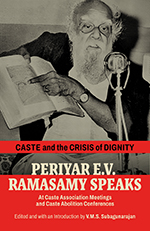
‘Down with Tamil’ and ‘Long Live the English!’ would be his rallying cry declares EVR Periyar, if there arises a situation where caste can be abolished only with the help of the British, at a caste abolition conference in Chennai. According to him, a true caste abolitionist must work with a singular mind towards dismantling the caste system and establishing equality, disregarding any loyalty owed to her/his State, nation or community. The tenacity with which he pursues the cause becomes evident in his principled resistance to God, religion, and nation. Periyar’s life and work are indispensable to anti-caste thought and struggle, making Caste and the Crisis of Dignity: Periyar E.V. Ramasamy Speaks, an English translation of Periyar’s speeches at caste conferences, a valuable resource on how to effectively and pragmatically confront the question of caste in 21st-century India.
Published in 2025, the collection has about sixty-five speeches that Periyar delivered at caste association meetings and caste abolition conferences from the 1920s to the 1970s, translated by R Vijaya Sankar, Vignesh Rajahmani, and M Vijaybaskar and edited by VMS Subagunarajan. The speeches, editorials and reports in the book are sourced from V Anaimuthu’s compilations, Dravidar Kazhagam’s Periyar Kalanjiyams, and the Periyar Archives of Kudi Arasu and Viduthalai, journals run by Periyar.
Editor Subagunarajan’s introduction and epilogue, which frame the speeches, orient the readers historically and guide them on how to engage with Periyar and caste. The expansive introduction draws a historical overview of Tamil Nadu’s political engagement with caste—the emergence of the Justice Party, the non-Brahmin intelligentsia, and the Self-Respect Movement—while also delineating the role of colonialism in concretizing caste divisions in India alongside Periyar’s own life experiences, influences and contributions to the anti-caste struggle. The epilogue analyses the usefulness of Periyar’s toolkit of atheism and rationalism in overthrowing caste and calls for the readers to honestly engage with his ideas, refraining from uncritical reverence.
The speeches in the book are thematically divided into three sections—‘Periyar on the need for Caste Conferences and Caste Parties’, ‘Annihilating Caste in Caste Associations’ and ‘Periyar at Caste Abolition Conferences’. At first glance, talking about annihilating caste at caste association meetings might seem paradoxical, but Periyar’s praxis becomes clear once we understand how he strategically utilizes the pre-existing caste forums for his own end of furthering the anti-caste agenda.
In every one of the caste meetings of the Sengunthars, Nadars, Adi Dravidas, and Chettiars, Periyar unfailingly emphasizes, ‘No one is above you. No one is below you,’ to address both the Brahminical hegemony that makes inferior the majority of the castes and the intermediate castes’ own ingrained casteism, which misleads them to believe they are above certain others. Periyar sees caste associations as opportunities for communities to come together and collectively introspect their position in society and get rid of their own regressive caste and religious doctrines to progress educationally, intellectually, morally and culturally. He explains:
Organising caste conferences to liberate yourself from your problems and humiliations should be your main concern, ignoring the criticism that it is an anti-national activity. Until caste, religious and class inequalities are abolished legally, it is imperative for people who are humiliated and harassed in the name of caste and religion to organise caste conferences and liberate themselves (p. 172).
Periyar also uses these associations to advocate for women’s empowerment and make men confront their own patriarchal tendencies. In the Sengunthar conferences, he condemns the Devadasi practice and places the onus on men to end the unfair and derogatory tradition. He takes on a radical feminist route and urges women to unlearn their religious and moral conditioning and stand up for their rights fiercely. At a meeting at Erode in 1931, he says:
…if a man has two mistresses, women should be ready to have three paramours… we have been trying to do justice to women by repeatedly asking men not to beat up women. We have realised that it is of no avail. Now we tell women to hit back when men hit them…. Similarly, we tell women to betray men if men betray them… importantly, they [women] should not give birth to children indiscriminately…. Women who think that begetting children is the result of God’s will and that it is one of the blessings of life are really suffering… (p. 147).
These bold proposals of Periyar might be the reason the term ‘Periyar Pethi’ (Periyar’s granddaughter), though often used derogatorily, has become synonymous with any free-thinking modern woman in Tamil Nadu.
Periyar is also heedful of not solidifying caste rigidities, which might be a natural consequence of having caste associations. For instance, at a fishermen’s conference, he encourages them to pass a resolution to leave the profession if their rightful demands are not met and to educate their children and provide them with alternative vocation options. He uses caste conferences as a means to destabilize caste operations and get rid of the indignity associated with caste labour.
The book, despite being a curation of Periyar’s speeches on caste, also includes his perspectives on the inalienability of state rights, recognizing and questioning (Brahminical) power, self-respect as a tool to attain equality and the eradication of institutions that hinder rational progress. His wide-ranging strategies on how to tackle the various oppressive structures are of immense contemporary value, making the book a timely publication.
The English translation renders the speeches in a simple and lucid manner, maintaining their spoken quality. Retaining the Tamil word ‘vengayam’ (onion) in the translation—Periyar’s popular metaphor for religion and superstitions that are empty and meaningless, with no substantial core, adds an interesting regional flavour to the speeches. While some translations like ‘Tear Drops’ for ‘Kanneer Thuligal’, which Periyar teasingly used to refer to the newly-formed Dravida Munnetra Kazhagam by CN Annadurai, miss out on the mocking rhetoric effect, the endnotes provided are more than helpful in conveying the historical depth.
More often than not, Periyar’s (dis)reputation precedes any proper engagement with his writings or speeches. Widely described as being radical, atheist, anti-Brahmin, anti-Aryan, and anti-national, there exists a substantial prejudice that prevents the conservative Indian populace from reading or knowing about the iconoclast. Despite being a household name and hailed as the ideological leader by political parties that wish to escape the Dravidian rhetoric, there are a very few who actively read his works in Tamil Nadu and even fewer outside the State. Reading Periyar would facilitate a better understanding of his ideological positions and help make reasoned judgements about him. The English translation, now, has lifted the language barrier and makes his speeches accessible to non-Tamil readers as well.
Periyar is famous for having said not to blindly accept everything he says but to use reason and critical thinking to arrive at conclusions, and this book provides exactly that very chance!
Aazhi Arasi A is a Senior Research Fellow in the Department of English, Stella Maris College, Chennai.