
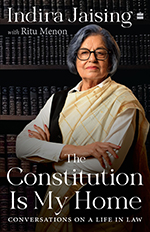
What does it mean to call a constitution a home?
For most lawyers, a constitution is a legal document. It creates institutions, distributes power, guarantees rights and limits the authority of governments. It is something one studies, interprets and invokes. It is rarely something one inhabits. Indira Jaising’s memoir begins with a different proposition. For her, the Constitution is not merely a legal text or a professional instrument. It is a place of belonging.
That claim gives The Constitution Is My Home its emotional force and intellectual coherence. Written as an extended conversation with feminist publisher and writer Ritu Menon, the book is ostensibly a memoir of one of India’s most influential lawyers. It recounts courtroom battles, feminist interventions, constitutional litigation, political conflicts and professional triumphs. Yet beneath these narratives lies a more fundamental question: where does one belong in a nation shaped by displacement, inequality and contested ideas of citizenship?
For Jaising, that question is inseparable from her own life. Born into a Sindhi family displaced by Partition, she grew up carrying what she repeatedly calls the ‘birthmarks of Partition’. Unlike many Indians, she cannot point to a linguistic State and call it her own. Sindh survives in memory, family history and longing, but not within the territorial map of contemporary India. The memoir returns repeatedly to this experience of rootlessness, not as a private wound alone but as a political condition.
It is from this experience that the title emerges. The Constitution becomes home because geography cannot. The idea is deceptively simple, yet it transforms the entire memoir. What follows is not merely the story of a lawyer’s career but an account of a lifelong search for belonging through law, rights and constitutional values.
One of the book’s greatest strengths is the way it humanizes constitutionalism. Constitutions are often discussed through doctrines, amendments and judgments. Jaising approaches it through people. The Constitution appears not as an abstract legal framework but through women denied equality, workers denied dignity, pavement-dwellers denied shelter, minorities denied security and citizens denied liberty. Again and again, the book returns to individuals standing before institutions and asking a simple question: is this fair?
The pavement-dweller facing eviction. The hawker whose livelihood is destroyed by municipal authorities. The woman confronting sexual harassment at work. The survivor of caste and communal violence. The citizen asked to prove her belonging. These figures populate the memoir as much as judges, politicians or lawyers.
In doing so, Jaising offers something unusual: a constitutional history told from below.
The book’s most memorable sections are often the least self-congratulatory. They concern not victories but encounters—with injustice, exclusion and the stubborn realities that constitutional promises alone cannot erase. The legal struggles surrounding Olga Tellis, Vishaka, Mary Roy, Githa Hariharan and countless other battles appear here not as milestones in a distinguished career but as moments in a larger project: expanding the meaning of citizenship and dignity.
This is also, unmistakably, a feminist memoir. Jaising belongs to the generation that transformed women’s rights from a peripheral concern into a constitutional question. Her reflections on the legal profession reveal how deeply gender continues to shape access to power, opportunity and recognition. Some of the book’s most revealing passages concern seemingly ordinary struggles: the absence of a crèche within the Supreme Court, the opacity surrounding senior designations, the resistance faced by women who refuse deference, and the informal hierarchies that structure professional advancement.
These episodes matter because they illuminate a larger conviction running through the memoir. Yet what distinguishes The Constitution Is My Home from many legal autobiographies is its willingness to dwell on disappointment.
Running through the later chapters is a profound anxiety about the fate of constitutional democracy in contemporary India. Jaising writes about citizenship, secularism, civil liberties, judicial accountability and the treatment of dissenters with the urgency of someone who believes that foundational constitutional commitments are under strain. Her discussions of the Citizenship Amendment Act, the National Register of Citizens, the shrinking space for civil society, and the changing relationship between courts and executive power are among the book’s most controversial and thought-provoking sections.
Readers will undoubtedly disagree with some of her conclusions. At times her assessment of institutions is unsparing. But disagreement is not the measure of the book’s value. Its significance lies elsewhere. The memoir captures the predicament of a lawyer who has spent decades placing faith in constitutional institutions while increasingly confronting their limitations.
Many autobiographies celebrate careers. This one often reads like an attempt to understand a series of disappointments. Political retaliation, institutional silence, attacks on civil society, failures of accountability and personal targeting all appear in these pages. Yet remarkably, none of this produces cynicism. Instead, it deepens Jaising’s attachment to constitutional values.
This is the memoir’s central paradox. The institutions disappoint her, but the Constitution does not. That distinction explains both the power of the title and the emotional core of the book. The conversational format chosen by Ritu Menon serves this project exceptionally well. Rather than producing a conventional chronological autobiography, Menon allows the narrative to unfold through reflection, argument and memory. The result is less a record of events than a meditation on law, feminism, citizenship, displacement and constitutional faith.
The book’s most enduring contribution may be its insistence that Constitutions are ultimately judged not by their text but by the lives they make possible. Jaising’s life has been spent testing that proposition. Sometimes the Constitution answered. Sometimes institutions failed. Sometimes justice arrived late. Sometimes it never arrived at all.
Yet the memoir never abandons the belief that constitutional promise remains worth defending.
In one of the book’s most striking moments, Jaising describes her final migration as a journey ‘home to myself’. By then, readers understand that the phrase carries more than personal meaning. It is the culmination of a life shaped by movement—across borders, professions, institutions and political eras. It is also the culmination of a search for belonging.
The Constitution, she suggests, is not simply where rights are protected. It is where citizens learn how to belong to one another.
Whether one agrees with all of Jaising’s politics is ultimately beside the point. The Constitution Is My Home deserves attention because it asks a question that has become increasingly urgent in contemporary India: what sustains constitutional faith when institutions themselves appear fragile?
Few books confront that question so directly. Fewer still answer it with such conviction. Jaising’s answer is not nostalgia, and it is not surrender. It is resistance.
Sahil Hussain Choudhury is an advocate and constitutional law researcher based in New Delhi. He holds an LLM in Constitutional Law from HILSR, Jamia Hamdard, Delhi.