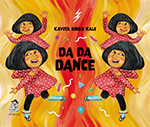
she takes flight into the boundless sky of her imagination. With a ball on her nose, she transforms into a clown; wearing a cardboard box, she becomes a robot; and with unique antennae on her head, she turns into an alien. Amidst the music and its melody, she shifts fluidly from clown to robot to alien. All this unfolds through the rhythm and movement of the illustrations.
2026
The story is a kissa, as we say in Hindi: a small incident, sweet enough to be worth telling. It reminded me of a friend’s little cousin who loved bhindi. Every time they went to the market, he would point at a vegetable and announce, ‘Bhindi!’ ‘No, beta, that’s mirchi.’ Another one: ‘Bhindi!’ ‘No, beta, that’s kundru.’ This went on until he finally held up a real bhindi. My friend was about to say no, thinking he was still showing the wrong vegetable, and that is what made it so funny. Children learn this way: they form a schema,
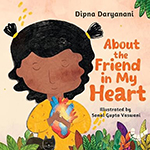
This, then, is the special something this book has managed to achieve in the simplest of ways. We would all like to encourage kindness and compassion in children but the author has managed to do so in a charming manner without preaching or moralizing so as to get the message across. Of course, she has been greatly assisted by the bright and colourful illustrations by Sonal Gupta Vaswani–and together, they make this an absolutely ideal book to be read to young children—4 years and above—even before they can read it themselves.
The story has Paati giving step-by-step instructions to Noni on how to make the perfect, buttery-crisp, yummy dosa. The whole process is beautifully described, using a lot of rhyme and onomatopoeia, making it very lyrical. One wonders if Noni, or any child listening to or reading this story, will be able to fall asleep without getting hungry and needing to eat a real dosa!
Incidentally, this story reminds me of my childhood days,
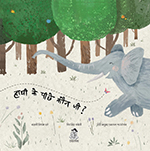
A novel piece of designing which has a centre page that opens up like an accordion, followed by another set of pages. Its soft illustrations and the dotted lines on each page act as a gentle nudge and compel the reader to turn to the next page. A butterfly is constant on each page and apparently poses the title question. It tracks all the animals till it completes a full circle and reaches the elephant again, only to realize that the same pattern of one following the other continues. How does that happen?
2024
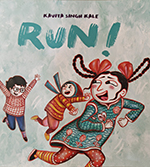
A big Himalayan sheepdog chases three children, who come face to face with it and, terrified by its loud bark, start running through the hills. When they reach the edge of the cliff they are met with a furry surprise. The illustrations are colourful and vibrant and little ones would want to see them repeatedly.