
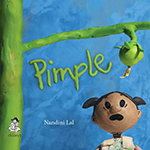
A small plant. A few days later, a strange pimple appears on this plant. What will happen now? Will all the other plants get a pimple like that? If we touch the plant, will we also get a strange pimple?
You can tell the book was made by a designer, and Nandini Lal is one, trained at IDC School of Design, IIT Bombay, with an interest in animation and sculpture. The size, the paper and the overall design are all coordinated, and together they invite children to interact with it. In two places, the reader can use their fingers and pull downwards to see a little magic. I won’t reveal it here, because this is a book to be read with your hands.
The story is a kissa, as we say in Hindi: a small incident, sweet enough to be worth telling. It reminded me of a friend’s little cousin who loved bhindi. Every time they went to the market, he would point at a vegetable and announce, ‘Bhindi!’ ‘No, beta, that’s mirchi.’ Another one: ‘Bhindi!’ ‘No, beta, that’s kundru.’ This went on until he finally held up a real bhindi. My friend was about to say no, thinking he was still showing the wrong vegetable, and that is what made it so funny. Children learn this way: they form a schema, test it, and adjust it when it doesn’t fit, which Piaget called accommodation. Pimple has the same curious spirit.
The artwork is what makes the book special. The illustrations are photographs of clay sculptures she made herself. She sculpted each scene and photographed it one by one, much like stop-motion animation. Just imagining the process is fascinating, and ordinary illustrations would have lost the tactile, handmade charm.
There is no preaching and no moral tacked on, only joy, wonder and curiosity.
I think children between four and eight will love it. Be ready for questions, because they will have plenty. Pimple is a good example of contemporary children’s literature: a simple story, space for interaction, and room for the reader’s own experiences.