
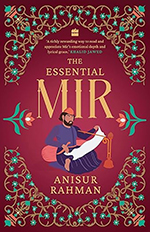
While reviewing Vikram Seth’s translation of Hanuman Chalisa for Frontline, Prathyush Parasuraman made the rather astounding claim that a good translator of poetry has to be ‘audacious’ enough to realize the ‘poetic possibilities’ of the translation. As an example he refers to Aijaz Ahmad’s edited volume, Ghazals of Ghalib, where Ahmad had selected 37 ghazals (in full or in part) and distributed them, along with their literal translations, and contextual and explanatory notes, among a bunch of American poets to create their own poems out of them. What Parasuraman did not tell the readers was that Aijaz Ahmad himself did not call them translations, but ‘versions from Urdu’. We have seen how audacity had led Edward FitzGerald to turn to Omar Khayyam from a mystical poet to a hedonistic Epicurean. We have also seen such audacity in some Western translators of Rumi who have emptied him out of the religious and mystical content in their attempts to make him more ‘secular’ and acceptable, and perhaps, to realize the ‘poetic possibilities’ of their translations. Fortunately, in The Essential Mir, Anisur Rahman as a translator felt no need to display such audacity. He preferred sincerity (which Parasuraman characterizes as ‘parasitic’) to audacity, and has stayed close to the original.
The Mir studies/translation (in English) that one is familiar with are those by Ralph Russell & Khurshidul Islam (Three Mughal Poets), Ahmad Ali (The Golden Tradition), KC Kanda (Mir Taqi Mir: Selected Poetry), Shamsur Rahman Faruqi (Mir Taqi Mir: Ghazals), Paul Smith (The Book of Mir) and more recently, by Ranjit Hoskote (The Homeland’s an Ocean). (In Urdu, Mir studies have been revived and refashioned by Shamsur Rahman Faruqi, his She’r O Shor-angez in four volumes contains his extensive interpretation and masterful analysis of Mir’s poetry.) In English, some translators (such as Faruqi) have chosen to translate full ghazals while others have picked up she’rs (couplets), as Rahman has done, from Mir’s six divans to curate their volumes.
It is evident that each one of the translators named above has processed and packaged Mir in a substantially different way than the others in the group, which only confirms the view that there are different models and strategies for poetry translation and its curation. In his scholarly Preface and comprehensive Introduction, Rahman has provided the reader with Mir’s biographical and historical details, Urdu literary tradition, conventions surrounding the genre of ghazal, etc. All this constitutes the context that will help readers understand and appreciate Mir’s couplets in their true spirit. The Essential Mir showcases 200 representative couplets from Mir’s massive six-volume corpus comprising over 13,000 verses and presents each one of them as a seemingly self-contained poetic entity in a two-page visual capsule. The left-hand page features the chosen she’r in the Urdu original along with Devanagari and Roman transliteration. Below the scripts, Rahman provides his English verse translation of the original and a short glossary of the difficult, unfamiliar and archaic words. The facing page contains Rahman’s commentary on the she’r where he parses the she’r into smaller units linguistically, illuminates the she’r’s social and cultural contexts, and then reflects on the various interpretive possibilities of the she’r in terms of the poet’s overall vision of love, life and all its rewards and discontents. The organization of the materials in such a capacious way facilitates both accessibility and readability.
Shamsur Rahman Faruqi, while discussing the salient characteristics of ghazal as a genre underlines the fact that there is a universe of discourse specific to ghazal tradition, defined by maa’ni afrini (meaning creation, i.e., generating layered, polysemic meanings within a single verse using clever syntax, puns, or wordplay [iham]), and mazmoon afrini (theme creation, i.e., inventing fresh themes or extracting an entirely new, unexploited angle out of a traditional metaphor). Though the possibilities of mazmoons are endless—as Wali, Mir’s predecessor, so evocatively said, raah-e mazmoon-e taaza band nahin/ ta qayaamat khulaa hai baab-e sukhan—certain kind of mazmoons were admissible to this discourse, others were not. He argued that classical Indo-Persian and Urdu poetry should be evaluated by its internal, formalist poetics rather than Western standards of raw emotional realism. The genre of ghazal should be appreciated for its impersonal, stylized artistry, its structural ingenuity and depth rather than its adherence to literal truth or some facile notions of realism. This is amply illustrated in the commentary section of The Essential Mir where one can see infinite variations on some common themes and the ingenuity with which those themes have been treated from different angles. We also see how Mir possessed the quality of kaifiyat which may be loosely interpreted as ‘mood’, akin to the rasa in Sanskrit.
Rahman hasn’t made any specific points about the challenges of translation into English. As for structural organization, in most instances in the volume, a couplet has been rendered through a four-line verse (Islam & Russell, and indeed Faruqi, generally rendered a couplet for a couplet, though there are deviations too), the second line in many cases has been repeated as the fourth, the repetition sometimes resulting in an overemphasis, not inherent in the original. For example, let’s take this simple verse–Kahaa mai ne kitnaa hai gul ka sabaat/ kali ne ye sun kar tabassum kiya that has been translated as–‘how long would the bloom last,/I asked;/ the bud only smiled at what/I asked’ (p. 10). Thus, what is said once in the original is said twice in translation, apparently to achieve the rhyming objective. Repetition does change the impact and import. In other cases, verses that were quite open-ended in the original didn’t remain so open-ended in translation because of the repetition. Over-translation has its own perils, as much as under-translation. The simple expression, ‘Hearing this, the bud only smiled …’, as in the original, certainly has much more rhetorical force than the elaborate ‘the bud only smiled at what I asked’.
Poetry always gains strength through suggestions, brevity and indirection. In the case of Mir, the most challenging task perhaps is to capture what is known as his sahl-e mumtana (deceptive simplicity, or what Rahman calls ‘subtle simplicity’), his singular poetic voice that relies to a great extent on tone, subtle internal rhythms, and conversational cadence. Well, the translator cannot be wholly blamed for the additions because such compromises become a sort of fait accompli once he/she has decided to go for a verse translation. Translators have done this down the ages.
All said and done, The Essential Mir is a carefully crafted volume, executed with deep care and attention, and deserves to be celebrated as a valuable addition to Mir corpus in English and appreciated in full measure.
* An expanded version of the review is available in the digital issue of The Book Review (www.thebookreviewindia.org)
M Asaduddin is author, critic and translator.