By Romila Thapar

The latter, obviously, reeks of violent prejudice. However, while insisting solely or even primarily on the former identity acknowledges her courage and perseverance, it often forecloses the possibility of engaging with the rich, complex, even conflicting uncertainties that Thapar continues to engage with, with clarity, confidence and care. As she asks, almost plaintively: ‘Who would understand that I dreaded being stereotyped (p. 97)?’
As I worked my way through the volume, I could not help wondering whether Thapar’s deep engagement with Sanskrit texts, ranging from the Vedas and Upanishads to the epics, charitas,


Reviewed by: Kumkum Roy
By Gopalkrishna Gandhi

The essay has long been celebrated as a quiet instrument of thought—plain in style yet deep in reach, brief in length yet lasting in effect. It is neither a polemic nor a treatise, but a way of thinking aloud with discipline. Francis Bacon called his essays ‘dispersed meditations’, showing how a short piece could hold a lifetime of reflection. George Orwell demonstrated how plain language could carry moral urgency. Virginia Woolf turned everyday observation into meditation, as in Street Haunting, where a walk through London became a reflection on identity. Nirad C Chaudhuri blended memory with sharp commentary,


Reviewed by: TCA Ranganathan
By Jaladhar Sen. Translated from the original Bengali by Somdatta Mandal

I found myself revisiting the happy days of my childhood and the cherished memories of my youth’ (p. 158). Time collapses, ‘I momentarily forgot the sorrow, suffering, and hardships endured along the journey’ (p. 163). Sen’s receptivity to the divine surfaces despite his scepticism: ‘This beautiful, harmonious sound did not arise from any earthly musical instrument, rather, it seemed to flow into the ears of the pilgrims like a divine congratulatory hymn’ (p. 182). Why ‘congratulatory’? For reaching the final destination or attaining the peace that his bruised soul craved? Perhaps it brought a readiness to return to worldly pursuits.


Reviewed by: Malashri Lal
By Akhtarul Iman. Translated from the original Urdu by Baidar Bakht

Iman writes in some detail about his professional or sociable associations with a few of the progressives. As regards the political or ideological stance of the writers, he remains mostly neutral though at times somewhat critical, and sometimes, ostensibly, he tilts in favour of the rubrics of the Lahore-based Halqa-e Arbab-e Zauq (circle of the men of taste) literary movement, his poetic art, language and his poetic subjects crisscrossing both. As regards the Partition which he was witness to,


Reviewed by: Fatima Rizvi
By Rajendra Banahatti. Translated from the original Marathi by Jerry Pinto

The judicious use of footnotes, something not in fashion currently, to explain cultural practices like antarpat, a benediction from Sanskrit, or a line from Sant Ramdas adds value to the smooth and flowing narration. A brief introduction to the context of the writer (especially when s/he is a lesser-known writer in the English-speaking scenario) and the place of this text in the Marathi ecosystem could have added some gravitas to the text and helped readers to build a more adequate picture about the context of production. It is curious to see the narrator, a retired engineer who has had no whiff of literature or art by his own admission, using words like uxorious or non compos mentis.


Reviewed by: Vanamala Viswanatha
Told by Mallu Swarajyam to Uma Chakravarti, Vimala Morthala and S. Katyayini. Translated from the original Telugu by Purnima Tammireddy

As she observes after becoming an MLA, ‘Regardless of one’s political leaning or ideology, one must discover the issues that people face and evolve strategies within the legal framework to resolve them’ (emphasis added). Although she eventually became one of the most recognizable leaders of the Communist Party, she disarmingly remarks, ‘All my work in the movement was unplanned; it happened organically.’ Unlike many political memoirs, which retrospectively impose ideological coherence upon youthful activism, The Fire of Defiance presents political consciousness as something that emerged gradually through lived experience, family influence, and direct encounters with oppression.


Reviewed by: Vijay Kumar Tadakamalla
By Abdul Bismillah

But he also shares the darker stories of writers’ lives, of acute financial insecurity or plain poverty, of mental anguish and bleak prospects. Poet and wordsmith Trilochan spent his early days in Banaras subsisting on chana before doing the rounds of offices looking for work. Sometimes, he would count the chana to make sure it lasted him throughout the day. Amarkant was an established writer in the seventies but still lived in a one-room house in Allahabad with his family of five. Later in his life, he fell seriously ill but didn’t have the money to get himself treated. When Bismillah went to meet Harishankar Parsai in Jabalpur, he found the great satirist almost bedridden (he was afflicted with sciatica). B


Reviewed by: Poonam Saxena
By Mahadevi Varma. Translated from the original Hindi by Ruth Vanita

Because she lived on her own terms, her poetry was reduced to autobiographical confession. The patriarchs of Hindi criticism systematically sidelined her achievement. Ramchandra Shukla allocated her a scant half-page in his history, mocking her ‘addiction’ to pain and confining her to the realm of spiritual mysticism. Hazari Prasad Dwivedi found a different route to the same patriarchal condescension, judging her talent inferior to Jaishankar Prasad’s by claiming she lacked his intellectual constitution.


Reviewed by: Nikhil Kumar
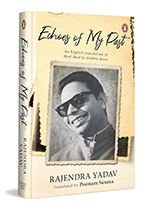
By Rajendra Yadav

While growing up, the entire locality basically acted as the perimeter of her house but now, as she rightly points out, the flat culture has made us all ‘illiberal, lonely and insecure’. Unlike Yadav’s memoir which seems like a vignette of fleeting moments trying to latch on to some significant event of his life and instead tends to seem like a quest to impose self-importance, Bhandari’s words are rooted and lay down her life bare for all of us to witness. She talks of how she got married to Yadav while studying in Calcutta but soon realized that she had to single-handedly take care of their household as he had already declared that he had dedicated his life to writing. While both of them went on to become celebrated writers, they struggled financially. She talks about writing but also yearning to write more.


Reviewed by: Chittajit Mitra
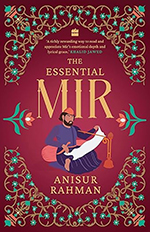
By Anisur Rahman

Though the possibilities of mazmoons are endless—as Wali, Mir’s predecessor, so evocatively said, raah-e mazmoon-e taaza band nahin/ ta qayaamat khulaa hai baab-e sukhan—certain kind of mazmoons were admissible to this discourse, others were not. He argued that classical Indo-Persian and Urdu poetry should be evaluated by its internal, formalist poetics rather than Western standards of raw emotional realism. The genre of ghazal should be appreciated for its impersonal, stylized artistry, its structural ingenuity and depth rather than its adherence to literal truth or some facile notions of realism. This is amply illustrated in the commentary section of The Essential Mir where one can see infinite variations on some common themes and the ingenuity with which those themes have been treated from different angles.


Reviewed by: M Asaduddin
Edited by Zothanchhingi Khiangte & Manab Medhi

The poems induce intellectual contemplation, and perhaps even an emotional engagement. Even after the poems have been read and the book laid down, certain lines linger, for in these uncertain times, like Anju, we too ‘are no longer surprised/ By the tyranny of tyrants, and the betrayal of liars’. Along with her, we mourn our own lack of surprise in a world where headlines scream of doom and disaster, and ‘what was once habit has become a disease./ Reading the newspaper is a disease’, as Dhirjyu Basumatary laments.


Reviewed by: Sanam Khanna
By Paul Zacharia. Translated from the original Malayalam by A.J. Thomas, Gita Krishnankutty, S. Gayatri Devi, S.P. Ramesh, Anupama Raju and the author

‘A Day’s Work’ is a son’s letter to a prospective nurse for his aged mother’s 24×7 care. It is a neurotic’s over-detailed checklist, which incidentally also reflects his meticulous concern as it does the extreme demands of a nurse’s vocation. The exactness and clarity of the minute-to-minute routine, put down without apparent emotion and as if mechanically, is like a clock face that hides the force wound up in the spring.


Reviewed by: Rajesh Sharma
By Imayam

For the teacher is one of those whose education and exposure to the wider world have kept his caste consciousness from diminishing his self-confidence. A place name for him is just an address. Not so for the girl, who is one of the few in her community to have made it to that middle school full of ‘other’ children from ‘other’ villages. Ironically, her name turns out to be Arivoli—the Light of Wisdom. Her parents have given her the name of the literacy movement—Arivoli Iyakkam—of the 90s, which drew people from every nook and corner of Tamil Nadu to raise the literacy level to 85.5 per cent. But Arivoli did not do away with the caste system. On the contrary,


Reviewed by: Vasantha Surya
By Gauri Shankar Raina. Translated from the original Kashmiri by Pankaj Bhan

We are introduced to many of the travellers on the journey from Jammu to Srinagar, initially bickering but later on settling into a familiar rhythm of many an Indian trip. We witness some charming encounters in the wistfulness of Swaroop Nath, a recently retired government employee, who eavesdrops on a burgeoning romance between a young footballer Ashfaq Dar and a girl visiting her maternal uncle and his wife on her own for the first time. Swaroop Nath, clearly a romantic, moves to a seat behind his allocated one to allow both to talk freely.


Reviewed by: Maithreyi Nandakumar
By Nanjil Nadan. Translated from the original Tamil by S. Thillainayagam

Tormented by his failure to get a job and left with no option but to pursue the hereditary occupation of farming, he mocks at the incongruity of his own situation in a series of questions such as ‘Did I learn Kepler’s laws, Sangam poetry, Shelley, Byron, Pilgrim’s Progress, Manonmaniam, King Lear and Macbeth…only to weed our field?’ This is followed by another series of questions, queries, commands and comments that he would hear all the while from fellow farmers. (Nanjil Nadan is well-known for the way he piles on details to achieve an incremental effect.)


Reviewed by: T Sriraman
By Jeyamohan. Translated from the original Tamil by V. Iswarya

The former has a story line that will sound familiar to readers of Malayalam fiction revolving round ancient joint families (tharavad) with rivalries, vengeance, curses and mental illness running in the family for generations. It is a dark world of collective guilt which has its roots in the feudal past of rampant criminality and treachery which refuses to be exorcised, despite retellings in every medium from folk-ballads to celluloid dramas.


Reviewed by: EV Ramakrishnan
By Ravi Shankar Etteth

An interesting one titled ‘Shhh’ is about his grandmother who handed him a spiky shell before she died. She, the wife of one of the native officers in the Malabar Special Police, along with her small daughter, had gone out of curiosity to see Gandhiji. There were milling crowds but all he did was to raise his finger to his lips, and everyone went silent. The soldier who was on guard came and stood in front of the lady at which the crowd felt disturbed. She bent down and picked up something. Gandhiji caught her eye and signalled that she should leave. The crowd parted and she went home.


Reviewed by: Ahana Lakshmi
By Sakyajit Bhattacharya. Translated from the original Bengali by Arunava Sinha

She is an investigative journalist who writes a column on closed cases. The case she has picked up this time is of the murder of Amitava Mitra, a popular poet of his times. The prime accused was the dead man’s friend Arun Chowdhury, but he was released for lack of evidence. The case has remained unsolved and lies buried in police archives for the last four decades.


Reviewed by: Aruna Chakravarti
By Feisal Alkazi

One of the techniques that Alkazi uses to honour his side of this bargain is to frequently recreate whatever has happened in a kind of mental action replay by his chief detectives so that the reader is also reminded of all the variables that are colliding in this labyrinthine plot. As Fernandes suggests, ‘Re-enter the scene imaginatively in a way, and it is amazing how much detail you will recall.’ What makes Alkazi’s mystery novel so fascinating is that each time this happens, a vivid picture does emerge but with a twist.


Reviewed by: Anjana Neira Dev
Translated by Akshaya Kumar & Navdeep Singh

‘Cry of the Sky’ by Bhura Singh Kaler is a poignant documentation of Dalit silence and marginalization. ‘My Story, Everybody’s Story’ by Prem Gorkhy is the most ideological in its fictional intent. Underlined by a palpably Marxist tone and texture, it goes on to etch the contours of socio-sexual inequities that, within the context of multiple hierarchies, create a spectrum of mutually hostile caste situations. ‘Gaurjan’ by Ajmer Singh Sidhu, the last story in this collection,


Reviewed by: Anup Singh Beniwal
By Mohammed Khadeer Babu. Translated from the original Telugu by D.V. Subhashri

The translator says: ‘Let me warn you, it’s not just mispronunciations, but a few misspellings too that have crept in on purpose, such as Idyaniketan for Vidyaniketan, Ishvodaya for Vishvodaya, Enkateswara for Venkateswara, haeroplanes for aeroplanes, rishckaw for rickshaw, otel for hotel, iskool for school, kilas for class, etc. In addition to aiding the tone and humour, my intention was to represent how words are sometimes regurgitated solely by their sound, and how pronunciation tends to morph as it travels across class, region, age or education…. This is just to remind the reader that these stories come from hinterland, where the colloquial idiom is typically a mixture of languages and cultures.’


Reviewed by: R Azhagarasan
Translated from the original Bengali by Anchita Ghatak

When her mother arrives to make her home with them, the clashes between these two strong personalities result in so much strife that the family members are forced to take sides.
‘The Temple’ brings together two disparate characters, Aparna and Shaktinath. Aparna is the daughter of a zamindar whose days are spent in prayers and rituals. On her husband’s death, she returns to her father’s village and resumes management of the temple. This brings her into contact with Shaktinath, the son of the old priest.


Reviewed by: Madhavi Sethupathi
By Jeyamohan. Translated from the original Tamil by Suchitra

It remained there for around sixty years, until the Vijayanagara kingdom restored the temple in the city of Madurai and reinstalled the idol. Around this regional lore, the novel weaves its web of nostalgia for a faith in which gods were intimately connected with the lands they were consecrated on, in which social bonds of kinship and forms of affect associated with them could apply to the gods. Such faith was characteristic of the many kinds of worship that are now collectively referred to as ‘Hindu’. Nostalgia for such faith was prominent, for example, in the vociferous opposition of this section to the Supreme Court judgment of 2018 that allowed the entry of women of menstruating ages into the forest-shrine of Sabarimala.


Reviewed by: J Devika
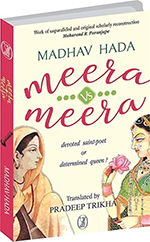
By Madhav Hada. Translated from the original Hindi by Pradeep Trikha

Unlike many saint poets, Meera’s own personality also shines forth in her poetry. Hada notes her use of symbols and imagery related to the feminine body. ‘Words like kaakan (bracelet), moondro (ring), ghagroo (skirt or lehenga), duladi (double threaded beads), dovodo (a special ornament), akhota (ear ornament), jhootano (pendant), besari (nose ring), choodo (ivory bangles), rakhari (head ornament), are frequently used in her poetry.’ Intense emotions caused by separation also fill her poems and she can say ‘Phaarungi chir karun gal kantha, rahungi bairagan hori ri’ (I’ll tear my clothes, will renounce all material pursuits, clad in a patched robe).


Reviewed by: Mohammad Asim Siddiqui
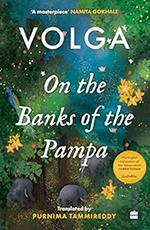
By Volga. Translated from the original Telugu by Purnima Tammireddy

It is not knowledge which centres around ‘man’ as being the sole harbinger of ‘civilization’ with relentless power to subjugate whosoever fails to obey him. This is the wisdom Shabari expects from Rama and this is the wisdom with which she feels that the world is yet to realize the kernel of truth in her words. Shabari tells Rama, ‘I was looking forward to seeing you. My hope is that you will guide mankind into times when there would be no kingdom, no cities, no civilization’ (p. 118). ‘Mata! You’re trying to spin the wheel of time backwards, and that’s impossible’ (p. 119), pleads Rama. Shabari attempts to convince him that in his desire and duty to fight and punish, he is abiding by the rajdharma of breeding enmity. Rama shares with her the inevitability of humankind’s march towards civilization.


Reviewed by: Disha Pokhriyal
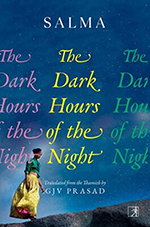
By Salma. Translated from the original Tamil by GJV Prasad

Her mother, Zohra, is gentle, obedient, and conservative. Her steadfast devotion to her husband’s authority renders her incapable of crossing the boundaries drawn by patriarchy. But all women in Rabia’s familial network do not belong to the same category; some openly rebel, while others find subtler ways of defiance. Through Rabia’s gaze and the polyphony of voices that surround her, Salma constructs a vivid theatre of women, living and dying; of women who, though confined to their cloistered lives, are dreamers and rebels, defiant survivors and victims, tragic sufferers and filled with laughter and gaiety, all at the same time.


Reviewed by: Nishat Zaidi
By M. Mukundan. Translated from the original Malayalam by Nandakumar K.

What was the way out? You loved life as much as the sea loves the shore. Your grouse was that life did not reciprocate even an iota of that love. The thought of suicide had never occurred to you. How could someone with a lust for life end his own life? Instead, you began to seriously consider the option of taking a vacation from life and going somewhere else.’ Witness the sensitivity with which the author captures the angst of an individual even while preserving the dignity and meaning of life! This showcases the essence of the writer’s contribution to modernist sensibilities in Malayalam literature. On the part of the translator, it requires sensitivity to the nuances of words, tones and voices in the text.


Reviewed by: V Bharathi Harishankar
By K Bharathi. Translated from the original Tamil by T. Sriraman

Married off before she has attained puberty, the fact (among other things) that she slowly grows taller than her husband, is pretty much a cause for complaint for her mother-in-law. Her fondness and talent for music is not allowed to flourish, and the veena she brought from her maternal home upon marriage is relegated to the forgotten confines of a store-room, never to see daylight or come alive under her deft fingers ever again.


Reviewed by: Malati Mathur
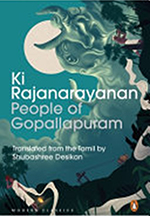
By Ki Rajanarayanan. Translated from the original Tamil by Shubashree Desikan

For me, one of the lesser problems in this translation is the tendency to annotate, to present words in the original language and give an endnote or explaining them in parenthesis inline. And I think it is perfectly alright if employed judiciously. But in the book, most often, such words from Tamil are not only explained within parenthesis in-line in the text, but also explained away in endnotes, and when it is done repeatedly on almost every page, unlike in the original, it impedes the narrative, acting as roadblocks as it were.


Reviewed by: Subash Jeyan
By Perumal Murugan. Translated from the original Tamil by V. Geetha

While translating them gives the reader unfamiliar with Tamil a sense of this, it also removes the linguistic tilt to the names. The first impression I had when reading this was a parallel to nicknames used by slave traders and white masters for their African American slaves. Using the original names would have retained the original flavour. There are many challenges a translator would face in translating Perumal Murugan, or indeed any author whose story lives in the soils of rural India and whose characters speak in unfamiliar dialects. This would involve a lot of interpreting, sometimes reading silences


Reviewed by: Shubashree Desikan
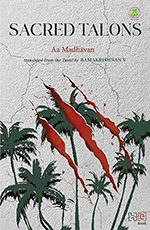
By Aa Madhavan. Translated from the original Tamil by Ramakrishnan V

The novel focuses on the relationship of a few families and their landlord, the protagonist of the novel, Guruswamy—an archetype of landlords across the country in the forties. With no particular skill or ability, he is granted respect and enjoys a standing in society conferred by birth as it were. Most of the action in the novel happens in and around a small coconut grove of some two acres owned by him.


Reviewed by: Ravi Menon
By Eka Kurniawan. Translated from the original Indonesian by Annie Tucker

While other boys his age get girlfriends and go to the theatre, Sato Reang is forced to spend every night in prayer recitation. There are tragedies involving fire. Fire begins to feel like a slowly developing leitmotif, a stand-in for anger, rage, rebellion and other teenhood feelings.
And then father dies. What initially feels like freedom from religious duties quickly starts to escalate into a taste for violence for the teenager. He quickly realizes that his father can no longer force him to play by the rules. Sato Reang is suddenly and absolutely and violently free to do anything he pleases.


Reviewed by: Deepa Bhasthi
By Tripurari Sharan. Translated from the original Hindi by Arunava Sinha

She narrates the story of George V’s visit to Ramanpur and the miles-long red carpet laid out to welcome royalty, as well as the vice-like regulations exercised over caste norms, female mobility and education within which constraints she is brought up. It is perhaps these strongly ingrained notions of caste purity that inform Dadi’s antipathy to her husband’s pet dogs. This can only be surmised, for Laura appears to have no answer to the same question raised repeatedly in her narrative.


Reviewed by: Rohini Mokashi-Punekar
By Syed Muhammad Ashraf. Translated from the original Hindi by A. Naseeb Khan

A book which Chotey Mian’s father considers to be ‘just an account of a journey and a few superstitions’, but which becomes an obsession for the young boy, one from which he has to be weaned away by incantation and prayer. Written across generations of the family, it contains accounts of journeys stretching way back into the past including a remarkable encounter between one of his ancestors and the spectre of Timur in Samarkand.


Reviewed by: Ranjana Kaul
Translated from the original Bangla by Anita Kar in collaboration with John Mackrell. Illustrations by Krishnendu Chaki

The first person, however, has no place in Sripantha’s storytelling about Kolkata. He narrates objectively and knowledgably. In contrast, the personal reminiscences of the authors’ relationship with the city are revived in books like Ashok Mitra’s Calcutta Diary (1977), Amartya Sen’s Calcutta after Independence (2019), Amit Chaudhuri’s Calcutta: Two Years in the City (2013) and Suresh Kohli and KA Abbas’s Evening in Calcutta (2015).


Reviewed by: Nivedita Sen
By Daisy Rockwell

The first part of her book swoops and soars through metaphors that can suggest, if not sum up, these relations. Among those metaphors are Lego, Fred and Ginger, a Bridge, a Genie in a Bottle, a Monster, a Phantom Limb, and a Three-legged Race. The middle of the book is a series of Kafkaesque nightmares as Rockwell narrates her own experiences of trying to secure the rights to translate the works of various ‘great’ living (but almost dead) writers.


Reviewed by: Arshia Sattar
By Maitry Roy Moulik. Translated from the original Bangla by Chandana Dutta

William Smith, the ‘living legend’, did have a few sympathetic friends like cartographer and publisher John Cary and Dr Fitton, aristocrat, Member of Parliament, the Royal Society and the Geological Society of London. Yet, Smith was entirely alone in upholding independent research in the fast-changing scenario of industrialization and mechanization of rural Britain.
A lifetime of personal suffering and professional humiliation was partially compensated with the award in 1832 of the first Wollaston Gold Medal, for Smith’s contribution to the emerging science of geology. The ceremony, held in Oxford’s historic Sheldonian Theatre Hall, begins with an eloquent address by a young man, recently enlisted as Professor in the geology department of the university.


Reviewed by: Jayati Gupta
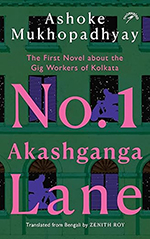
By Ashoke Mukhopadhyay. Translated from the original Bengali by Zenith Roy

We never have a chance to fully cognize its impact and fallout. Problems inexplicably get resolved ‘off-stage’; for instance, a character who is preparing to abduct her own son from the home of her hostile in-laws and philandering husband—arguably a very high-stakes situation—has her son suddenly and voluntarily handed over to her by said in-laws and husband.


Reviewed by: Aishwarya Jha
By Ajay Navaria. Translated from the original Hindi by Nita Kumar

The novel begins with his encounter with a sex worker, Ayesha, and ends with the birth of his girl child, Maya. The presence of the sex worker becomes the catalyst for the protagonist to deliberate upon his relationships with other women: his earlier affair with an older married woman, his failed relationship with his first wife who eventually commits suicide, and the strained relations with his present wife, which lying about his past precipitates. Interestingly, the protagonist resists the charms of Ayesha throughout the novel, only to exchange a kiss towards the end.


Reviewed by: Deeba Zafir
By Kusum Khemani. Translated from the original Hindi by Banibrata Mahanta

For many contemporary Hindi readers, me included, this ‘high’ style can feel alienating, and relief comes only in the dialogues, where the idiom is more fluid and accessible. Against this backdrop, the translator’s fear that his English version might sound ‘too academic’ (p. 241) feels ironic, since reading the Hindi original is no less a challenge for the reader. Khemani’s preference for this elevated register may not be accidental. Her ancestors migrated to Kolkata in the late eighteenth and nineteenth centuries, when the bhadralok elite valued Sanskritized Hindi and formal diction as marks of refinement.


Reviewed by: Umesh Kumar
By Kamal Desai. Translated from the original Marathi by Shanta Gokhale

Who burnt the studio and the film has been kept hazy, but the thrust of the novel suggests that she herself would have set it on fire. Writer-critic Prakash Deshpande-Kejkar writes, ‘The heroine of Hat Ghalnari Bai mortgages her body for giving shape to the movie of her dreams; this freedom of body is a noble culmination of women’s freedom.


Reviewed by: Nadeem Khan
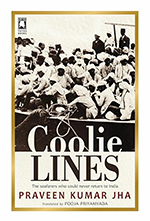
By Praveen Kumar Jha. Translated from the original Hindi by Pooja Priyamvada

The agreements themselves were drawn up in English and translated into Hindi or Urdu. Despite being detailed, the agreements meant very little to the workers, most of whom were illiterate and had no real way of knowing what they were agreeing to. Most agreements had four main clauses: both parties were to sign before a British Government officer; the period of indenture was five years, extendable by another five; on completion, the labourer was to be returned to Calcutta; and the ship carrying them was required to provide food, sanitation and a doctor. The machinery that fed this system was no less corrupt than the contracts it produced. Jha traces the role of the arkaati, the local recruiting agents who frequented the villages of Bihar and Awadh, luring poor and desperate men and women with tall promises of jobs and prosperity.


Reviewed by: S Deepika
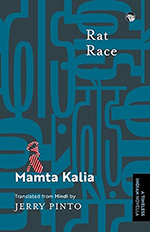
By Mamta Kalia. Translated from the original Hindi by Jerry Pinto

One of the strengths of the novella is the compassion with which Kalia portrays each character, without making anyone the villain. The parents’ sorrow is real and recognizable. They are not demanding people. They are simply unable to reconcile themselves to a world in which children no longer see their future in the same place as their parents.


Reviewed by: Malati Mukherjee
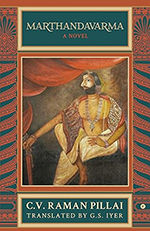
By C.V. Raman Pillai. Translated from the original Malayalam by G.S. Iyer

The moral compass of the novel, expressed in the word ‘qualities’, is the key to differentiating Parukutty’s prince-like lover, presumed dead, and Padmanabhan Thampi, who is wooing her. This takes us beyond the legalistic question of who the rightful successor to the throne should be. Had Thampi been that person, he would still be deemed unworthy in the moral scheme that the novel upholds. In this sense, Marthandavarma is a profoundly moral novel.


Reviewed by: Himansu S Mohapatra
By Basudev Sunani. Translated from the original Odia by Raj Kumar

Burnt is the story of Makaru’s journey, both in life and on the train, the latter holding a tight grip on the narrative as the protagonist—if a victim may be so called—recollects the anguish of both witnessing and suffering atrocities perpetrated on the untouchable class of Lathore. The narrative begins with a realist description of the train compartment in which Makaru (who appears to be the alter ego of the novelist) is travelling. He looks upon his fellow passengers, many of whom are from the more privileged class of society but with hardly any civic sense, smoking like a chimney, throwing peanut shells and even allowing little girls to urinate on the floor.


Reviewed by: Sumanyu Satpathy
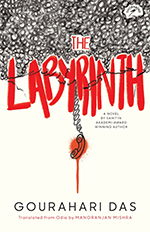
By Gourahari Das. Translated from the original Odia by Manoranjan Mishra

How the mind plays tricks in the most complex of situations is illustrated in this novel, which the translator has brought out effectively. Debadatta, who detested everything about the place he has been posted to, suddenly realizes he has formed an attachment to the same place he thought vile.


Reviewed by: Sabita Radhakrishna
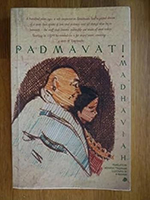
By Madhaviah Translated from the original Tamil by Meenakshi Tyagarajan Katha

The novel opens in a small village in Tirunelveli district in south Tamil Nadu. Our protagonist Narayanan is a shy and sensitive young boy and his honest testimony in the court of law leads to his father Sitapathi Iyer’s imprisonment. Despite his father’s misdeeds and notoriety pushing his family into penury, his virtuous mother’s upbringing and erudite teacher Rajagopala Iyer’s guidance infuse right values in him.


Reviewed by: Divya Shankar

Renowned Hindi author Mridula Garg emphasized that writing must create disturbance and discomfort. She challenged the assumption that women’s rebellion must necessarily be directed against the home, calling this a problematic reduction. On translation, she cautioned against imposing personal interpretations that distort the original text, while asserting that she writes not ‘as a woman writer’ but simply as ‘Mridula Garg’.


Editorial
Edited by Susmita Basu Majumdar

. Bordeaux urges caution in numismatic studies, emphasizing the need for chemical analysis in addition to the usual focus on visual representations, scripts and the external forms of coins so as to arrive at surer conclusions. Kazim Abdullaev’s discussion, highlighting the problems when the provenance of coins is unknown, is in a sense complementary; he also touches on the untidy, and occasionally murky world of markets for antiquities. François Thierry provides a glimpse of premodern ‘numismatists’—Chinese scholars who described,


Reviewed by: Kumkum Roy
By Vidula Jayaswal

The next two chapters are about the archaeological remains of the greater Varanasi zone covering Sarnath and Saidpur-Ghazipur area on the left bank of the Ganga and Vindhya-Kaimur Hill zone on the southern side. These contain information about a lesser-known Gupta temple at Bhitari in Ghazipur district and stone quarries at Chunar and other places on the southern side which supplied sculptural and architectural elements to Sarnath and other places. Then there is a short essay on the clay bull figurines from the early historic period at Hastinapur which, according to Jayaswal, formed part of fire rituals or yagnas.
The concluding essay,


Reviewed by: K Paddayya
By Himanshu Prabha Ray and Ajay Yadav

Amalananda Ghosh would be involved in the Bikaner survey, and he would present some of his findings to the Indian History Congress in Jaipur in 1951: ‘The discovery of these mounds brings the Harappa culture much closer to the heart of India and reveals how deeply it had taken its roots in the Indian soil.’ The authors however also point out that Ghosh was not, in referring to India,


Reviewed by: TCA Raghavan
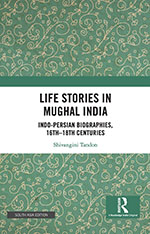
By Shivangini Tandon

In this context, she emphasizes the role of natal affiliations, marriage alliances, affect and emotions in the political process. Tazkiras, when compared with information in the Mughal official records, are extremely valuable for studies on elite Mughal women, who are presented as politically influential, with vast personal economic power, creativity, self-expression, and as patrons of political and cultural activities, particularly, architectural enterprise and building construction. The tazkiras,


Reviewed by: Meena Bhargava
By Sarmistha Dutta Gupta Jadavpur University Press, Kolkata

who visited the site in 2021 when thousands of villagers were in town in double-decker trolleys for a mela. One of the stops before the Swarn Mandir (Golden Temple) was the Bagh. But where was the Bagh I saw as a child? In its place was a shiny new memorial with museums cooled by Chinese air conditioners. The entry has been widened, and the walls of the entry passage are adorned with murals. An exit is provided, possibly to aid tourists.


Reviewed by: Sucheta Mahajan
By Rajwanti Mann Rajkamal

‘Punjab ka Khoon’ written by Kavi Das in 1922 expresses the pain of families whose relatives were killed in this massacre, and challenges the British saying, ‘dekhenge tere kaam, karishme apne bhi dikhla denge, tu aankh nikal dekh, ahinsha se swarajya ham pa lenge’.
The fourth chapter includes only one poem, ‘Gaurang Gunanuvad’ written by Sree Muktajeev. The poet describes the quality of the Whites in his poem of 52 lines.


Reviewed by: Jitendra Kumar
By Allen James Fromherz

The Gulf in the 18th century, under the Qasimis of Ras-al-Khayam, emphasized the need to revise Western political and military domination in West and South Asia. The British rule, referred to by a historian as a Pax Britannica, benefitted from its establishment in India and the Gulf. The chapter on Dubai addresses the end of British colonial rule, the shaping of the oil economy, and the emergence of modern states. It provides an analytical overview of modern-day Gulf societies, the creation of their welfare states based on redistributive economies, and their monarchical political systems.


Reviewed by: Azeemah Saleem
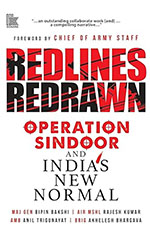
By Maj Gen Bipin Bakshi, Air Mshl Rajesh Kumar, Amb Anil Trigunayat, Brig Akhelesh Bhargava

Nuclear signalling has been evident in any period of tension between the two conflict parties. While the Indian nuclear doctrine rests on the pillars of credible minimum deterrence, no first use, and massive retaliation in case of a nuclear weapon attack, Pakistan’s nuclear posture rests on Full Spectrum Deterrence that allows the state to indulge in nuclear sabre-rattling.


Reviewed by: Reshmi Kazi
By Padmini Swaminathan

PLI schemes assume that lowering costs and raising returns will induce firms to invest and expand. Swaminathan cautions that if the institutional terrain remains weak, firms will expand output without changing employment practices or investing in skills. The result is more production, but not necessarily more secure jobs or stronger capabilities. Competitiveness achieved through informality and insecurity may deliver output, but not the social foundations of a mature manufacturing economy. Her essays, therefore


Reviewed by: TCA Ranganathan
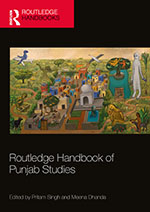
Edited by Pritam Singh and Meena Dhanda

The Central Government’s persistent meddling in State affairs under Indira Gandhi’s leadership, the dismissal of the Akali-Janata Party Government, the refusal to return Chandigarh to the State, and the repression of the peaceful Dharam Yudh Morcha, all contributed to the rise of Sikh militancy in the 80s. Chopra highlights the State’s violations of human rights as the security agencies employed coercive tactics to quell militancy. Many of the Sikh youth who sought refuge abroad during the period later developed sympathies for the separatist cause. Shruti Devgan examines the diaspora community’s attempt to digitally create, reconstruct, and revive the horrific memory of the anti-Sikh violence in order to subvert the Indian state’s attempt to erase the hurtful memories of the anti-Sikh pogrom in 1984


Reviewed by: Ashutosh Kumar
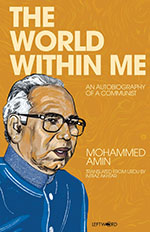
By Mohammed Amin. Translated from the original Urdu by Imtiaz Akhtar

Also incarcerated in Rajshahi Central Jail at the time was the legendary peasant leader Ila Mitra—an Olympic-level athlete who had suffered sexual violence and torture in police custody. In prison, Amin studied Marxism, political economy, history of religion and Bengali. He had the responsibility of reading and explaining English newspapers to those who could not read English. Amin used this to improve his command over both English and Bengali—something he put to use after his release by writing an Urdu-Bengali dictionary.


Reviewed by: Indraneel Dasgupta
By Seema Azad. Translated from the original Hindi by Shailza Sharma

Her arrest on 6 February 2010 along with her husband, her incarceration in Naini Central Jail, and the charges brought against her under the Unlawful Activities (Prevention) Act or UAPA, accusing her of waging war against the state and having Maoist links, do not read like an exceptional episode from the past, especially when one considers how long she remained in prison before being granted bail by the Allahabad High Court.
What is particularly compelling about the diary is that it does not try to turn prison into a site of constant spectacle or heightened drama


Reviewed by: Eshan Sharma
By Anand Teltumbde

Dalits must opt to remain within the Hindu fold as the downgraded ‘scheduled castes’, while those Dalits who exercise agency by stepping out of Hinduism to convert to Islam or Christianity are ‘punished’ by being denied the mechanics of reparation of historical wrongs afforded to the ‘Hindu’ Dalits. Quite inexplicably, and rather arbitrarily, Dalit converts to Sikhism or Buddhism do not have to pay any penalty for their conversion.


Reviewed by: Tapan Basu
By Maitrayee Chaudhuri

In the 1990s, there was explicit use of the term ‘feminism’ in the media. In this process, concepts like autonomy, freedom, and choice began to be associated with feminism, while women’s activism was seen as an imposition. An example is the way International Women’s Day is celebrated. Generally, this day is marked by women’s organizations that align themselves with progressive forces. But, in the 1990s, one can see that there was a hijacking of Women’s Day. Feminism was associated with discounts and free goodies, and consumption became central to its meaning. The media promoted a notion of feminism which is market-friendly.


Reviewed by: Rituparna Patgiri
By Varsha Uke Nagpal

I tell them that there are many who take up wide problems but no one takes up narrow and small issues, therefore I have to be narrow minded…’ (p. 132). Similarly, another diary entry of Narayan Uke dated 02.11.1946 mentions that Dr Ambedkar was busy most of the day with the British Prime Minister Winston Churchill in an important meeting and how the latter praised his book What Congress and Gandhi have done to the Untouchables.


Reviewed by: Arvind Kumar
By C. Yamini Krishna

Yet, the space was carefully designed to ensure that the ‘masses’ were separated from the ‘classes’ thereby building social inequity into the very architecture of the space. Neither the Europeans nor the Princely State, the author observes, were willing to imbibe the ‘idea of equality as a central tenet of being modern’ (p. 68). Later, in its bid to become a global city, Hyderabad witnesses the construction of a giant IMAX theatre with a six-storey-high screen, a four screen multiplex and other recreational facilities.


Reviewed by: Shohini Ghosh
By Jyoti Yadav

India of course is largely a population of ‘informal workers’, with no formal contracts, no unions representing them, living precariously on subsistence wages in small enterprises in the cities. With these enterprises shutting down, what were they to do? There were no buses or trains—the Shramik trains came much later—they decided to walk back to their villages.


Reviewed by: Mohan Rao
By Radhika Swarup Tranquebar

It is the mundane materiality of groceries, virtual schooling, work from home, and housework that remind us about the behind-the-scenes effort that people, especially women, make on a daily basis to carry on with the business of life, even in times of upheaval and uncertainty. The author goes beyond the residents who inhabit this relatively prosperous street to include in her creative ambit the grocery delivery boy Shyam, who decides to walk home to the safety of his village however illusory that safety might be


Reviewed by: Anjana Neira Dev
Edited by Mona Chettri and Prava Rai

The pervasiveness of patriarchal atrocities come across as unusually stifling as stories such as ‘Dastoor’ elucidate how they thrive under the garb of custom and tradition. Such a hostile environment is exacerbated by rampant alcoholism, abject poverty and lack of employment whose intersection is reflected in many of these writings. Consequently, one also comes across women fighting and trying to forge an identity of their own and ‘dukka’ or toil becoming a defining aspect of their life.


Reviewed by: Shibani Phukan
By Aruna Chakravarti

In doing so, it weaves the spatiotemporal coordinates of interbeing where body, soul and universe are mutually entwined. The wife’s (Ira’s) deep connect with the luminous world of nature is manifest in her tender attachment to her brio-filled mulberry tree that fructifies, provides pleasant shade, attracts chirping birds, and vibrates with lively monkeys. Ira’s empathy with the refulgent tree annoys Sudhiranjan, her pragmatic botanist husband, and makes him so jealous that he poisons it secretly.


Reviewed by: Davinder Mohini Ahuja
By Daljit Nagra

In ‘Lucozade’, a childhood incident reveals caste prejudice within the diaspora. His mother confronts a ‘cleaner-caste Sikh’ shopkeeper; the moment exposes how ‘tamarind agony’ hardened into ‘values rigid as pumped biceps’. Migration did not dissolve inherited hierarchies; it hitchhiked to the newfound geography.
Nagra repeatedly foregrounds writing as physical labour. He speaks of composing with a ‘Bic biro’, calling it the ‘comeback tool of the underclass’. This is a refreshing take on the everyday object.


Reviewed by: Yogesh Patel
by Atanu Roy

His humorous answers to questions put to him by the King illustrate his presence of mind and ability to extricate himself from tricky situations effortlessly. There are innumerable stories of Tenali Raman’s cleverness. This story is also one such. Once the King asks him to tell him the measurement of the length and breadth of the universe as also the number of stars in the sky.


Reviewed by: By Gita Dharmarajan. Illustrations
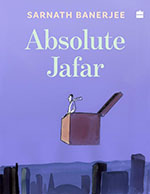
By Sarnath Banerjee

In this sense, Brighu resembles the figure of the flâneur described by Charles Baudelaire, an urban observer who maps the city through meanderings, curiosity, and detached reflection. Banerjee’s storytelling in Absolute Jafar can similarly be understood as a metaphorical act of walking, whereby urban spaces are represented not as mere locations but as lived environments that are experienced and remembered by their inhabitants. The illustrations and panels of Absolute Jafar seem attuned to the narrative’s preoccupation with memory.


Reviewed by: Ann Susan Aleyas
By Dr Ira Saxena

She comes to India not as a tourist but as one coming home to the Bhansi Estate, where her great-grandfather had built a magnificent colonial bungalow, the Nandan Van. Anjula finds the landscape unattractive in comparison to the English countryside (p. 5). But the first five months make her adjust to the family home of paddy fields, eucalyptus and sal trees, tomato plantations and fruit orchards,


Reviewed by: Dipavali Sen Debroy

The illustrations complement the story very well.
The Red Bus; Laal Bus by Harjeet Ahluwalia, illustrated by Saurabh Pandey, winner of a prize in the category Concept Books in the Competition for Writers of Children’s Books organized by the Children’s Book Trust, is a fun read aloud picture book for the very young. Join the little red bus on its journey from the bus station to its shed, carrying the rabbit, brown bear with baby bear, a dog with long ears, a cat with big whiskers,


Editorial

He clarified the distinction sharply: ‘We grew, but we didn’t have structural transformation.’ Turning to governance, Subramanian addressed debates on decentralization and federalism. While acknowledging the normative appeal of decentralization, he warned against treating it as a cure-all. He argued that performance often deteriorates as authority moves downward, citing weaknesses in State Finance Commissions


Editorial
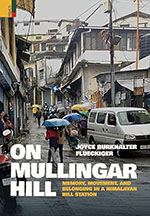
By Joyce Burkhalter Flueckiger

This the author seeks to achieve by expanding the archive to include real residents––the natives––in local histories and heritage descriptions. By referencing her work to Mullingar Hill, and not the Landour Cantonment, the author immediately succeeds in shifting focus away from the colonial. Mullingar, perhaps the second oldest bungalow in this hill station and the erstwhile home of Frederick Young,


Reviewed by: Lokesh Ohri
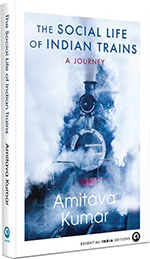
By Amitava Kumar

The anticipated positive externalities of the railway soon outweighed scepticism. Although the system was designed to serve colonial interests, facilitating troop movement and promoting commercial crops, often at the expense of local needs, it nonetheless contributed to a profound shift in social perception, introducing a velocity of movement far beyond the pace of bullock carts and reconfiguring notions of space and time.


Reviewed by: Murari Prasad
By Anuradha Roy

2025

Her general serenity makes the explosions all the more fierce: ‘In a country run by politicians who are almost all thugs of different shades, the poor know that governments are of the rich, for the rich, by the rich.’ In the chapter on ecological devastation poignantly titled ‘The Wounded Mountain’, she asks, ‘Isn’t it convenient for governments like ours to have climate change to blame?’


Reviewed by: Rajesh Sharma CALLED BY THE HILLS: A HOME IN THE HIMALAYA
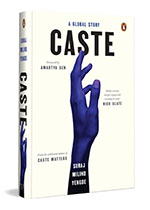
By Suraj Milind Yengde

It situates Dalit activism within broader discourses of universal human rights, anti-caste ethics, and transnational solidarities, thereby demonstrating how Dalit claims-making resonates with, and contributes to, wider cosmopolitan frameworks of justice. The chapter underscores the ways in which Dalit aspirations for dignity, equality, and emancipation are no longer confined to the territorial boundaries of the nation-state but are increasingly embedded within global normative and institutional arenas.


Reviewed by: Krishna Swamy Dara
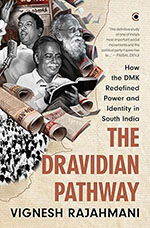
By Vignesh Rajahmani

The manifesto-like list prepared by the DMK included land reforms with ceiling on land holdings, limiting the Union Government’s power to tax the States, nationalization of industries, health care benefits for the working class, a casteless and classless society, promotion of the Tamil language and renaming the State as Tamil Nadu. Though the Kamaraj Congress won a decisive victory in the 1957 elections, the DMK’s fight for linguistic reorganization of States and its alliance with the CPI worked to its advantage. The DMK won 50 out of 142 seats it contested to the Legislative Assembly.


Reviewed by: KA Manikumar
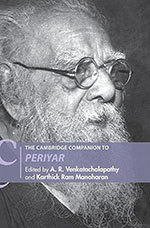
Edited by A.R. Venkatachalapathy and Karthick Ram Manoharan

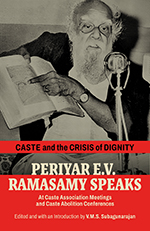
Alagirisamy shows how Tamil reform organizations drew on existing traditions of Tamil devotionalism to articulate a caste-transcendent, progressive Tamil identity, distinct from the politicization of caste in Tamil Nadu. Despite upper-caste resistance to Periyar’s visit, he found support among working-class and lower-caste migrants. However, the claim that Tamil identity politics produced a distinct Malayan national consciousness among Tamils remains underdeveloped. The political emergence of pan-Malayan identity appears abrupt and largely driven by Periyar’s exhortations to adopt Malayan citizenship.


Reviewed by: Kiran Keshavamurthy
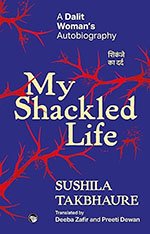
By Sushila Takbhaure. Translated by Deeba Zafir and Preeti Dewan

The idea underestimates the inflexibility of its stranglehold on everyone who is subject to it, including the ‘upper’ castes. I wish to affirm that there are at least three major differences between caste discrimination and racial discrimination (in the American context) which need to be kept in mind while making this comparison. Firstly, the logic of racial discrimination is the colour bar, i.e.,


Reviewed by: Tapan Basu
By Tapan Basu

Having renounced his Brahminical heritage, he founded the Navratan Committee, an anti-caste rainbow coalition, aimed at challenging entrenched caste hierarchies. While he wrote two books on Buddhism, his book Mool Bharatvasi aur Arya (1930) is his most significant work, where he reiterated the argument about the indigenous inhabitants having been dispossessed by the Aryan invaders—a thesis already advanced by Phule and Acchutanand.


Reviewed by: Preeti Gupta Dewan

Historical Antecedents and Contemporary Trends’ describe the history of election studies and voting behaviour analysis in India post 1990. They claim that the ‘coming together of a plethora of Hindu castes and communities under the political banner of BJP forces us to rethink existing theories of caste-class cleavages’ used to explain Indian electoral politics (p. 235).


Reviewed by: Pratip Chattopadhyay
Edited by Yatindra Singh Sisodia, Ashutosh Kumar & Pratip Chattopadhyay

Second, it offers a nuanced account of federalism by examining the dynamic interplay between central authority and regional autonomy. While acknowledging the rise of centralizing tendencies in recent years, the contributors demonstrate that States continue to remain critical arenas shaping political discourse and governance practices. The volume also shows how regional parties have challenged the dominance of national formations, reshaping the competitive landscape of State politics.


Reviewed by: Shashikant Pandey
By Gitanjali Surendran

Surendran underscores the importance of Dharmapala to this project of universalizing Buddhism by decoupling him from the nation-state frame. Dharmapala is even today popularly remembered as a Sinhala nationalist. However, Surendran argues that we ought to understand his role in making Buddhism the first non-semitic religion to be named and placed in the category of a ‘world religion’.


Reviewed by: Suraj Thube
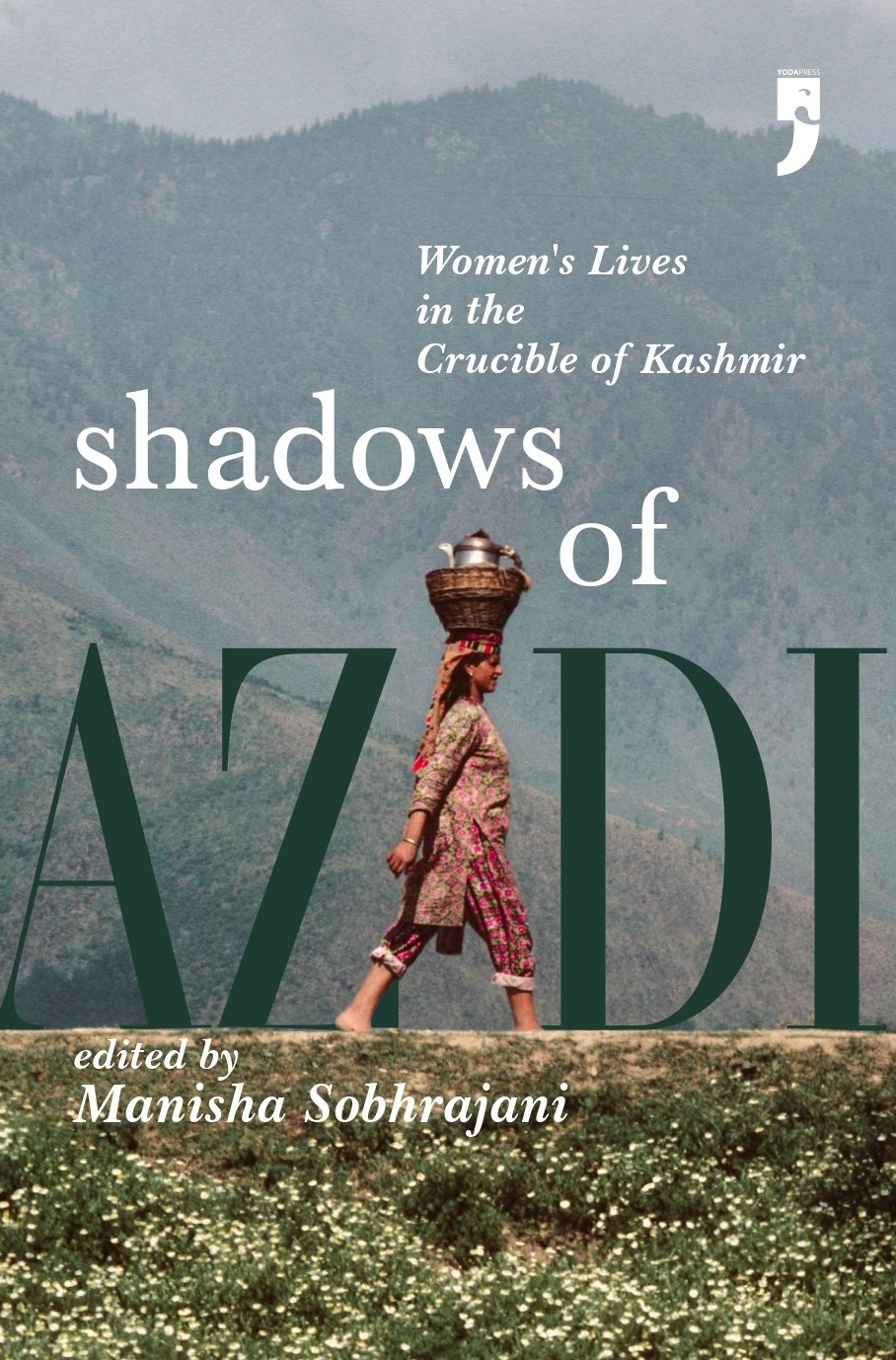
Edited by Manisha Sobhrajani

My memory of the word goes back to the year 2008, when I was seven years old. The Valley erupted in a major agitation against the land transfer of 40 hectares of forest land to Shri Amarnathji Shrine Board (SASB). The Valley reverberated with loud chants of the word. The lyrical, catchy slogans were registered in my young and impressionable mind. Back then mostly for the rhythm.


Reviewed by: Shimaila Mushtaq
By Sravana Borkataky-Varma and Anya Foxen

‘The Serpent in the Melting Pot: Kuṇḍalinī in North American Counterculture’ examining the concept of ‘experience’ is perhaps the most theoretically sophisticated and engaging. Drawing on thinkers such as William James, Michel Foucault, and Talal Asad, the section contends that religious experiences are not raw, unmediated phenomena. Instead, they are always articulated within particular discursive frameworks. Kuṇḍalinī, therefore, becomes a case study in the historicity of interiority itself.


Reviewed by: Amol Saghar
By Youri Martini

who enjoyed the support of influential figures within the imperial harem. Despite the shift, the Jesuits continued to carry out their duties and were able to translate further portions of the Gospel into Persian. By 1582, however, the debates at the Ibadat Khana had been suspended. In the same year, hostilities between the Mughal and Portuguese further complicated the situation, leading the Jesuits Provincial in Goa to consider recalling the missionaries


Reviewed by: Anas Zaman
By John Richards, Manzoor Ahmed, and Shahidul Islam

In turn, the political economy of education comes to mean the field concerned with political decisions about educational governance and their consequences for human development. While this may be a dominant approach in the academic settings where the authors are based, it is clearly a limited one. Here the political, the economic, and the educational appear as relatively discrete domains that interact externally. Education possesses its own technical foundations, politics has its own logic of power and administration, and economics names the domain of welfare, allocation, and productivity.


Reviewed by: Manu V Mathew
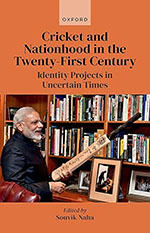
Edited by Souvik Naha

The politicization of cricket had far-reaching implications for the representation of the Blacks—the Africans, Indians and coloured contingent of the populous on the cricket pitch. As a measure of undertaking affirmative action, the quota system came into existence for selection of players in the national cricket team. It projected a link between national identity and equality of opportunity in South African cricket. Moreover, the sporting success of players such as Hashim Amla, Makhaya Ntini, Vernon Philander, JP Duminy and Kagiso Rabada in international cricket made a strong case to revisit the existing stereotypes pertaining to the incompetency of the non-white cricketers.


Reviewed by: Avipsu Halder

Could this beautiful child truly possess such a horrid affliction?
As if in response, Swami Haridas marched over to yank the tape from her mouth; he sprang back nervously. For several moments, nothing happened. Anamika stared into the faces of the gaping men; their eyes, glinting, devoid of mercy, awakened only memories of imprisonment: of suffering, of crushing loneliness.


Reviewed by: Kartikeya Shekhar

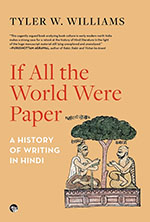
‘And just as the pemkatha combined elements from Arabic, Persian, Sanskrit, and other Indic literary traditions but was more than the sum of its parts, so too the manuscript codices fashioned to contain the pemkatha drew from multiple book-making and aesthetic traditions, combining them to produce a material text artefact with its own distinct character’ (p. 28).


Editorial
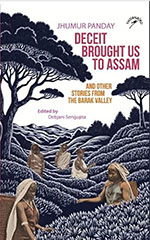
By Jhumur Panday. Edited by Debjani Sengupta

The fact that many stories situate such violence during the time of pujo, a time of celebration, only underlines the extent of deprivation the labourers are subjected to. Of course, many of the stories—such as ‘Saluk Flowers Have Bloomed’—also suggest the gendered nature of the violence and sexual exploitation women labourers were subjected to by the British who employed them in these tea estates.


Reviewed by: Shibani Phukan
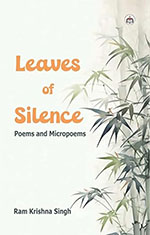
By Ram Krishna Singh

The poem ‘Body’s No Picnic’ exemplifies the poet’s respect for women and his ability to portray sensuality with sensitivity and depth. The interplay between desire and loneliness creates a complex emotional landscape, where the search for connection is both necessary and fraught with disappointment.


Reviewed by: Tabinda Shamim
By Cheryl Rao. Illustrations by Viky Arya. Translated into Hindi by Kusumlata Singh

I guess, the picture book is published in a single language. The Hindi and English can be appreciated simultaneously. Some phrases/words sound better in one language than the other. That difference may make the reader understand the beauty of both languages.


Reviewed by: Indira Ananthakrishnan
By Monika Bhatkhande

The same is true for the poems, books, and articles that are mentioned, as quite a few are footnoted and can be looked up. In fact, the narrative seems to encourage readers to verify historical references, as the characters do so often, even using search engine techniques. This dynamic line between fact and fiction is necessary to the story as one of its central questions is whether the Star of India is really as powerful as the stories declare.


Reviewed by: Anagha Gopal

While there is much enthusiasm in big cities and among the young about joining Europe and seeking new opportunities in the West, there is a strong cultural and even political attraction elsewhere about the Russian connection. Many do not like the prospect of free migration into the country that may result from joining Europe.


Reviewed by: By Partha Chatterjee
By Vince Cable

Furthermore, a very high domestic savings rate powered the investment driving China’s development, and it also enjoyed very high productivity levels. Chapter two argues that China and India have versions of ‘state capitalism’ with a complicated mix of private and public sectors. Tracing the history of liberalization in both, Cable considers ‘creative destruction’ and the varying ability to tolerate its social costs. While China’s early reform period was often ruthless, Xi Jinping is now far more cautious. And although India has not matched China’s earlier zeal, liberalizing trends continue.


Reviewed by: Anton Harder
By Utsa Patnaik

However, while these are valid points, the new ‘norm’ of calorie intake cannot be arbitrarily arrived at without a systematic assessment of the population structure, work patterns and bio-medical status of the population. An exercise like that, involving professional nutritionists, statisticians and economists will be more than welcome periodically to see how the norms of poverty are changing.


Reviewed by: Arindam Banerjee
Edited by Amita Batra and A.K. Bhattacharya

The chapter highlights increased financial inclusion via UPI, economic formalization, and improved productivity through digital business models as key developmental drivers, but warns against complacency. The concentration of data power, a global public good in a few hands remains a regulatory challenge.


Reviewed by: Ram Singh
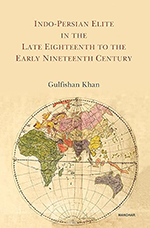
By Gulfishan Khan

For Gulfishan Khan, one such bureaucrat, intellectual and historian was the author of Siyar-ul-Muta’khkhirin (An Overview of the Modern Times), Ghulam Husain Khan Tabatabai (born 1727). With deep connections in the old Mughal world of Delhi, Agra, Patna, and Murshidabad, Ghulam Husain wrote the book in 1783 for his British patrons in Calcutta. A fine English translation of the work was almost simultaneously prepared by a scholar, later identified as Haji Mustafa. Considered to be one of the best historical works produced in the late eighteenth century, it offers ‘a description of glorious past, as well as a sad narrative of the Mughal decline, and above all an indigenous critique of the impact of the early colonial rule’ (p. 46).


Reviewed by: Raziuddin Aquil
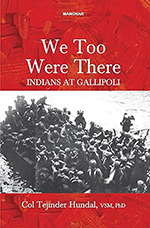
By Col Tejinder Hundal

At over 600 pages, his book is comprehensive and deeply researched. It is built from extensive research into primary sources, including war diaries, personal letters and regimental records. These sources document the deployment of Indian infantrymen, artillery units, mule transport and logistic corps, and the hardships they endured on the Dardanelles Peninsula from April to December 1915


Reviewed by: Anil Khosla
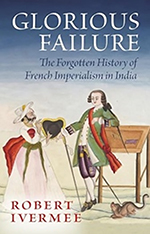
By Robert Ivermee

The author subjects this interpretive tradition to sustained critical scrutiny and ultimately dislodges it with compelling force. Drawing upon expansive and carefully curated archival corpus, he demonstrates that French imperial expansion was neither anomalous nor benign, but instead grounded in modalities of power and domination structurally analogous to those deployed by other European empires.


Reviewed by: Amol Saghar
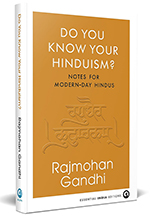
By Rajmohan Gandhi

Today, nine years later, seeing the terrifying effects of Zionist zealotry unfold all across West Asia in real time, Jews with a conscience, whether in the US, Israel or Europe are asking themselves what constitutes morally defensible Jewish politics. What should their stance be, so as to not relentlessly weaponize either the long historical memory of anti-semitism or the relatively recent experience of the Holocaust? How should they stop their co-religionists from seeking to oppress and dominate supposed enemies, especially Muslims, whether in Palestine, Lebanon,


Reviewed by: Ananya Vajpeyi
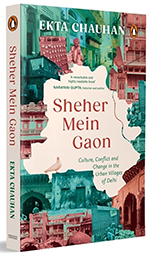
By Ekta Chauhan

The areas explored in Sheher Mein Gaon sit atop deep and complicated sediments: the residues of older Delhis, the scars of 1857 and Partition, the afterlives of endowment, and the shifting meanings of heritage. Hauz Khas, in particular, poses a question the book might have confronted: why do the architectural remains of great learning complexes in much of the Muslim world continue to function as transregional centres of scholarship, while in India similar sites survive largely as aesthetic fragments, embedded in precarity and neglect? Delhi is full of structures that once organized knowledge, devotion, and public life.


Reviewed by: Nikhil Kumar
By Rasheed Kidwai, Ambar Kumar Ghosh

Instead of seeking proportional representation based on identity, the Constitution seems to expect that elected MPs must act as ethical advocates for all citizens. This shifts the focus from who the representatives are to how they act, turning the protection of marginalized minorities into a collective moral obligation rather than mere numbers game. Representation, in this sense, is envisaged as an entirely secular act. The Constitution, nevertheless, is conscious of group rights.


Reviewed by: Hilal Ahmed
By Anita Khemka

Farida Parvin, an elderly lady, seems at ease looking into the camera perched delicately on the shore rocks, as the mighty ocean spreads behind her and a thin layer of black cloud cuts the frame horizontally. Our attention is drawn to the flower tucked in Farida’s henna-coloured hair that matches the colour of her saree. In the interview with Gadihoke, Khemka tells us that the flower was the subject’s last-minute choice. The last picture is of Shahnoor Khanum who, stands confidently with both her arms on her hips atop a small fishing boat parked on the dry shore right at the edge of the sea.


Reviewed by: Sohail Akbar
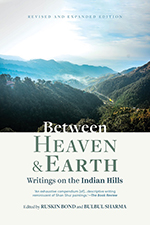
Edited by Ruskin Bond and Bulbul Sharma

The colonizers left a large volume of literature about the hills, with innumerable accounts of exploration and adventure, escapades and gossip. As Indian writing became more prolific in the later years, perceptive accounts of sojourns in the hills were penned by well-known storytellers and essayists.


Reviewed by: Govindan Nair
By Amitav Ghosh

The irony proves pointed: species deemed threats to native ecosystems are the very fish Isha once knew, now providing sustenance and cultural memory in diaspora. The novel withholds its most startling revelations until late, interrogating the very nature of identity, memory, and kinship across temporal and ontological boundaries.


Reviewed by: Mir Wafa Rasheeq
By Amalanjyoti Goswami

The next line reads: ‘This would never happen for English poetry.’ Indian poetry still retains its oral roots in its strong bonds with rhythms and music. The audience waiting for a Qawwali knows that it will transport them into the world of youth and romance.


Reviewed by: EV Ramakrishnan
By Radha Chakravarty

The trope of memory has been used effectively by the poet through the lens of both the young girl and the mature woman. In ‘Wild’ she reminisces with tender emotion about the relationship with her mother. When she was a young girl, mother ‘struggled’ to ‘tame’ her curls, even as the ‘rebellious tresses refused to obey’.


Reviewed by: Payal Nagpal
By Shehnab Sahin

‘In 2018, at a meeting in Meerut in the northern State of Uttar Pradesh, the chief of Rashtriya Swayamsevak Sangh (RSS), Mohan Bhagwat addressed one of the largest conclaves of RSS workers on a crisp February morning. In his long address to more than a thousand people, he said, “In India, one may follow a different eating habit, way of worshipping gods, philosophy, language and culture.


Reviewed by: Juanita Kakoty

It began with a well-executed burglary.’ The lively poet at the festival is ‘lost and disconsolate’ when he sees the literary world ‘full of privileged hierarchies and lucky chances, of winning streaks and downward spirals of defeat and heart break.’


Reviewed by: Ranu Uniyal
By Sanjoy K. Roy

He has travelled widely, cavorted with celebrities, vacationed frequently and consumed copious quantities of vodka. The text makes little attempt to temper this presentation, leaning into the spectacle of a life lived large. But it unfortunately becomes the most glaring issue in the book—the repetitive references to luxurious hotels and expensive food and brands. It is tiring and begins to feel shallow rather quickly. In ‘An Accident Foretold: Goa’, their hotel’s name—Taj Holiday Village—is cited so frequently that it begins to feel less like a setting and more like a refrain.


Reviewed by: Alizia Kumail
By Gautam Bhatia

The original Panchatantra story has the typical lion waiting to devour a jackal. It’s a play of wit between the King of the Forest and the most wily creature in the jungle. In Bhatia’s modern version, the lion does not enter the fragile cave of the jackal because he may simply bring down the structure, so he devices a ‘plan’. Since he is the chief of the ‘Jungle Planning Commission recently renamed Neeti Vanyog’, the members of the King’s Cabinet round up a random bunch of painters, art collectors, print makers, and start an Art Camp.


Reviewed by: Malashri Lal
By Shefalee Vasudev

Vasudev dissects how Indian leaders craft public image through clothing. From Prime Minister Modi’s signature kurtas to Kangana Ranaut’s elegant sarees, politicians dress for the public in ways the public rarely does. Is their apparent indifference to fashion trends genuine, or calculated to suggest that priorities lie beyond style, with the ‘real issues’ of the public? Indian netas favour ‘traditional’ handloom, cotton, and khadi to project authenticity. But is it a genuine connection, or hypocrisy for voters who can no longer afford these fabrics?


Reviewed by: Muthara Khan
By Nicholas J. Abbott

Subsequently, Bahu Begam consented to abandon the remains of her wealth to the Company, and emerged as one of the largest individual investors in British India’s public debt. This action demonstrated not only the willingness of the Company to reinstate the Nawab but also its anxiety to be recognized as a sovereign state in the South Asian political order, and its dependence on the financial and political capital of women like Bahu Begam.


Reviewed by: Meena Bhargava
By Faith K. Beasley

In retrospect, la Sabliere appears as a twentieth century socialite, who is a patron of writers and intellectuals, academics and statesmen. But the salon presided over by aristocratic women became the shining example of French intellectual life in the seventeenth century. Neither historians in general, nor historians of social trends and ideas, seem to focus on this aspect.


Reviewed by: Parsa Venkateshwar Rao Jr
By Phil Craig

The fact that Bose, in his death and after the defeat of the honourable INA, united Indians across the political spectrum is noted in glowing terms by Craig. The second section has interesting narrations about individuals and various Allied armies who rallied ‘round the flag’, meaning the Union Jack. The story of the immense sacrifices made by men, officers and civilians in the theatres of war and war crimes, including the horrors of Belsen in the West and Borneo in the East, is told in a prose which makes the book unputdownable.


Reviewed by: Anirudh Deshpande
By David Boyk

It was here that wealthy traders and aristocrats lived. Later, they served as indispensable intermediaries between the colonial state and the broader population in Patna. However, the colonial state eventually developed the Danapur and Bankipur regions, away from the old town, also known as Patna city. Present-day Patna developed around Bankipur.


Reviewed by: Mithilesh Kumar Jha
By Raman Mahadevan. Introduction by Gurcharan Das

And the collapse came in the 20th century. The depression of the 1930s was the first serious blow. While the larger business houses were able to stay afloat, the medium and small firms suffered a near collapse. Next came World War II and the Japanese invasion.


Reviewed by: Kanakalatha Mukund
By Girija Joshi

The text contains an extensive account of the manner in which the Kalsia zail (retinue) was organized as a raiding and soldiering band with sections on its allies (hamrahan, tab’in) and relatives. Disputes over succession arising out of a range of superior and inferior conjugal unions (karewa, chadar dalna, shadi, byah) form an important part of this study. Women in the roles of wives,


Reviewed by: Vikas Rathee
By Karma Lekshe Tsomo

Chapters focus on early Indian traditions, followed by a region-specific treatment of South and Southeast Asia, East Asia, inner Asia, the West, and Women’s ordination across cultures, ending with a chapter self-explanatorily titled ‘Grassroots Revolution: Buddhist Women and Social Activism’, which is an account of women in what is called ‘engaged Buddhism’. Blurbs by eminent Buddhist scholars such as Jay Garfield, Jose Cabezon, and Paula Orai situate it within academic discourse as a valuable resource.


Reviewed by: Maya Joshi
By Louise Tillin

A new social and political class dissociated from the Congress and with considerable political clout was emerging in rural areas. As a result, policies like the Employment Guarantee Scheme (EGS) and the Integrated Rural Development Program (IRDP) emerged during this time.


Reviewed by: Waqas Farooq Kuttay
By Abhishek Choudhary

In his own way, though, he was defying stereotypes associated with pracharaks. He had little by way of a formal education’ (p. 324). It was Advani who persuaded Vajpayee to send this pracharak from a little room of the Party office in New Delhi as Chief Minister of Gujarat. Second, the author’s narrative of Vajpayee’s indifference towards the Ayodhya issue, even with the ongoing Allahabad Kumbh Mela.


Reviewed by: Ajay K Mehra
By Sudhir T. Devare

In these four decades plus, the country has experimented with democracy which was short-lived. It ‘remains a grey zone of uncertainty’. The ‘people deserve a better future’. Will that ever come to pass, wonders the author. Korea appears to be the author’s soft spot. Again, with good reason. Unlike Myanmar, South Korea has moved, in around the same time period, from being a despised dictatorship to a robust democracy. In 1983, in an infamous attempted assassination of the then President, the Korean Foreign Minister who had earlier been Ambassador in India was killed. Korea’s economic growth is exemplary.


Reviewed by: TCA Rangachari
By Sohail Hashmi. Illustrated by Pervez Rajan

The Great Stupa at Sanchi is presented not via dates or dynastic connections, but through physical experience encompassing its dimensions, curvature, and routes. Concepts such as the stupa as a commemorative structure, the practice of circumambulation (parikrama), and the symbolic arrangement of space along cardinal directions are described contextually. The absence of anthropomorphic representations of the Buddha in early reliefs becomes understandable through narrative exchange rather than doctrinal explanation.


Reviewed by: Nida Farooqui
By Joerg Esleben with Rolf Rohmer and David G. John

Bennewitz records in great detail the day-to-day progress of his work in the many regions and languages of India that he engaged with. After his death in 1995, Mertes handed his entire archive—the letters, of course, but also a large number of documents and other materials—to an association of his friends, who then set up the Fritz Bennewitz Archive in Leipzig.


Reviewed by: Sudhanva Deshpande
By David Matthews

Notwithstanding the struggles waged by the British working class against Capitalism, this work could have deployed a more analytical approach to the history of colonialism and its relationship with the development and the evolution of not only the labour, but also the material origins of that robust post-War welfare state which perhaps would have been a nonstarter, had it not been for the colonial legacy.


Reviewed by: Moggallan Bharti
By Manish Gaekwad

It is guided by precisely this impulse that Gaekwad repeatedly reframes his key life moments through the visual grammar and narrative idiom of Bollywood cinema as a ‘primal source of imagination’ (p. 46). Presenting his life and experiences through this cinematic lens, he draws upon songs, dances, and the attendant celebrity culture of Hindi mainstream cinema to foreground and navigate his complex familial reality. The impact of cinema is evident in his personal details:


Reviewed by: Nishat Haider
By C. J. Fuller

This is portrayed in chapters that focus on his time as a district officer in Chhotanagpur that cover the management of a land dispute involving Santhals, a dispute over the Ghatwali tenure system and the 1881 census. What is especially intriguing is how the resolution of disputes involved negotiations with different groups such as the Santhals and Bhumij and other ICS officers who often differed on courses of action. The exploration of the disputes also reveals the complex relationship between ICS officers and European-owned businesses, which were seen by the officers like Risley to cause problems and yet had to be supported in the interests of the empire.


Reviewed by: Ankur Datta
By Asha Gopinathan

Though Mani rarely expressed bitterness about her own Ph.D. refusal, she later told sociologist Abha Sur in an interview that her late friend deserved one at least posthumously. In The Uncut Diamond, published nearly 25 years after Mani’s death in 2001, Gopinathan makes a strong case for both women receiving posthumous doctorates. It will be interesting to see if the Indian Institute of Science ever considers this.


Reviewed by: Nandita Jayaraj
By Anamika. Translated from the original Hindi by Nishtha Gautam

Sita’s Veil consistently upholds the author’s vision in its portrayal of Sita’s resoluteness in persevering with her ideals, her insistence on the importance of education and her championing of other women characters, at times even suggesting the radical possibility of viewing instances such as her abduction as one of abuse and therefore, viewing Sita as a survivor. However, one does note an element of essentialism too in the author’s suggestion of women being intrinsically connected to nature or the spiritual, and more disturbingly, in the detailing of women’s expertise in the kitchen or their natural aptitude at mothering.


Reviewed by: Shibani Phukan
Edited by Perundevi. Translated from the original Tamil by Janani Kannan

‘The Blouse’ interrogates civility and its absurdities. An innocent old woman, compelled to conform to the propriety of wearing a blouse to cover her breasts, develops a cyst—a mysterious tool that may enable her to assert agency over her own choices. Perhaps the most thought-provoking story in this oeuvre is Sundara Ramawamy’s ‘The Breaking of a Story’. As the media rushes to cover an unfolding event,


Reviewed by: Shilpa Nataraj
By Usha Raman

Kaveri, positioned in a transitional phase, experiences turmoil as she attempts to balance inherited traditions with her personal sense of self. Aparna, the youngest, represents a more liberated orientation toward life and appears freer in her choices; yet she too struggles with emotional expression and communication within relationships.


Reviewed by: Sara Faraz
Edited by Jintu Gitartha

The anthology opens with explorations of identity that challenge foundational social constructs. Moushumi Kandali’s ‘A Tale of Thirdness’ (translated by Atreyee Gohain) is a study of gender transcendence. Its protagonist, a professor and dancer, embodies a femininity and yearning for motherhood that exist independently of biological sex. Kandali, through lyrical and metaphorical prose—comparing the scent of a kitchen to longing,


Reviewed by: Mridul Moran
By Dinesh Singh

101 is auspicious perhaps to ward off the readers’ profane thoughts and to invoke the humane sublimity in them. If brevity is the soul of wit, then these are not just brief tell tales but are close to Sufistic and Biblical aphorisms. Some of the tales have a philosophical and ethical slant while some are able to depict and reflect upon the socio-economic processes as well. For instance, the story titled ‘Sage’


Reviewed by: Dhrub Kumar Singh
Guest Editor: Sukrita Paul Kumar

That earlier urgency diminished, and with it, a certain fire; the impulse to know more, understand more, and remain connected to one’s immediate oral environment. In linguistics classes, the first thing we are taught is how words are produced in the mouth as we speak them.


Reviewed by: Semeen Ali
By Paritosh Sen Classix,

The play of colour, shapes, forms, and contrasts of light and dark is Sen’s métier, making cognition of the precepts in this volume predominantly visual. Even though this volume is black-and-white, he captures the Arjuna tree’s transformation across the day in captivating prose. When it catches the first rays of the sun, it looks like Gautama Buddha in deep meditation. At high noon, in the harsh mercury-white light and lamp-black shadows,


Reviewed by: Chitra Gopalakrishnan
By Kiriti Sengupta

This restrained fury runs through the collection’s most recent poems. They come from a tradition of Bengali literary conscience that has always understood literature as a moral act. Sengupta continues that tradition without announcing it. His poem ‘Tradition’ turns a familiar concept into something quietly subversive:


Reviewed by: Arpan Mitra
By Paro Anand. Illustrated by Priya Kuriyan

they were branded as criminals by the British under the 1871 Criminal Tribes Act, which made their traditional way of life illegal. Junglee, a Pardhi girl herself, protects a vulnerable tiger cub, even though her community is blamed for hunting such animals.


Reviewed by: Shagun Tomar
By Hansda Sowvendra Shekhar. Illustrated by Proiti Roy. Book Design by Saurabh Garge.

The ‘secret question’ works like a small lesson in resistance. When the ghost copies the mother’s voice, the girl uses what she knows about her widowed mother. She remembers that her mother does not apply alta. She even breaks the rule about not touching the chuhla to burn the ghost’s wolf-foot,


Reviewed by: Eishita Tiwari
By Jaya Tyagi

Should he have mentioned his name Ashoka more often? Again, if this was a name specifically connected with his Buddhist affiliation, he may have preferred not to use it in inscriptions meant for a wider, diverse readership/audience, choosing other epithets instead. And, given that we now have the label inscription from Kanaganahalli, mentioning Rāyo Asoko, it is possible that people were familiar with the name. Further, although perhaps anachronistic,


Reviewed by: Kumkum Roy
Edited by David Lunn with an Introduction by Samira Sheikh

limited in their study to lives and worldviews of individuals. However, with the waning of the teleological, unilineal view of history, historians are now beginning to realize the need to place human experiences, emotions and everyday events within the larger historical context. With this has come the realization that personal accounts are not just records of individual experiences but rather reflect an incessant interaction of the individual self with the wider socio-cultural discourse in diverse spatial and temporal contexts. The current work by Simon Digby, a renowned British scholar of pre-Mughal India,


Reviewed by: Shivangini Tandon
By Rosalind O’Hanlon

This question of the role of Brahmans in the kali yuga is a central one around which Brahman scholarship and judicial power pivot themselves over the centuries. One discursive context can be found in the history of critical responses of Maratha Brahmans like Krishna Sesa (16th c.) and Kamalakarabhatta (17th c.) to Gopinatha’s Jativiveka (circa 14th/15th c.). The Jativiveka, a key scholarly reference point until the 19th century and consulted in various disputes across centuries into the colonial period, defended the varnashrama dharma, was hostile to varnasamskara and Bhakti, and traced Kayasthas to a degraded pratiloma intermarriage. While both Krishna Sesa and Kamalakarabhatta widened the range of communities to which the ‘good’ Sudra status applied, Kamalakarabhatta also defended the survival of Kshatriyas and Vaishyas in the kali yuga,


Reviewed by: Rahul Govind
Edited by Partha Chatterjee and Sobhanlal Datta Gupta

The Subaltern Studies collective after four decades of its academic rise and dominance has now started being questioned in terms of what it has really achieved. The recent book by Meera Nanda has already been cited and follows another book-length study over a decade earlier by Vivek Chibber, Post-Colonial Theory and the Specter of Capital, which was equally damning in terms of its assessment.


Reviewed by: Amir Ali
By Peter Robb

Like Jaffe, Robb also emphasizes dialogue between imperial ideals and local realities. However, he goes further and excavates the moral self-understanding of administrators themselves. Moreover, Robb’s approach adds a significant layer to intellectual histories of the empire, such as those explored in the works on liberal imperialism. Unlike ideological accounts that locate justification in theory, the present study turns our gaze to administrative interiors, showing how moral and legal discourses shaped bureaucratic decision-making in substantial ways.


Reviewed by: Amol Saghar
By Pronoti Datta

Datta serves up this delicious nugget that one of the more well-known residents of the area was Florence Ezekiel, more popularly known as Nadira, the actress!
The history of Mumbai’s Irani restaurants, cafés and bakeries has been documented in films and books. Sadly, many have shut down, the latest being another favourite, B. Merwan opposite Grant Road station.


Reviewed by: Kalpana Sharma
By Pushpesh Pant

The Delhi Sultanate, ruling over large parts of the subcontinent till the early sixteenth century, became the home of immigrants from the Central Islamic lands. Pant’s treatment of Delhi’s cuisine under the Sultans is disappointingly brief as it mainly relies on information from the writings of Amir Khusrau, the famous poet and Ibn Battuta, the fourteenth century Moroccan traveller.


Reviewed by: Sandeep Kumar
Edited by Avrati Bhatnagar and Sumathi Ramaswamy

‘A Takli Procession organised by the Congress to Encourage the Art of Hand Spinning’. Such descriptions make the photographs speak to us and give an insider’s view into the mood of the nation. Manufacturing salt as a form of protest is so well documented that one finds these series of pictures a learning manual in salt making! Predominantly women but also men are shown congregated at the Chowpatty beach as well as other sea fronts of Bombay collecting brine. Many photos have pots of salt water boiling in the foreground with the crowd looking on and even tasting the product. Two lovely photos that are posed for the camera on the street are described as those of ‘Gujrati Women


Reviewed by: Sohail Akbar
By Ananya Vajpeyi

We carry awhile the burden of our Karma like stones; we rise from ashes like jewelled birds; we fly away into the blue, on extended wings’ (p. 5) The extended passage exemplifies Vajpeyi’s mode of writing, in which metaphor and abstraction are mobilized to render ethical crises and human emotional geographies legible.


Reviewed by: Sabah Hussain
Edited by Alka Behari

Islamic societies to reiterate that education has always been reduced to social hierarchies, norms and structures. Her revisiting and reconstruction of the apprentice teacher model, and the emergence of normal schools map not only the genesis of the programmes but also the shift in epistemological assumptions such as what counts as knowledge, who is authorized to teach, what capacities a teacher must embody,


Reviewed by: Kalyani Akalamkam
By Uma Das Gupta

His approach to nationalism was differently textured, particularly in his two novels, Gora (1910) and Ghare Baire (1916). There, nationalism was neither entirely rejected nor hailed, but it cemented a bond among those fighting for India’s emancipation from the British yoke.


Reviewed by: Bidyut Chakrabarty
By Hari Kunzru

Centred here, the story moves backwards and forwards to London and New York, and to a few places in Europe and India. It is the time of the pandemic.
Other than those who dominate the writer’s visual canvas, there are characters in the background and the foreground. Each is drawn with a master’s spare, sure touch. But those who rule the canvas are rendered with a magical mix of lucidity and inscrutability. We never know anyone enough,


Reviewed by: Rajesh Sharma
By Arundhati Roy

What follows is neither a saintly portrait nor a sentimental tribute, but a steady, unsparing account of a woman too forceful to be idealized. At the same time, the memoir reads unambiguously as a record of what Roy has made of her life—of the success, security, and meaning she has accumulated along the way. She animates a private archive she has long mined in fiction, now approached with the directness and vulnerability of memoir


Reviewed by: Amandeep Kaur
By Inez Baranay

India are used by the author to periodically punctuate the text and convey Halide’s impressions in her own words. In fact, the title itself borrows from Halide’s description of her feelings for India. On the other hand are the three girls: Zoya, making her way from doodling to creating ‘national’ art, Nuran, scholarly and contemplating marriage, and Aisha, who sees herself as a ‘modern’ woman aiming to become a lawyer.


Reviewed by: Asma Rasheed
By Paul Waters

While Sister Agatha is a forceful, pragmatic personality, whose ‘outsider’ tag becomes useful, especially in getting access to certain spaces, where her ‘foreigner’ tag and skin colour open doors that may be closed to ordinary Indians. Avtar is the essential counterpoint to Agatha. He is rooted in the history and complexity of Old Delhi, and his own personal experience with displacement allows him to empathize with the missing Pakistani pilgrim. Together this unlikely duo of detective and assistant get caught up in non-stop adventure, starting with a robbery they witness just outside the hotel,


Reviewed by: Madhumita Chakraborty
By Abha Iyengar

Iyengar’s women, in particular, stand out. They refuse to remain confined by the roles assigned to them; they are flawed, capable, contradictory, vulnerable, and intensely alive. Though their lives are shaped by limits and pressure, their choices—often brave,


Reviewed by: Malati Mukherjee
By Salil Desai

The why of the crime becomes more important. However, these sections often err on the side of over-articulation. Motivations are explained and justified at length. In seeking to make the psychology legible, the narrative occasionally flattens it. The repetition of grievance, resentment and self-pity risks turning complexity into monotony.


Reviewed by: Parvin Sultana
By Bhavika Govil

her 14-year-old brother who has just entered the ‘Pew Burty Club’, has a bigger share of questions without answers than her even though he is older. Their Ma is a far cry from a typical mother; she tells her children that she picked them from a shop when she was in the mood and had to keep them as the shop didn’t have a return policy. She forgets basic household chores on many days,


Reviewed by: Divya Shankar
By Khalid Jawed. Translated from the original Urdu by A Naseeb Khan

Creating an absurdist world, it is not love but rather hatred and lust that are the clearer emotions in the novel. ‘The lines of love perpetually spiral into a whirlpool. Hatred and lust are better for they never fall prey to misunderstanding and doubt. Their manoeuvres, principles and rules are transparent…. It is love alone that remains trapped in doubt and suspicion, perpetually soaked in fear.’ The narrator celebrates lust.


Reviewed by: Mohammad Asim Siddiqui
By Sannapureddy Venkatarami Reddy. Translated from the original Telugu by Narasimha Kumar

it becomes his own creation. The first chapter in the source text raises some fundamental questions the novel raises, of the following of the traditional occupation of tending sheep versus taking up modern jobs and the priorities of people of different generations in the same family. The translator chooses to begin with chapter two in the source text. Unlike the source text that makes the entry of the tiger surreptitiously, even the word tiger is not directly used by the novelist until the fifth chapter and he prefers to use instead the word pedda nakka, the big fox;


Reviewed by: M Sridhar and Alladi Uma
By Tho Mu Si Ragunathan. Translated from the Tamil original by Peer Mohamed Azees

Also, the translator Peer Mohamed Azees, might have done well to have given the meaning of those words that require an explanation the very first time they occur, especially the names of the various literary magazines that Pudumaipithan worked for. Also, it isn’t till page 30 that we are informed that Pudumaipithan means ‘the one crazy about the modern’. Equally inexplicably, a glossary is missing;


Reviewed by: Rakhshanda Jalil
By Satish Alekar

In substance, the government dominated over society in all the spheres of activities during the pandemic. Alekar further suggests that constitutionalism that respects the division of powers between the legislative, executive and judicial organs of the state and operates through mechanisms of checks and balances has been gradually on the wane in India since 2014.


Reviewed by: Rajen Harshé
By Raj Gauthaman. Translated from the original Tamil by S. Theodore Baskaran

The essay on religion from Dalit perspective underscores the significance of religion for Dalits. Moving away from the atheistic and rationalistic critique of Brahminical Hinduism, Gauthaman asserts the significance of folk deities (non-Brahminic) in strengthening Dalit struggle against Brahminism and caste.


Reviewed by: Parthasarathi Muthukkaruppan
By M. V. Venkatram. Translated from the Tamil original by Sumi Kailasapathy

Thus, it was that the Parsis found a home in Gujarat and Jewish traders in Kochi. Within India itself, communities migrated for economic and religious reasons. The weavers of Saurashtra fled their native land after Ghazni destroyed the Somnath temple.


Reviewed by: Lakshmi Rajagopalan
By Santosh Desai

the simple pleasures of the good old khichhadi, the stall for South Indian food with an old but sturdy way of doing business, and the changing design of the kitchens, among others. The essays around work were particularly fascinating for me. Today the job market not only offers different kinds of jobs and modes of work/bussiness but also a more fundamental change in our very attitude towards work. A work-life balance is unfolding.


Reviewed by: Shimaila Mushtaq
By Ranjith Radhakrishnan

In the author’s note at the end of the second book, Ranjith highlights his approach to writing about Parashurama after the feedback he received on the first book. At the outset he clarifies that he wanted to avoid writing Parashurama as a mere mortal who later came to be considered as an avatara. Taking creative liberties, which he is upfront in calling out,


Reviewed by: Bharat Kidambi
By R. Kaushik

The book is also one of the first to highlight his temperament and captaincy style in detail. It brings out both his meticulous preparation: spending hours in video analysis and attending team meetings with the bowling and batting units even when he wasn’t mandatorily needed, and his people-first management that balances his blunt honesty with backing for his players.


Reviewed by: Aditya Karnik

Equally significant is the attention paid to themes that blur the boundary between the international and the domestic. Issues of citizenship, migration, inequality, gender, and information are no longer confined within national borders. Books on law, human security, media, and social movements reveal how global processes are refracted through local institutions and everyday lives.


Editorial

Questions of social justice that coalesce around caste, gender, class and marginalization are another thematic focus. Counting Caste, Elusive Democracy, Democracy and Impunity, A Woman’s Job, “New” Women, Why the Poor Don’t Kill Us and Boats in a Storm explore how power operates through social hierarchies and everyday governance. Finally, several essays further blur the boundary between disciplines, high politics, and daily life.


Editorial
By Shivshankar Menon

In conclusion, we should engage with the world, but smartly. Instead, we have seen a closing of the Indian mind and a lack of engagement over the last decade: We have abstained or stayed mum on every important international issue recently (the Russian invasion of Ukraine, the slaughter in Gaza, the bombing of Iran, the raid on Venezuela, etc.); we walked away from regional integration in South Asia (SAARC) and Southeast Asia (RCEP);


Editorial
By Katja Gloger,

This pattern extends across security, diplomacy, and energy policy. Gloger and Mascolo demonstrate how military cooperation formats and confidence-building measures with Russia persisted long after Moscow’s authoritarian consolidation and rearmament were evident. Even more consequential was Germany’s deepening energy dependency. The expansion of Nord Stream and the systematic dismissal of Eastern European concerns revealed a strategic culture that equated economic interdependence with political moderation.


Reviewed by: Tilmann Kulke
By Amitav Acharya

He suggests that with the decline of the West, other non-Western nations will be more important in the future world order, and that it will be marked by cultural and political diversity. His preferred description of the coming world order is that it will be akin to a multiplex, with multiple shows on offer, giving the audience a choice of plots, actors, directors and so on.


Reviewed by: Shivshankar Menon
By Vivek Katju

India built Afghanistan’s Parliament building. The author recalls Hamid Karzai calling him to a meeting to his Presidential office and telling him that his Cabinet colleagues and he felt that it would be only appropriate for India, the world’s largest democracy, to build Afghanistan’s Parliament House. India built the Zaranj-Dilaram Highway and brought electricity from across the Hindu Kush mountains to Kabul through power transmission lines.


Editorial
Edited by Mohammad Naushad

(The Vedas echoing in his blood,/ the azan illuminating his forehead/ and the cross swaying upon his breast). This veneration for Nehru’s secularism seems ironic, considering the fact that scholars like Mushirul Hasan and Ayesha Jalal have argued that Nehru’s secularism prevented him from addressing the specific insecurities and marginalization of Muslims after Partition.


Reviewed by: Nishat Zaidi
By Aria Fani

It was not just top-down reform or policy. Rather, the transformation took place in the lively debates and unpredictable collaborations among writers and intellectuals, the energy of voluntary reading circles, and periodicals that crisscrossed borders. These were spaces of possibility where new literary collections took shape and where different visions of the nation’s future could be imagined,


Reviewed by: Muneer Ahmed
By Ashutosh Singh

Notwithstanding the Agreement, clarity on status of the territories of Hunza, Chilas, Koh Ghizar, Iskoman and Yasin to be part of Gilgit Agency continued to elude the British. They wanted to retain the frontier for maintaining direct control over all the areas. Finally, in 1941 the Government of Jammu & Kashmir referred the matter to a Court of Arbitration, to reinforce their claim over these territories. The author herein has given a very detailed account of the report prepared by Ram Chander Kak, Chief Secretary of Jammu & Kashmir, and the opinion of the Resident of Kashmir, Lt. Col S M Fraser.


Reviewed by: Major General Nalin Bhatia
Edited by Purna Bahadur Karki

Nepal witnessed long spates of Maoist insurgency, and later, there were insurmountable challenges in assimilating the insurgent constituencies in the mainstream politics. In this context, the first chapter discusses the inception of the Communist movement in Nepal—founded early in 1949 upholding socialist slogans and agendas concerning universal civil liberty. The promulgation of the Constitution was significant in reinforcing the status of Communist politics in Nepal as combatants were mainstreamed and inducted in security forces, thereby legitimizing their agenda of equality and inclusion


Reviewed by: Priyanka Singh
By Gautam Hazarika

The Second World War generated one of the largest and most diverse populations of prisoners of war (POWs) in modern history, with an estimated 35 million individuals experiencing some form of military captivity between 1939 and 1945 (Cohen 2012). Governed nominally by the 1929 Geneva Convention on the Treatment of Prisoners of War—ratified by most,…


Reviewed by: Reshmi Kazi

By Shweta Singh

The intention, and the effort was to highlight how India was still not ready for self-rule, given the deplorable condition of its women. This of course, offered the needed moral umbrage, where the white man was on a ‘civilizing mission’—out there to save the brown woman, from the brown man (Spivak 1983). Interestingly, the nationalist discourse too deployed the narrative of ‘Mother India’,


Editorial
By Ilyas Chattha

In West Pakistan, the Bengali officers were neither declared ‘enemy’ nor POWs but were treated as ‘war necessities’ while harsher treatment was reserved for the soldiers (p. 63). Details of internees and their interaction with their fellow Punjabi course mates and friends given by Chattha reveal how affinity for fellow officers overtook the impending division of the country. Documentation of individual correspondence reveals the humane side of the relationship. Pakistan struggled to arrange the safe upkeep of the Bengali detainees to prevent them escaping

Reviewed by: Smruti S Pattanaik
By Wasantha Karannagoda

But, to get there, the author, as the navy’s first ever chief appointed from an area command, had to do a lot to improve the navy in every sphere. He points out certain weak areas when he took over as the SLN Chief: absence of basic facilities, uniforms, accommodation, insufficient fighting capabilities, lack of leadership and confidence in the senior officers on the part of junior officers and sailors


Reviewed by: N Manoharan
By Kalyani Ramnath

Also notable in Ramnath’s work is an acknowledgement of the imposition of Western knowledge systems on a region that did not feature in the West’s intellectual consideration. Colonial law did not account for subcontinental practices, and by inheriting fundamental frameworks from colonialism, the new nation-state’s law alienated the people it was meant to serve. For example, people were classified as per borrowed administrative definitions like citizen, stateless, immigrant, refugee, etc., while in reality,


Reviewed by: Fiona Raval
By Swasti Rao

Internally, India’s neighbourhood policy suffers from sluggish execution, bureaucratic delays, and limited financial resources compared to China. Refugee inflows, internal security spillovers, and unfulfilled trade potential have compounded these challenges whereby India has not been able to leverage enough the people-to-people ties with countries like Nepal, Bangladesh, Sri Lanka and so on.


Editorial
By Vamsi Vakulabharanam

Its greatest strength lies in its comparative and class-based approach. Vakulabharanam is successful in using comparative political economy frameworks while managing to avoid the problems associated with Methodological nationalisms. By placing class at the centre of his analysis, he effectively questions mainstream economic theories that reduce inequality to mere income or consumption gaps. The integration of global capitalist forces into national inequality trends contribute significantly to his analysis, as well as to the broader literature. In terms of structure, clear chapterization, periodization, and the use of both primary and secondary data enhance the flow of arguments as well as the credibility of the author’s findings.


Reviewed by: Tapan Bharadwaj
By Nandita Haksar and Soe Myint

Structurally, the book adopts an unusual and effective format. After an introductory chapter that offers a concise overview of Myanmar’s military since 1962 for the benefit of unfamiliar readers, the volume consists of fifteen chapters presented as personal narratives by five different voices. In addition to the two authors, three Mizzima associates contribute their accounts.


Reviewed by: VS Seshadri
By Gunjan Singh

The two sides came to a patrolling agreement in October 2024 for Depsang and Demchok areas in Ladakh. As per the Indian External Affairs Minister S Jaishankar, ‘(India and China) reached an agreement on patrolling, and with that we have gone back to where the situation was in 2020 and we can say … the disengagement process with China has been completed.’


Editorial
By David Kilcullen and Greg Mills

This is one of the motifs they use to comment on the decay and failure of Western approaches to the business of war-fighting and peace making. The book also finds that 21st century wars take place in already unstable geopolitical conditions. The backdrop of global disorder, evolving multipolarity, Western decline, and diminishing reliability of alliances have several negative—and some potentially advantageous—ramifications.


Reviewed by: Ruhee Neog
By Anne Irfan

Towards the 1980s, Gaza emerged as the fulcrum of Palestinian resistance and in 1987, the first Palestinian Intifada started here. In 1994, the Palestinian Authority (PA) established its first headquarters in the Strip. From the beginning of the 21st century, Gaza’s politics of resilience underwent a fathomable transformation with the advent of political Islam which later overpowered Arab and Palestinian nationalisms


Reviewed by: MH Ilias
By Elizabeth Lhost

After conquering South Asia in the 19th century, the British decided to retain precolonial personnel, like qazis, while designing structures to meet their requirements. In 1864, however, Act XI abolished the position of qazi, as they were considered superfluous. This led to operational difficulties in Muslim legal practices and the British were forced to re-establish this position a decade later.


Reviewed by: Mirza Asmer Beg
By Dinkar Prakash Srivastava

This was the case in many of the newly independent countries of that time, including India, but it became a bigger issue in Pakistan. Of the six major nationalities within Pakistan during its initial phase—the Pashtun, Punjabi, Baloch, Sindhi, Bengali and Mohajir, all others except one (the Punjabi) have raised questions over the national identity (Pakistani) vis-à-vis their linguistic and ethnic identities during the last seven decades. While the Bengali identity assertion resulted in the partition of Pakistan in 1971, the Sindhis


Reviewed by: D Suba Chandran
By Shadi Hamid

Hamid, however, has a tough time explaining away continued American military, diplomatic support and arms supplies to Israel which have resulted in the current bombing of Gaza and indiscriminate killing of women and children. Israel’s bombing of Gaza has led to over 67,000 deaths of which more than 20,000 were children and close to 170,000 injuries. To his credit, he does anticipate that the American support to Israel in the Gaza war ‘will stand as the strongest objection to the arguments in this book’. When Hamid argues that America


Reviewed by: Arun Vishwanathan
By Neil Shearing

As the world fractures into rival blocs, many countries like India will resist becoming a part of this rivalry between the US and China, especially as they cannot determine its outcome (p. 60). However, it will be difficult for these countries to avoid picking a side and they will be forced by their economic, financial, cultural and political ties to align with one side or the other (p. 64). He argues that India is likely to align with the US, based on the fact that the US is India’s largest export market, invests much more in India than China


Reviewed by: Uma Purushothaman
Edited by Paula Banerjee

Since none of the South Asian states have signed the 1951 Convention, they never legally recognize having refugees. On the contrary, they have sought to deal with such challenges through numerous national legal frameworks. The patterns of national interest decide state responses. The European Union (EU) today is deeply divided on how to cope with the influx of people from West Asia, which is testing the principle of solidarity and making the Union look heartless and ineffective, pitting member states against each other, thereby infusing populism and anti-Islamic sentiments.


Reviewed by: Abidullah Baba
By Partha Chatterjee

The book is full of perceptive insights like the discussion of the different terms used in Indian languages for the terms ‘nation’ and ‘state’—desam and arasu in Tamil, jati and rashtra in Bengali, and the implications of that (p. 17); an analysis of the stability of India’s federal democracy if the ‘Hindu ethnic group’ (80% of the population) is mobilized, or alternatively, if the ‘Hindi ethnic group’ (slightly less than 40% of the population) is focused on as the largest linguistic group (p. 288). There is also a fascinating discussion on the difference between an understanding of the norm as the empirical average or as the normative.


Reviewed by: Shefali Jha
By Avinash Hingorani

As the book progresses, what does emerge from the analysis is the way in which the larger structure of the nation-state in both the US and India impinged adversely on the Dalits in India and Blacks in the US. This resulted in greater adverse encounters with the repressive apparatus of the state, leading to more frequent police detentions and prolonged incarceration. Blacks in the US and Dalits in India are thus more likely to be found serving prison sentences


Reviewed by: Amir Ali
Edited by Milinda Banerjee and Julian Strube

The paratexts also become an essential means of understanding the Mahabharata’s transnational connections. Christopher D Bahl and Abdallah Soufan read Wadi-al-Bustani’s introduction of his Arabic translation of the Mahabharata, ‘Understanding Global Intellectual Exchanges through Paratexts: Wadi-al-Bustani’s introduction of his Arabic translation of the Mahabharata’. Paratexts, such as an introduction, offer crucial insights into the text in the new language.


Reviewed by: Dhananjay Rai
By Manu Joseph

As a psychological curiosity, I wonder not just what makes the poor remain poor, or the forces of over-consumption in this capitalist living and what ‘deprivations’ is this really fulfilling but also would have appreciated an enquiry into what draws the rich to writings on the poor. Many books written, much research done—what is the impact of this work on the subjects? I understand better why the authors may want to write about these areas—these may come from lived experiences, as does in the case of Manu Joseph, along with the need to put out their anger, share experiences and ensure the experiences of the marginalized; not just remain on the margins.


Reviewed by: Surabhika Maheshwari