
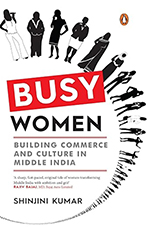
The fairly well-established recipe for success as well as the marker for it in India is the move from the rural to the urban. The statistics and the ground reality might remain ambivalent, but the aspirational pull of the cities remains as strong as ever. A counterpart exists for the folks living in smaller cities—the move to the ever growing and expanding Tier-1 cities brimming with opportunities that their Tier-2 and Tier-3 cities and towns cannot provide. And yet these cities and towns are changing and growing as some businesses wither, some grow and new ones are born. Entrepreneurship has been a male-dominated field for many reasons: family businesses being passed on to the sons, only the sons’ business acumen deemed worthy of investment, occupational stereotypes and familial gender roles. Despite all odds being stacked against them, women have established, expanded and worked in businesses across the middle cities and towns of India. While the larger picture for gender parity when it comes to income and wealth in the business world still remains gloomy, the women whose stories this book covers show that change is slow but not absent.
Considering the sheer size of the country and the number of middle-size cities and towns, the book’s coverage in terms of the number of places covered is impressive. The author takes the reader along as she sets out on a quest to document the journeys of women who are actively shaping the commercial landscape of middle India. The book is written in a very accessible style and reads like a travelogue. More than reading the product of months and months of research, the reading experience is akin to travelling with the author in and out of the cities and towns of middle India. The astute observations sprinkled throughout the book further allow the reader to transcend the confines of time and space, and join the author as a listener to the tales of challenges faced and achievements unlocked by these women.
The book looks at the bright side of things. But despite carrying success stories of women business owners and entrepreneurs, one can’t help but notice how this success is mostly contingent on negotiations with patriarchy that often leave women with the double burden of managing the business as well as the disproportionate share, if not all, of the household work and parental duties. Further disheartening is how privilege in terms of access to wealth, income and education has failed to translate into a more equitable familial life for women. The only solace then is how these women have carved out a space for themselves in the business world, sometimes becoming the first Bahu, Beti or both in the family to work in the family business or set up a new one. They are indeed trailblazers in their families. Framed photographs of founders and previous owners on the walls of commercial establishments in India is clearly a male-dominated arena and the thought of these women breaking this pattern is a pleasant one.
And yet the purported cultural impact of these entrepreneurial interventions feels rather exclusionary, exaggerated and inaccessible to many. While the contribution of these women to commerce is quite evident and self-explanatory, the arguments made about the cultural contribution and leadership could have been elaborated through an in-depth and immersive look at the work of some women especially where the impact of the business goes far beyond branding and profits. Moreover, a very brief discussion of the commercial and socio-economic landscape of each city and town, if added, could have helped the reader place the stories of these women in the local context and add depth to the narrative. In the absence of sufficient backdrop, the book, despite being divided into chapters based on places, can occasionally feel like one long chapter and middle India like a monolith despite teeming with diversity. Lastly, a clearer definition of what comprises the middle in terms of proximity to generational wealth, family business and social/educational capital would have enriched the book in terms of clarity.
The book’s foremost contribution is highlighting the role of a demographic often ignored in conversations about economic growth and change. While the privilege of the women can neither be denied nor excluded in a grounded understanding of their success and achievements, their ambitious work and refusal to let patriarchal gender roles limit them is commendable. The book, presumably as intended, leans more towards being a collection of stories of women entrepreneurs and business owners from middle India and not as a socio-economic analysis of this demographic.
Shimaila Mushtaq is pursuing her Ph.D. at the Department of Political Science, Jamia Millia Islamia, New Delhi, and is currently the Social Media Consultant with The Book Review.