
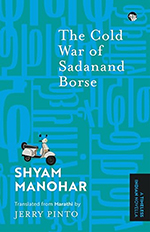
A basic conundrum faced by a reviewer of translated fiction is whether one should review the quality of the fiction or of the translation. Considering that I—like many readers of translated works—do not know the source language, it is primarily the narrative itself which becomes the focus of the review. Jerry Pinto is a fine writer himself, and one assumes that the translation must, therefore, be true to the original.
Sadanand Borse comes upon a stringy funeral procession and crashes his scooter into the corpse—a baby. He faints, revives briefly and faints again, upon which two pahalwans who were part of the cortege take him to a hospital despite their fury at the scooterist’s ‘disrespect’ to the corpse. While waiting for him to recover, they rummage through his belongings and discover bills for several big purchases. They eventually escort him home too, to his pregnant wife, and return to visit Sadanand the next day to extract punishment for hitting the dead baby.
Sadanand is not rich but has recently won rupees one lakh in a lottery. Among the consequences of this windfall is his landlord’s demand for a raise in rent—a demand Sadanand and his co-tenants find unacceptable, even though the other two tenants are themselves jealous of his sudden stroke of luck. Interestingly, the landlord and his wife interpret the visit of the pahalwans as Sadanand’s attempt to intimidate him, retreat in the face of the non-existent threat and proceed on a pilgrimage while Sadanand and his wife try and cope with the repeated demand of the pahalwans for retribution.
More than anything, the narrative paints a picture of middle-class/lower middle-class life sometime in the late twentieth century. Though the specific context is Maharashtra, it could be true of almost any small town anywhere in India. The anxieties generated by the pahalwans’ repeated visits, the way in which the neighbours rally around—with all the attendant jealousies and interpersonal politics, the young couple’s hopes from the lottery money and worried discussions regarding how much they would have to shell out to get rid of the pahalwans are done very well.
Nothing major happens—the pahalwans do not engage in any actual violence, nor do they even make extortionate demands—their desire for revenge being limited to delivering two tight slaps. But while Sadanand reluctantly comes round to receiving the slaps, his wife insists that the humiliation involved was unacceptable.
A charming enough slice-of-life piece of writing, but it should have been a short story. As a short novella, however, it dragged and dragged and dragged till the dialogues—as repetitive as in real life—started spinning in my head. My copy had some misaligned pages—while pages 81 to 95 were missing altogether, the pagination didn’t just jump. Instead, the pages between 67 and 80 were repeated in random combinations, several times, and I didn’t even realize it—the entire structure being so similar—dialogues in a loop going nowhere, a sense of overwhelming ennui, the pointlessness of everything… if that was what the writer intended to convey, he succeeded, but left me, the reader, with the sense that the book was quite pointless.
It is of course possible that the Marathi prose sparkled; the English text was simply prosaic. And while I have frequently felt thrilled at the inventiveness of writers from Arundhati Roy to Zadie Smith, realizing how no word in the extant dictionaries could have quite captured the exact nuance that the newfangled word dazzlingly conveyed, I could not see why Sadanand ‘gentled’ his wife’s hair/head. ‘Caressed’, ‘smoothed’, ‘comforted’ could all have worked perfectly; ‘gentled’ sounded just wrong!
All in all, a rather underwhelming read.
Bharati Jagannathan teaches history at Miranda House, University of Delhi, Delhi, and studies issues related to religion and gender in early India. She enjoys telling stories and watching birds and trees.