
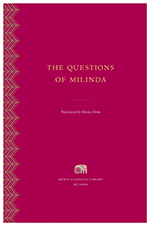
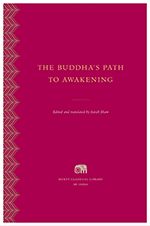
 The Murty Classical Library Series of India describes itself as ‘a modern invitation to diverse pre-modern literary works’. These two gems from the Buddhist tradition augment its already rich offerings to the world of translation and Indological literary studies. One has enjoyed texts as varied as the poems of the first nuns, the Therigatha from the Buddhist tradition, and Bulleh Shah’s lyrics from the Sufi one. Brilliantly conceptualized under able guidance, these titles are rigorous enough for scholars and accessible enough for the general reader. These exquisitely produced volumes can sometimes be chunky to hold—a small price to pay for the joy of being able to read in Roman script of the original text facing the translated one!
The Questions of Milinda (Milindapanho in Pali) is one of the most revered texts in the Pali Theravada tradition in Sri Lanka, with the Burmese tradition going so far as to canonize it in the Khuddaka Nikaya and even the Chinese tradition boasting of a version of the story. An oft-quoted text in explications of Buddhist philosophy, especially the iconic analogy of the composite nature of the chariot for understanding the notion of the self in the Buddhist tradition, it is an extended dialogue on fundamental questions of ontological, epistemological, and even political import believed to have taken place between the Greek King Menander (Milinda) and a Buddhist monk named Nagasena. The earliest versions of the text originate from Greater Gandhara, where Buddhism had spread during the reign of Ashoka as early as the third century BCE.
The Greek encounter with this part of the world led to the efflorescence of Greek-inspired art and literature, especially the familiar Gandhara style in sculpture.
As such, Milindapanho is historically significant as evidence of vibrant inter-civilizational exchange in the ancient world, albeit historians are still uncertain as to the historicity of this particular event. For Buddhists, of course, the conversion of an initially sceptical Menander/Milinda into a committed Buddhist by the end of the dialogue serves as an example of the rigour and refinement of the Buddhist philosophical understanding of the nature of reality. However, the text also serves as a resounding affirmation—much needed today—of a cosmopolitan culture of deep dialogue as a mode of engaging with the world, especially the ‘other’ minds, regardless of which way we see the flow of influence.
The Introduction to the present edition by Maria Heim situates the text within these and other debates and is one of the key contributions of this volume, making it welcome and timely, despite the existence of earlier English translations: the two scholarly ones by TW Rhys Davids from the end of the nineteenth century, and by IB Horner from the sixties for the hoary Pali Text Society and the popular abridged one by Bhikkhu Pesala published in the 1990s. This text, in presenting the full texts in Pali and English, also avoids the somewhat dated Victorianism of some of its predecessors.
The second volume from the Murty Series is also a beloved part of the Pali Buddhist canon. The Jatakanidana, rendered into English as The Buddha’s Path to Awakening: The Origin of the Birth Stories, is the first complete prose narrative that describes his search for freedom. Likely authored by a monk from Anuradhapura in northern Sri Lanka, this fourth/fifth century text was intended as an introduction to the Jatakas—the 547 narratives that trace Bodhisattva Sumedha’s journey across lifetimes as he fulfils his heroic quest towards perfecting the qualities that make him a Buddha (Awakened One) or Tathagata (Thus Gone). The tradition posits the many Buddhas across time and space.
Ancient texts such as this require us to revisit our notions of time, space, genre, and authorship. As with many pre-modern texts, not only are multiple unnamed authors a likelihood here, the many-lives-as-one continuum poses its own challenges to attempts at generic classification of this text as a ‘biography’. These texts challenge the conceptual vocabulary of modernity, something to keep in mind while reading these stories against the larger story of the Buddhist tradition, of which these texts constitute an essential part—which is often lauded by moderns for its compliance with and amenability to ‘modern’ sensibilities.
The philosophical paradox a text such as the Jatakanidana (nidana meaning origin, which is explicated in three sections: ‘Far’, ‘Near’ and ‘Recent’) presents us with how a doctrine of non-self (anatta) can still sustain a narrative of a personal quest through time, space, and constant change. It also ‘offers a template’, as the translator Sarah Shaw suggests in an inspired moment in the lucid Introduction that contextualizes the work comprehensively, ‘for everyone, Buddhist or not, to tell their own “story” in a new way, with themselves as part of a vast web of interdependencies in time and space.’
Regardless of one’s philosophical leanings and personal beliefs, these texts retain their relevance, not least for their literary attributes and imaginative reach. Abounding in vivid similes and metaphors, laced with humour and rich in compassion, they transcend the dryness of philosophy and hagiography to humanize, delight, uplift and expand the spirit. Together they constitute a precious archive of the highest human striving. Kudos to the Murty Classical Library for presenting them to the world afresh, in ways both intellectually satisfying and aesthetically appealing.
Maya Joshi teaches Literature at Lady Shri Ram College, University of Delhi, Delhi.