
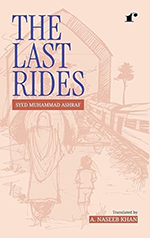
Syed Muhammad Ashraf’s The Last Rides is an unusually reflective and haunting work which gives a glimpse into a lost way of life, into the disappearance of worlds which were once held together by rituals, beliefs and refinement. The novel unfolds through recollection, moving along the labyrinth-like corridors of memory returning again and again to moments, people, landscapes and feelings which remain with the narrator, Chotey Mian, long after they have vanished from the world around him.
Chotey Mian is not merely an observer; everything that happens in the novel filters through his consciousness. He is the emotional anchor for a story that constantly moves between the personal and the historical. The novel opens with his childhood memories and quite significantly with Jammo, the young girl who becomes one of the emotional touchstones for the young boy. Living near Chotey Mian’s maternal grandparents, she and her sisters are invited home by his grandmother, Nani Amma to learn the Quran but, aware of their straitened finances, she also feeds them, dealing with their embarrassment at accepting charity by telling them she needs help in the kitchen. Moments like these in a world shaped largely by women who nurture and guide the young boy, gradually come to define the moral universe of the novel in which dignity and generosity go hand in hand.
From them Chotey Mian (or Akram) learns not only manners and customs but also the delicate art of living with others. A beautiful example of this is the shared wall which stands between Nani Amma’s Muslim household and that of Pandit mama. The wall dividing the two households does not signify separation; instead it merely constitutes a boundary recognized by both while they share the minutiae of everyday life.
The relationship between Akram and Jammo is remarkable for the innocence which invests its portrayal. Neither character fully understands the nature of the attachment developing between them. When Jammo comes to live with Chotey Mian’s family, she enters a strange new world of comfort and gentility. The young boy gradually becomes intensely aware of her presence, catching ‘the warm fragrance of her breath’ or noticing that the ‘colour shimmering in her eyes was so rich and varied’. He is drawn to her warmth and companionship without having the words to explain his feelings. What makes the depiction of their relationship so moving is the manner in which the adults recognize the bond between the two children and handle it with so much tact and tenderness.
Alongside these personal memories runs a richly observed portrayal of rural life marked by the shared anxiety over delayed rains, the excitement of participating in the Janamashtami festivities and characters like Pyare Lal, the wrestling master who gives away half his prize money every alternate year for the marriage of a Hindu and a Muslim girl. It is a composite culture where the villagers think nothing of asking Chotey Mian’s father to preside over prayers for rains on Janamashtami despite his being a Muslim.
The broader dimension of the novel, however, emerges through the mysterious travelogue and relic inherited by Akram with which the novel opens and ends. A book which Chotey Mian’s father considers to be ‘just an account of a journey and a few superstitions’, but which becomes an obsession for the young boy, one from which he has to be weaned away by incantation and prayer. Written across generations of the family, it contains accounts of journeys stretching way back into the past including a remarkable encounter between one of his ancestors and the spectre of Timur in Samarkand. However, there is no glorification of the conqueror or of Bahadur Shah Zafar, the last Moghul King whose humiliating departure is witnessed by another forebear. Akram feels Timur was just a fundamentally brutal man with no great vision, while Zafar was a weak and indecisive ruler.
Neither figure commands his respect but what is significant for him is the gradual disappearance of the world around them, of stories that have disappeared with time. The travelogue and the small relic are not merely historical artefacts; they are repositories of memory, the weight of which is inherited by Akram who sees languages, customs, traditional foods, in effect an entire civilization, fading away before his eyes. Reflecting on the departures and losses, he tells his wife, ‘I feel frozen with fear at the thought of the departing rides and wagons from childhood till now. None of the rides and wagons that departed ever came back.’
What finally distinguishes The Last Rides is not its plot but its atmosphere of remembrance. Naseeb Khan’s sensitive translation does justice to this complex work which is so dependent on mood, memory and cultural nuance. The book is a travelogue, but the journeys described are not merely real journeys; they also symbolize movement across time through ancestry, displacement, longing and historical consciousness. It is a difficult task to preserve the meaning and emotional cadence of a narrative with such a fluid and non-linear plot in translation, but The Last Rides more than succeeds in giving the reader access to the layers of cultural memory and feeling embedded in the original. The result is a novel which is moving and elegiac without ever becoming sentimental.
Ranjana Kaul, former Associate Professor, Department of English, College of Vocational Studies, University of Delhi, Delhi, translates from Hindi and Kashmiri (Devanagari) into English. Translations include Saga of Sattisar by Chandrakanta (Zubaan), Paper Bastions by Meera Kant (Rupa), and In this Metropolis by HK Kaul (Sahitya Akademi).