
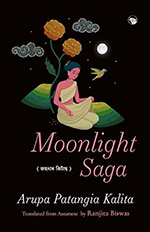
Arupa Patangia Kalita has been a powerful voice in Assamese literature. Her fiction has chronicled the agony and uncertainty in the lives of people living on the margins in conflict-torn post-Independence Assam.
In Moonlight Saga, Kalita takes the reader through the arduous journey undertaken by people of the Adivasi community from the heartlands of central-eastern India to Assam’s tea gardens (a phenomenon that started from the nineteenth century onwards in the service of the Empire’s tea industry), and their stories of suffering, survival and resistance in the face of colonial oppression and brutality. The work reflects extensive research as it documents the process by which forest land is converted into a tea plantation, the difficulties involved in tea planting and growing, and the lives of the white men who own and manage the gardens with help from natives holding various clerical positions.
The story of the protagonist is inspired from that of a real person, Durgi Bhumij, a first-generation migrant who arrived in Assam with her husband in the years preceding India’s Independence. In the novel, she is a tall and beautiful, feisty young girl, the lead dancer (agdohoni) of the jhumur party, an expert singer, and a lover of flowers and plants. Like so many of her fellow Adivasis, her family too lost control of their lands, forests and rivers to the British colonizers. Their hunger, induced by artificial famine, left them no option but to migrate to the promised land of the ‘green gold’. In the midst of the horrors of their ferry journey, where cholera-afflicted persons were abandoned in the dense jungle to be devoured by animals and where human waste mingled with the boiled rice served to them, the only ray of hope was offered by the bundle of seeds of marigold flowers that Durgi secretly brought from her home.
Kalita gives harrowing details of the death and disease that festered in the gardens, the regular whippings by the sahibs, the strangulating hold of the moneylenders, the stupor induced by opium and country liquor, the high mortality rate, and the dead bodies landing in what was called the ‘depot’ from where a continuous stench emanated. However, despite the cloud of sorrow that hovered over the labour lines, there was communal feasting, singing and dancing of jhumur, and women merrily walking to the haats to buy trinkets. Kalita depicts a vibrant oral culture thriving among the illiterate ‘coolies’. Durgi specifically sings songs of joy, grief, and everyday life of the tea gardens, and teaches them to her daughter, Baby. Indigenous and supernatural beliefs abound reflecting the tea workers’ love, fear and awe of nature. In sharp contrast is the contempt and disrespect shown to nature by the colonial masters. Nature is invested with a power and mystery incomprehensible to the whites.
The colonial project of civilizing an inferior race and the entrenched belief in the superiority of the white race are effectively displayed in the white sahibs’ attitude and behaviour towards the ‘coolies’. They are reduced to their bodies, filthy and stinking. But the core of the novel is the heartrending story of the dark women who became ‘mem’, the ‘kept’ women of the whites, and their children, snatched away from their mothers, some of whom landed in an orphanage in Kalimpong. They occupy a liminal space with no social position. Kalita’s powerful images and metaphors convey the devastating loneliness and agony of Durgi and her son, Laba. Durgi hallucinates about women like her floating over the tea bushes with vague sounds coming from them—‘Were they singing, or weeping, or angry?’ She could neither enter the respectable Assamese society, nor her own community living in the labour lines; and stepping into matrimony with a white man was unthinkable. While her son Laba, treated like an untouchable in a North Guwahati household, enters ‘a cave of loneliness’, Durgi becomes ‘a mad river’. She is temporarily revived by her work with the volunteers of the freedom movement, passionately shouting slogans, working on the spinning wheel, singing songs of independence, and passing on valuable information, thereby turning her personal sorrow into political activism. It is worth noting how the novel demonstrates the gardens coming under the influence of Gandhi’s cry of freedom and the attempts at bringing about reforms. The participation of the tea labourers in the anti-colonial movement and their increasing resistance to injustice with some of them succumbing to the sahibs’ bullets mark a significant, radical change in the world of the plantations.
The numerous references to ghosts, nightmares and unearthly sounds bear witness to the haunting nature of the past, the trauma that continues to persist. ‘Like an amarlata vine wrapping itself around a tree. It did not die even if chopped off; wherever it fell it found a new tree to climb again…. These memories were just the same. They just needed a human mind to spread their tendrils. And then they did not let go.’ The novel’s symbolism adds to the atmosphere of pain and loss, and aids in drawing connections between Durgi and women like her. The tea liquor furnishes the author with a binding metaphor to express the mazdoors’ buried dreams and memories, and even the colour of their dark bodies. At the end, Durgi wishes that the moonlight had never shone on the tea bushes, a potent and poignant image of the white man’s curse on her.
Ranjita Biswas’s translation, with several words and songs in the baganiya dialect retained, reads smoothly and conveys the richness and dense fabric of Kalita’s fiction. The novel is an essential read for anyone wishing to enter into the tragic, harrowing world of the ‘coolies’ and the ‘coolie women’ in particular, their lives erased from all history and memory.
Jayashree Borah is Associate Professor, Department of English, Indraprastha College for Women, University of Delhi, Delhi.