
The hill stations of India were a nineteenth century invention of the British. Since then, they have generally been represented through the lens of the picture-postcard aesthetic of the colonials, or through works of authors such as Rudyard Kipling, who projected these little wedges in the vast Himalayan wilderness as orderly playgrounds of the white man, and of their subservient royalty. Rarely did the ordinary Indian––the one that really ran these hill towns as beasts of burden, from those lifting luggage, firewood or coal, to those pulling rickshaws and carrying mem sahibs in palanquins––find a voice in their narratives.
Landour, amongst the earliest hill stations to be ‘discovered’ in the 1820s by the two Fredericks––Shore and Young––is perhaps one of the bigger victims of this colonial fixation than most other hill stations. Since, being a Cantonment, it has largely been protected from the onslaught of the publics from the plains that have earned for other hill towns in North India the appellation of slums on the hills. Today, with almost every travel blogger having extolled the Landour bungalows and their gardens, the funny quotations affixed on the stately Deodar trees and the numerous cafes and bakeries serving pancakes, waffles and crunchy peanut butter, Landour has become the perfect comfort staple for the brown person’s insatiable, and to people like me completely incomprehensible, nostalgic craving for that age of enslavement.
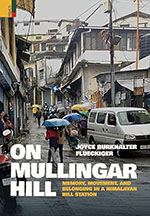
On Mullingar Hill: Memory, Movement, and Belonging in a Himalayan Hill Station by Joyce Burkhalter Flueckiger is a book that sets out to correct this voicelessness by going beyond the usual colonial narratives. This the author seeks to achieve by expanding the archive to include real residents––the natives––in local histories and heritage descriptions. By referencing her work to Mullingar Hill, and not the Landour Cantonment, the author immediately succeeds in shifting focus away from the colonial. Mullingar, perhaps the second oldest bungalow in this hill station and the erstwhile home of Frederick Young, is today a bustling settlement inhabited by motley migrants who run petty businesses, or are descendants of the Nepali porters referred to in earlier times as dotiyals (people who actually ran the hill station): some leather workers, junk dealers that pose as antique merchants, mechanics, tea-shop owners and Tibetan refugees.
The author explores oral histories and personal narratives of about twenty families residing in the bazaar that connects Mullingar Hill with the tourist town of Mussoorie. This space, a typical hill market, is Landour Bazaar, sitting right next door but perhaps worlds apart from the seventy-odd bungalows in the forest, now owned by the super-rich, some of them turned into boutique hotels, that the tourists imagine to be Landour, the hill station. This book is about the ordinary folk that, unsung and unappreciated, provide for every need of resident and visitor, in this often difficult terrain. Authored in an interview format, it focuses on families that have contributed to the culture of the Himalayan hill station of Landour, foregrounding the historical narrative with participation from real people.
Think of any family history and one realizes that beyond a generation or two, we are all refugees or nomads, moving from hither to thither, in search of employment, better lives or just escaping a troubled past. What is common to the often voiceless people of the hill stations––the native families and their offspring––is that they are all migrants who somehow found themselves here, and are now tied to the bazaar for various reasons. It seeks to question the idea of what is home, the need or reasons for movement, and what constitutes belonging. These are relevant questions in a day and age where the notion of home is often politicized, and belonging is increasingly becoming contingent upon hitherto unknown factors such as Internet access and upward social and economic mobility.
The book presents authentic oral histories and personal stories, making it essential reading for anyone interested in the nuanced realities of Indian hill stations, mountain life and the everyday people who sustain them. But read the book if you are interested in just that. Do not go looking for theoretical insights and seminal contributions to concepts such as memory, movement and belonging. The book, in that sense is a mere reversal of roles, of giving voice to the native by someone from the other side. The author, while documenting these lives, however, does add an element of interest by seeking answers to questions of how rituals performed by her respondents, through their sheer repetitiveness and persistence, create a sense of home and belonging.
The author refers to the rituals and practices performed among the people as performative. In the sense of what their performance leads to, instead of thinking in terms of what actually transpires, and what is performed, reflecting deeply on how every ritual and practice––the carrying of pitar patthar, the arrangements of idols in the family shrines, the tidying of graves, the processions of the devi-devtas in the bazaar––is somehow distinguished, as practised by the actors in the given ethnographic context. With these myriad rituals and practices, we are also made aware of a sort of cosmopolitanism that pervades the hills, emerging from people’s propensity to migrate. This mobility, the author argues, is the sort of thing that constitutes this hill station’s real heritage.
The book brings forth an ethnographic approach to people and their lives, with ritual and everyday practices that are foregrounded in time and space, in what they do, the kinds of decisions they make, and their own interpretations of these everyday practices. As a book, it is descriptive of life worlds in this unique spot three kilometres closer to the heavens than places at sea level, rather than prescriptive; so, we get to know what people really do, rather than what social prescriptions tell them to. It is for this reason that the book is worth a read.
Lokesh Ohri is an Indian anthropologist, historian, writer and a cultural activist based in Dehradun, Uttarakhand.