
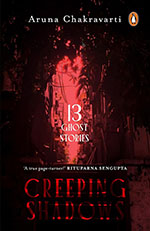
Aruna Chakravarti’s latest work weaves translucent and amorphous threads of the unverifiable supernatural with a tangible undergird of history, geography and collective social idioms that carefully organize her characters’ everyday lives.
Chakravarti’s prose bears a taut, luminous economy and quiet control. As they cut across various divides, these richly diverse and meticulously crafted indigenous narratives—often seen through a gendered prism—span over 200 years. While mostly set in Bengal—crisscrossing terrains both rural and urban—and replete with a vivid redolence of flora, fauna, smells and tastes—they also include locations ranging from a province in China in 1822 to Indian Agricultural Research Institute in modern-day Delhi.
As the stories grow, the plausible begins to deflect into unforeseen inflection points, which in turn distend and meld into a stunning, variegated register of paranormal phenomenon—ghosts, phantasmal spirits, revenants, shape-shifting chimeras, shadowy doppelgangers, simulacra, nocturnal visions and apparitions, seances and mediums, black magic, exorcism, miracles, telepathy, fortune tellers and clairvoyants. Confronted thus with the twisty, the reader experiences startling psychological disturbances: our wrenched responses, suffused with fear and terror, snake around the spectral as it secretes itself abruptly, and rupture our habitual modes of seeing. While the expansive emotive quotient here saturates narrative atmospherics, the incremental weight of the dark, foggy layers of the uncanny rehearses the chill of the thin line between the living and the dead.
A disquieting concept, the materialized Ghost is a floating signifier, a metaphor where not only the living and the dead intersect—the past remaining relevant to the present—but also encrypts an ungraspable encounter with otherness.
There are several riveting reads here, some of which I discuss below. ‘The Motorcycle Rider’ is set within the academic confines of a ‘well-guarded’ university in Delhi—the last place where we look for the grotesque. The cumulative atmospherics here are blood curdling: dark shadows creep and swallow clarity; hazy phantom silhouettes speed past us; strange body-snatching visions tantalize as they appear, dissolve, and reappear; and the decaying carapace sheds its peels, only to render our intellectual framework defunct.
Shrouded in eerie atmospherics, ‘There are More things in Heaven and Earth’ orchestrates semiotics with measured restraint. Here, absent presences are suggested through a chilling sensory and neural mosaic of sounds, gestures, and signs. As sensations surge, latencies spiral into the ghostly smoke of horrific political truths. In sync with her themes of the indeterminate paranormal, Chakravarti suspends hegemonic linguistic contours to foreground the intricacies of memory and trauma through retrospective flashbacks buried within flashbacks.
Similarly, ‘The Caregivers of Gazipur’ haunts with its phantasmal absent presences, liminal silhouettes, and creeping shadows. Hinged on the uncertain axis of the improbable probable, it enacts a palimpsestic series of erasures, traces, and a rewriting of identity. Here, the illusory return of the dead, with their unspeakable secrets of a covert and hyphenated identity, has deep psychological and sociological ramifications.
Paratactical and often perforated, memory forms a significant and recurrent subtext of these narratives as they mirror multiple alternate worlds. ‘Truth is Stranger Than Fiction’ charts a fundamentally subjective and arbitrary reconstruction of the 200 years’ history of a family of Punjabi immigrants from (what is now) West Pakistan to (erstwhile) East Bengal. As we tunnel through the family’s old mansion in Jalbhum and peep into the innate repression of its crepuscular and gothic topology, it wields a startling and menacing world of death and decay. Compelling as any crime thriller, it plays out its intensely intriguing mysteries to hit a dead-end of phantasmal action— ‘“Come with us…come with us.” The room was full of echoes. Like bees they came buzzing at her from the walls. The shadows in the room deepened.’ And we wonder. Do dead spirits exist? Can they carry the residue of old prejudices and be vengeful even after they cease to be? Was the spectral legerdemain who instigates, patriarchal?
Conversely, and set in the contemporary, everyday world, ‘The Necklace’ pirouettes into a tempestuous and intriguing love story of an outgoing Anglo-Indian woman and a proud Rajput prince. Their different backgrounds and temperaments carry deep racist, communal and colonial underpinnings. Its substantive social flair notwithstanding, the story’s embedded ‘peripeteia’ suddenly bursts with unnatural and surrealistic elements to cause an unsettling frisson. This visceral turn of an uncanny occult and its clandestine machinations spews a menacing, primeval animus.
Garnering her insights from remote corners, Chakravarti explores the dark areas of the human psyche. While most stories here are distinctly women centric, the eco-feminism of ‘Vendetta’ foregrounds the empathetic conflation of woman with nature and animism. In doing so, it weaves the spatiotemporal coordinates of interbeing where body, soul and universe are mutually entwined. The wife’s (Ira’s) deep connect with the luminous world of nature is manifest in her tender attachment to her brio-filled mulberry tree that fructifies, provides pleasant shade, attracts chirping birds, and vibrates with lively monkeys. Ira’s empathy with the refulgent tree annoys Sudhiranjan, her pragmatic botanist husband, and makes him so jealous that he poisons it secretly. This perverse action with its undercurrents of toxic masculinity is so deranging, and her symbiosis with the dying mulberry tree so intense, that Ira withdraws into a germinating darkness within herself, and gaunt silences follow. What unfolds is a contest between the incipient memory of (a feminine) nature and patriarchy’s dispassionate, deterministic, and ‘nerdy’ repression.
‘The House of Flowers’, set in Quigzhen, China, is an implicitly ironical story. As three young men float across the Suansui Lake towards the tea house, language assumes a pristine cadence: ‘A full moon, swimming in and out of clouds in an indigo blue sky, shimmered … in the black water and thousands of stars speckled the surface with gold dust.’ This sweet stillness, however, soon changes when Zihan illegally plucks and breaks ‘a lotus pod and forced it open…. he peeled the tough green skin with his teeth and crunched the sweet milky kernel.’ This forbidden voracity and carnal surplus prefigure the story’s denouement. Appearances prove to be illusory as the narrative exchanges its luring rooms for a lurid, haunting spectrality to rupture credulity. As exotic curiosities turn delusory and covers are rent asunder, we witness a descent into moral nakedness when a tantalizing prosopopoeia transmogrifies into a volatile trope of past repression.
As these narratives vacillate between lucidity and obscurity, between the real and the chimeric, our perception diminishes into a psychic conundrum and Chakravarti makes us wonder: is this spectral projection of the Other outside or within? Is it a product of collective prejudices, or of hallucination—a simulacrum emanating from delusion and auto-suggestion, or does it simply exist?
The supernatural might be real after all.
Davinder Mohini Ahuja retired as Associate Professor, Department of English, Ramjas College, University of Delhi, Delhi.