
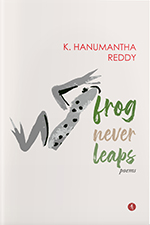
K Hanumantha Reddy, popularly known as HRK, is one of the famous Telugu poets who hails from Gani, Nandyal district (formerly Kurnool) and lives in Pennington at present. He is also a short story writer, literary critic and a fountainhead of inspiration to many young writers. He has worked as a revolutionary, journalist and an activist with NGOs.
Reddy’s book Frog Never Leaps testifies to his profound poetic sense, love for life, language, celebration of nature and passion for basic transformation of the anarchic and exploitative system on the globe. In it one finds his poems which mirror his vast reading, rich experiences, beautiful images, numerous literary allusions, historical references, yearning for meaning of life and history, appreciation of nature, children, mundane scenes and an undying hope for a better world. We also find his reflections on life, death, poetry and earth, references to famous writers, philosophers and leaders such as Camus, Coetzee, Dostoyevsky, Marx, Nietzsche, Fidel Castro and Mao.
In the poem ‘The Stony Book’, the poet remembers the past and the present, sadness in the eyes of the frog under dissection, and refers to the schism between thought and action. ‘The heart in scalpel’s shadow/ No longer moved, beats no more. /The frog will never leap again’ (p. 17).
The poet is sensitive to nature’s communication and the pangs of the birth of a new world. He eulogizes Saddam Hussein’s resistance to American imperialism. He sees proletarians as the base and blasters of a machine that represents the civilization of the yellow devil described by Gorky that kills humanity. He says, ‘Instead of discarding experiences, /Can’t we build barricades with them?/ When living means losing, why don’t we dare to fight?’ (p. 26).
Reddy’s poem ‘We Are Still Alive’ pays tribute to the invincibility and endurance of the Mashantucket Pequot tribal nation, braving decimation and attempts to treat them as museum pieces. ‘Like the sky, like water, like air, /Like the sad resonance of a native flute, /Without leaving this air, we exist. By existing we defeat them. Please, spread the word: / We are alive’ (p. 67).
While ‘Derailed’ refers to an anarchic system which dashes hopes for revolution and affects the environment, ‘A Few Announcements!’ brings out the agony, anger and will power of the insulted and the humiliated to struggle for freedom. They seek no mercy. ‘We are untamed horses with iron jaws and wings. We submit to no reins. We fly away with caves and sell them to the man of old goods… Many will come to our songs, enraptured by our battles against the adversities that won’t let us speak for ourselves, eat our food, or shake our hands with ourselves’ (p. 52).
Reddy urges people to march ahead for freedom saying, ‘The book of life is not for reading, / It is for writing and tearing up as you go. / As soon as you wake up in the morning, / Brew your coffee with a torn calendar page’ (p. 118). He wants them to become actors on the stage of history. In the poem ‘Roar’ written after Rohith Vemula’s suicide, he says statues of dictators fall but dreams stand.
Rain teaches like a dance teacher; one can learn solidity and invisibility from rain (‘Rain in a Coconut Tree in Rain’). ‘The Light’ beckoning is scary, offers mystic symbols of pain, and in love one listens to the teardrops, sorrows, tales, chains of fear. When ‘Rain and She’ come together, ‘The poem blooms like lightning, / A rainbow fills the entire sky. / They teach me the art of being without me.’
New expressions like ‘munching on some pieces of Nirvana’, ‘words roll like strained cats on the swept carpet’, poem ‘piercing like a Dracula bite’ are startling.
Like all poets he too experiences loneliness, its pain, and asks the coconut tree to speak, in ‘When She is Away’. He sees desires as fossils and laments none has real desires. The poet understands the value of being alone, observing seeds come by windfall, cloud rains, earthworm ploughs causing joy. ‘Branches rise to catch the songs of flying birds, / They wear seeds on their fingertips as bait for the birds’ (p. 109).
For Reddy, his work is a weapon to protect posterity, and a persistent search for unravelling the mystery of life. He writes in ‘The Word’, ‘Must search the seas, / Must seek the sky, / Must ignite the forests, / For a single word. When the word is found, life begins’ (p. 86).
The poet searches for life, identity and word. He laments the vanishing of the ancient song, learns about the mystery of life, kindness, love, freedom and contentment from small creatures, a butterfly, kittens and fireflies. He is elated by a bubble blowing child, the beak of a conure nibbling at his shirt buttons. He sees word as the guide on the path of contemplation, truth, and enlightenment.
The poems in the book are translated by the poet himself into English from his mother tongue Telugu. As his wife Jaya mentions in a poem in the beginning, the poet searches for words and laments for his village. His poems are relevant in the present times marked by struggles for emancipation, identity, meaning of history, increasing religiosity, self-righteous attitudes, violence on the globe, proliferation of technology, receding humanity and indispensable harmony between the inner and outer worlds.
J Ravindranath is former Professor and Head, Department of English, GVP College of Engineering (A), Vishakhapatnam.