
A popular joke doing the rounds on social media a few years ago wondered, ‘People who write “k” instead of “okay”, what do you do with all the time you save?’ Although trite in its Instagram-cockiness, it pointed to an inherent fallacy in modern obsession with convenience: everything is quicker, but we don’t have more time. Everything is easier, but we don’t have less stress. Sometimes, the added stress falls along invisible lines—nationwide strikes by gig and delivery workers brought this fact home to us more expediently than a ten-minute delivery of potato chips.
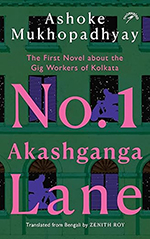
No. 1 Akashganga Lane arrives expediently too, then. A simple tale about Sriman, a gig worker in Kolkata struggling to make ends meet, and his friends and family, many of whom reside in the titular edifice, it serves as an exposé of the injustices and dangers of an industry encumbered by low pay-outs, protection and regulation. Liberally imbued with heart and conscientious intent, the novel offers perhaps the first such exposé in modern fiction of a very modern problem.
Unfortunately, in much of the text, intent seems to prevail over storytelling, making it read more like a non-fiction account or lesson.
Mukhopadhyay’s robust research provides us with compelling facts and figures, but they would perhaps have been more compelling had they been woven organically into the story, permitting us to sympathize with the characters on a human level because we can’t help it, not because we think we should. The characters end up as cardboard cut-outs, almost incidental to the story, across a clear dividing line—delivery workers: good; corporations: bad. There is little scope to get to know them in any flesh or fullness; Sriman is a delivery worker and a ‘good guy’; Subhra is a benevolent nurse; Jnuiphool is a feisty matron. Towards the end of the novel, when one of the main characters embarks on a new career making clay idols, we are told it was always her dream, but there is no hint of this anywhere in the preceding pages.
Perhaps it is this disconnect with the characters that prevents the stakes from developing or landing properly. Even when the worst happens, it happens quietly and the characters appear to move on fairly easily. We never have a chance to fully cognize its impact and fallout. Problems inexplicably get resolved ‘off-stage’; for instance, a character who is preparing to abduct her own son from the home of her hostile in-laws and philandering husband—arguably a very high-stakes situation—has her son suddenly and voluntarily handed over to her by said in-laws and husband. The actual story arc is challenging to figure out. Incidents happen randomly and the reader is left wondering what their significance is within the broader scheme of things. Although abundant real estate is devoted to exposition and backstory, there is a certain propulsion lacking in the narrative, preventing it from holding one’s interest and empathy.
Some of these issues may be ascribed to the inherent difficulties of translation, wherein depth and nuance can be lost along the way, as is the case even in popular translated titles such as Before the Coffee Gets Cold by Toshikazu Kawaguchi. In No. 1 Akashganga Lane, the language, though simple for the most part, is often stilted, replete with unnecessary repetition and adjectives (e.g. a ‘livid argument’, a ‘cockily aggressive attack’). The novel could have flowed better with tighter editing, leaving the readers to draw their own conclusions about tone, emotion and motivation from the actions and dialogues of characters and the situations around them.
And yet, there are characters and qualities that stand out. Bishan-da, the eccentric patriarch of the house with his sights set on the stars, is endearing with an old-school charm, stern of spirit and generous of heart. His retellings of astrological myths and tales from his own colourful life are some of my favourite passages in the book, transforming him into a fully formed character who, while falling squarely into the camp of ‘good guys’, has more than a little punch to his personality. His sometimes-paramour Jnuiphool too, despite being a more absent character whom I would have liked to get to know better, won me over with her fire and gumption. A mature romance between the two of them would make for a captivating novel in itself.
Most strikingly, there is a sense of community that permeates the story, of people bound together not necessarily by blood or relationship but by a shared humanity that often seems to be dwindling in today’s nuclear, polarizing world. The characters help each other and share in each other’s troubles, whether professional, medical or emotional, opening doors both literal and metaphorical with a simple kindness that more of us would do well to aspire to. Perhaps this is all the more striking from the vantage point of the heaving, fulminating metropolis of Delhi, and not quite as uncommon in Kolkata, a city that has arguably been less ruthless about severing ties with its past and its culture. It’s hard to say. What can be said, without doubt, is that in the febrile quest for more convenience, more speed, more things, what we have left behind—relationships, integrity, thoughtfulness—is incalculable.
No. 1 Akashganga Lane is a sincere, if inelegant, effort to bring some of this to the fore and to invite readers into a world they would not encounter otherwise, even though it intersects with and buttresses ours on a daily basis.
Aishwarya Jha is an award-winning writer, designer and entrepreneur. Her debut novel, The Scent of Fallen Stars (Penguin/Random House, 2024), earned her the prestigious Ram Nath Goenka Sahithya Samman for Fiction.