
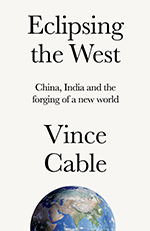
In Eclipsing the West: China, India and the Forging of a New World, former UK Secretary of State for Business Innovation and Skills, Vince Cable, now a Visiting Professor at the London School of Economics, makes a convincing argument for how the world will look by the middle of the twenty-first century. Centring China and India’s economic performance, Cable updates the old metaphor of a Chinese hare and an Indian tortoise by describing the hare’s new limp while the tortoise now gallops. In our imminent future, this means that we will have three ‘superstates’ of unmatched economic, technological and military power where once we had only the US. Cable then issues a warning. He is less interested in the much-discussed ‘Thucydides Trap’, in which a declining hegemon (US) and a rising power (China) come to blows. Instead, we must worry about the ‘Kindleberger Trap’, in which a hegemon’s declining capacity to underwrite global goods such as free trade, security, nuclear arms control, and the environment is not offset by another actor.
The first half of the book compares China and India’s politics and economics. The first chapter elaborates the economic development of both in the post-war era, particularly since their dramatic reforms (under Deng Xiaoping in China in the late 70s and 80s, and a decade later in India under Manmohan Singh). Cable explains that the Chinese hare was fuelled by its export manufacturing strategy, while India’s tortoise was burdened by the failure to create employment. Furthermore, a very high domestic savings rate powered the investment driving China’s development, and it also enjoyed very high productivity levels. Chapter two argues that China and India have versions of ‘state capitalism’ with a complicated mix of private and public sectors. Tracing the history of liberalization in both, Cable considers ‘creative destruction’ and the varying ability to tolerate its social costs. While China’s early reform period was often ruthless, Xi Jinping is now far more cautious. And although India has not matched China’s earlier zeal, liberalizing trends continue. Infrastructure development was a key manifestation of state Capitalism in China, but it is India which now promises major returns on that front. Another decisive difference has been China’s far greater local autonomy in economic decision-making than of centralized India.
Chapter three argues that the binary lens of democracy versus autocracy barely captures the reality of India and China. Both are in a current phase of ‘strongman politics’ within an overall post-war arc that saw initial centralization and personality cult (under Nehru/Indira Gandhi and Mao), followed by a period of decentralization (post-Emergency in India and the Deng Xiaoping era), and a swing back to centralized power and charisma (Modi and Xi). The chapter suggests that while India has famous democratic principles, in many ways China’s government delivers better outcomes.
The final chapter of Part I considers current and future growth. Cable notes that debates on ‘peak China’ are intense and says that there is more consensus on India’s promising future. The chapter reviews key factors such as China and India’s demographics, apparently starkly bad and good respectively; it dissects the savings-investment-debt matrix in China and the vast overcapacity in housing and infrastructure. The risks within Xi Jinping’s solution to these woes, his focus in ‘New Productive Forces’ (meaning the manufacture of frontier technologies), are well-discussed. Having detailed China’s productivity and prowess in science, the chapter shows that India is also developing on these fronts fast and may find it easier to realize its current potential.
Overall, Part II looks at the global implications of China and India’s relative rise. But the first chapter argues that the world has already fundamentally changed. Geopolitics is no longer the dominant frame by which policymakers understand the world. Instead, it has now become economic security, i.e., geoeconomics. Trump’s economic nationalism is the American consensus. China too is more wary of economic relations having defined the concept of ‘comprehensive national security’ in 2014. Trust has been further rocked by COVID and the Ukraine War. Paranoia and competition dominate. Barriers are imposed on technologies, threatened over scarce minerals and firms are held suspect. India sees opportunities but also suffers from this disruption. Many in the West assume that India will support it in this new era. But while Delhi’s security anxieties have also meant restrictions on economic ties with China, it has many shared interests with Beijing.
The following three chapters then consider the threats to vital global goods, and China and India’s centrality to these issues. The first global good is climate, and Cable outlines how both are embracing renewable power (China on a uniquely massive scale). Simultaneously, expansion of coal means they are not in line with targets necessary under UN modelling. The second global good is the world’s stable economic and trading environment. Despite benefitting from this, Delhi and Beijing are very critical of the under-representation of the Global South in bodies like the IMF and World Bank and the dominance of the US dollar. China’s muscle makes it far more active, and it has been issuing loans outside the IMF, resisting multilateral debt talks and promoting development through the Belt and Road Initiative. The third global good is a stable system of alliances and security.
As the West fractures, alternative state groupings become more salient. The BRICS formation is expanding numerically and in ambition. This and other formations like the Shanghai Cooperation Organisation are complicated however by India’s instinct for nonalignment and the real delicacy of China-Russia relations, inter alia. But it is India which best demonstrates the fallacy of portraying international relations as now defined by democratic and autocratic camps. A penultimate chapter analyses China-India relations specifically and labels them ‘frenemies’. Despite important shared interests in global reform, they are profoundly distrustful due to border dispute. China’s close relations with Pakistan and major presence across South Asia compounds the mistrust and gives India a motive for joining the US, Australia and Japan in the ‘Quad’, generally regarded as balancing China in the Indo-Pacific. Cable concludes by outlining three possible future scenarios in which China and India enjoy parity with the US. First, a global West, backed by a rapidly developing India, standing against a stalling China. Second, a world of multiple power centres which could see China, India and US competition undermine arms control, the environment and global security. Third, and most likely, a major catastrophe (a pandemic, environmental disaster, war) occurs due to the Kindleberger Trap, but then a new order is built up.
The book has many strengths. It dissects simplistic binaries, most notably democracy and autocracy, highlighting the real strengths of Chinese governance over India. India’s demographic ‘dividend’ is carefully qualified: without unprecedented growth in employment the dividend will be a huge burden, and India also needs to tackle the low level of female labour participation. Cable also repeatedly mentions one route out of China’s economic doldrums: hukou reform; giving rural Chinese access to urban rights might generate a new wave cycle of growth. Cable also makes a potentially unpopular point that the current dire state of Sino-Indian relations might not only be about a more aggressive China; it is possible that Beijing has also perceived India to have been more aggressive. Finally, challenging the assumption that India will be the US’s counterweight to Xi’s China, it is clear that shared interests may see China and India patch things up. Of course, since the book was written, Donald Trump’s India tariffs and other moves have done huge damage to India’s attitude to America.
The book does leave me with further questions. The legacy of the Mao period for later growth might be probed further. Cable notes that China’s decades of growth produced social progress, but in mentioning education, land reform and other things, I wondered how far such social factors might have actually contributed to China’s economic miracle. Amartya Sen, for one, argued for the causal importance of these social factors for China’s better economic record. Furthermore, characterization of the Mao era as ‘centralized’ oversimplifies a turbulent period: the Cultural Revolution was in some ways a radical experiment in decentralization.
A major pillar of the book is the argument that we are now in an age of geoeconomics and not geopolitics. But has economics not been seen as an integral part of security for many decades, if not longer? The Marshall Plan, preferential support for Japan, the trade embargo on the PRC in 1950, and sanctions on revolutionary Iran are all examples of US economic power serving its security and strategic posture. In addition, you do not need to be a radical critic of US foreign relations to point out how far the liberal order serves US power, and how selectively the US has adhered to many norms and rules. And finally on China’s current economic predicament, I wanted to know more about Xi Jinping’s strategy for focusing on ‘New Productive Forces’. Many foreign economists have long discussed how China must rebalance its economy by boosting domestic consumption. Cable very usefully explains Beijing’s aversion to building up a welfare system as one reason why the consumption strategy is avoided. But I want to know more about Xi’s surprising approach, given that it is a strategy still dependent on investment and exports in a world now much changed.
Anton Harder teaches International History at the London School of Economics. He is currently completing a book on Sino-Indian relations in the early Cold War.