
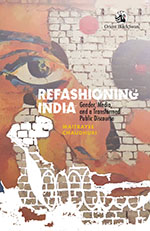
Refashioning India: Gender, Media, and a Transformed Public Discourse, first published in 2017 by Orient BlackSwan, was released in a second edition with an epilogue in 2026. The book explores the multiple transformations of India’s public discourse where the state, market, and media play a significant role from the early 1990s through the next two decades, up to mid-2017. Through an analysis of media texts and narratives in post-liberalized India, gender is the common trope through which the shifts are discussed in eleven chapters (including the Introduction).
The book offers a lens to understand the way media constructs a gendered Indian identity in a neo-liberal India. Ideas of gender are an integral part of this transforming public discourse. The Indian nation-state envisions the role of women in three primary ways: women as agents and recipients of development, women’s political participation as equal citizens, and women as symbols of national culture. Questions of culture and community identity have been central to the way in which the women’s question has emerged in India. Be it issues such as sati, personal laws related to marriage, domestic violence, questions of honour, etc., images of ideal women are created and recreated. Using examples of the 1985 case of Shah Bano and the 1987 instance of Roop Kanwar, Chaudhuri asks the question about who gets to speak about the culture of a community. Indian womanhood has been closely tied to questions of honour and tradition. In fact, they continue to remain relevant even today, as illustrated by the cases of Sonam Raghuvanshi, Nikki Bhati, Twisha Sharma and many others. Women’s issues represent broader ideas about nationalism, community and honour. The media plays a crucial role in this through its different portrayals of women.
The author focuses on the fashioning and refashioning of the Indian identity and its relationship with gender by emphasizing media discourses. Print media advertisements and new-look newspapers with colourful commercial add-ons were the highlight of the 1990s. In the 2000s, it was television. The 2010s saw the rise of new media and social media platforms. The modern public discourse can be understood through the presentation of the nation’s self, its identity and image through media texts. In the process of this identity construction, gender acquires new meanings. It becomes a pervasive presence and is critically intertwined in complex ways with the recasting of India. The Indian media plays a key role in this process of recasting. Gender is visible, but not in the way the Indian women’s movement had raised women’s issues. A separation is drawn between the two.
As Chaudhuri shows in chapters four (‘Gender and Advertisements: The Rhetoric of Globalisation’) and five (‘Feminism in Print Media’), advertisements in the English print media in the 1990s portray a specific Indian identity. Ideas of individual achievement and pleasure take centre stage in a neoliberal India. The shift in the Indian state’s economic policy in favour of globalization was accompanied by a shift in public discourse through the media. The new Indian is global and cosmopolitan (p. 90). Luxurious goods like Mercedes cars play a critical role in constructing this new identity. The Indian woman is presented as a combination of tradition and modernity. Women are portrayed as excellent mothers who can cook well, take care of their family’s health, and at the same time also excel in their work outside the home. Images of the men, on the other hand, became more conspicuous with power and success. Liberalization has heralded a new effort to make the Indian male more like a ‘man’, and less the ‘native slob’ (p. 94).
There was a vision of freedom for the new generation of Indian women and men, as chapters eight (‘The Indian Media and its Transformed Public’) and nine (‘Gender, Media and Popular Culture in a Global India’) highlight. In this process, two popular versions of feminism were promoted in print media: a feminism of choice and a more traditional feminism. In the 1990s, there was explicit use of the term ‘feminism’ in the media. In this process, concepts like autonomy, freedom, and choice began to be associated with feminism, while women’s activism was seen as an imposition. An example is the way International Women’s Day is celebrated. Generally, this day is marked by women’s organizations that align themselves with progressive forces. But, in the 1990s, one can see that there was a hijacking of Women’s Day. Feminism was associated with discounts and free goodies, and consumption became central to its meaning. The media promoted a notion of feminism which is market-friendly. The representation of feminism as choice and corporate feminism can be juxtaposed against a ‘true Indian feminism’. This true Indian or traditional feminism meant that women did their gendered roles without any complaint. These women were the ‘real feminists’ who not only worked outside but also inside the home. In the contemporary context, the rise of digital content related to ‘tradwives’ is seen as a choice which ‘real feminists’ are making.
The author emphasizes how the media plays a critical role in constructing the different meanings of feminism. With the television boom, the Indian media universe was also transformed. Women became hyper-visible in contemporary Indian popular culture. For instance, one can see the different meanings of feminism juxtaposed against each other as netizens debate the parallels between dowry and alimony. Today, it is not just in the print or electronic media, but also digital media, where these contestations are taking place. Women are allowed to be empowered as long as they fulfil societal gendered expectations. In 2024, Prachi Nigam, a class 10 UP board topper, was trolled online for her facial hair, proving this. Since she did not look ‘feminine’ enough, the focus was on her appearance rather than her accomplishments.
In the epilogue, Chaudhuri makes some remarks about the evolving relationships between gender and authoritarianism in neoliberal states. Gender is weaponized by states to promote their ideological interests. The media has played a crucial role in its apparatus of publicity, communication, and management in ‘refashioning India’, its ‘public discourse’, and ‘gender’ (p. 265).
The continued contemporary relevance of the book lies in the ongoing refashioning of the Indian identity with its continuous intersections with gender and media discourses. It can be of interest to policymakers, students and scholars of various disciplines, including Sociology, Cultural Studies, Gender Studies, Media Studies, Political Science and Anthropology. It is one of the first works in the ambit of Sociology of Media which brings together historical and contemporary debates. In fact, with the increasing popularity and visibility of different forms of digital media, the book offers a template to understand the intersections between state, market, and media in recent times.
Rituparna Patgiri teaches Sociology at the Indian Institute of Technology (IIT) Guwahati, Guwahati.