
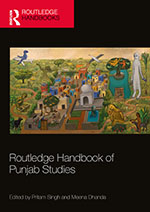
The Handbook edited by two Punjabi Sikh academics settled abroad contains essays written by scholars from all over the world, and not only of Punjabi descent, giving the volume a ‘global’ character, offering readers also an ‘outsider’ viewpoint. Also, the majority of the contributors, including those from Punjab, are based overseas.
The essays in the volume cover a wide range of topics, including literature and art; political economy of development; issues facing the Punjabi diaspora, including women, who are still burdened by inherited patriarchy; movement politics, religion, race, caste, and gender; and Partition and its aftermath. The essays also cover recent events and developments such as the 2020 Farmers’ Movement. Significantly, the Handbook has a whole section of essays that examine the lived experiences of the Punjabi diaspora settled in the West, including women and second or third generation youth. The variety of themes mean that the contributing authors come from a variety of disciplines, saving readers from stereotyped discipline-specific knowledge and jargon.
In his essay, Tan Tai Yong describes how Sikh leaders requested a territorial homeland for the Sikhs due to the impending Partition. The Akalis responded favourably to Nehru’s promise that they would have a ‘place of their own’ in independent India following fruitless talks with Jinnah. Although religion was always a major factor, the assurance was fulfilled when Punjab became the final Indian State to be reorganized on the basis of language. It granted the Sikh community some ‘limited self-governance and cultural autonomy’. In addition to the secular politics of the Congress and the community-based politics of the Akali Dal and the Muslim League, revolutionary socialist politics also had an impact on colonial Punjab. In contrast to the Unionist Party, which was backed by landed peasantry, the Communist Party had a notable presence in colonial Punjab. The Communist Party, Bhagwan Josh argues, was supported by small farmers. The Party continued to play a leading role in social movements and maintained its electoral influence until the 1980s, even after Partition. The decline in Left politics only occurred during militancy. Nonetheless, it is still present in the State’s intellectual heritage.
Radhika Chopra argues that Sikh disaffection with the Indian state was caused by a number of factors, including the dithering on the creation of a Punjabi Suba, the excessive delay in accepting the demand that Punjabi in Gurmukhi script be recognized as the State language, and the submergence of the Sikh ethnic identity within broader Hindu identity under Article 25. The Central Government’s persistent meddling in State affairs under Indira Gandhi’s leadership, the dismissal of the Akali-Janata Party Government, the refusal to return Chandigarh to the State, and the repression of the peaceful Dharam Yudh Morcha, all contributed to the rise of Sikh militancy in the 80s. Chopra highlights the State’s violations of human rights as the security agencies employed coercive tactics to quell militancy. Many of the Sikh youth who sought refuge abroad during the period later developed sympathies for the separatist cause. Shruti Devgan examines the diaspora community’s attempt to digitally create, reconstruct, and revive the horrific memory of the anti-Sikh violence in order to subvert the Indian state’s attempt to erase the hurtful memories of the anti-Sikh pogrom in 1984, preceded by Operation Blue Star and ask the Sikhs to ‘move on’. Dipin Kaur discusses militancy and the Indian state’s attempts to quell it, conceptualizing what she refers to as the ‘Punjab model’ of counterinsurgency. She contends that the Centre used the Punjab police, which is made up mainly of Sikh personnel, when the insurgents were on the defensive because of the lack of support from the local populace, while non-Sikh security forces personnel were used during the height of the insurgency. While the state was able to create the impression that they were there to protect their fellow ethnic groups from insurgents during the later stage, which involved the co-ethnics manning the security agencies in anti-insurgency operations, the first stage saw outright repression.
Punjab politics was bipolar for a long time after the Partition, with the Congress and the Akali Dal as the two main Parties, the latter in coalition. The other important Parties were the Jana Sangh and the Communist Party. Pramod Kumar claims that because of the competition and alliance between political organizations that represented Sikhs and Hindus, religious identity played a significant role in Punjabi politics for a considerable amount of time. The Akali Dal-BJP (previously Jana Sangh) electoral alliance, according to him, is a ‘competition-versus-coexistence’ political strategy. The alliance assisted both Parties in achieving their electoral objectives because of their complementary bases of community support. However, the Congress, which had previously formed a brief alliance with the CPI in the 1990s, remained a viable party on its own due to its base of support among both Sikhs and Hindus. Due to their differing positions on contentious farm bills, the long-standing Akali Dal-BJP alliance broke up, causing significant political realignments in State politics. The Akali Dal has been losing its core Sikh support base as a result of the Party’s inability to deal with sacrilegious incidents, charges of hanging out with Deras, and the purported involvement of Akali leadership in drug promotion. The attempt to undermine the independence of the SGPC and the Akal Takht, the two cornerstones of Sikh politics, also irritates the Sikh psyche. Kumar cites the major parties’ appropriation of the community elites as the reason why there aren’t many Dalits in leadership roles in Punjab politics, despite making up one-third of the State’s population.
Christine Moliner investigates the understudied impact of Hindutva politics on Sikh-majority Punjab. She traces the origins of religion-based politics back to colonial Punjab. Sikhs are seen as the sword arm of Hinduism and a part of the larger Hindu community by proponents of Hindutva, who are essentially members of the upper caste groups, such as Brahmins, Khatris/Aroras, and Banias. Sikhs, however, encounter mistrust and even animosity whenever they try to claim their distinct religious identity. She alludes to this duality by mentioning how Hindutva supporters labelled the Farmer’s Movement as an expression of Sikh separatism. Jasdeep Singh views the Farmers’ Movement as the ‘most remarkable socio-economic event’ in 21st-century India because of its ability to unleash mass energies and creativity on a scale never seen before in the greater Punjab region. The farm bills, which sought to restructure agricultural marketing and allow market forces to take over, were successfully withdrawn, a rare backdown for the Modi Government. Singh specifically alludes to a newsletter called Trolley Times, which was published in several Indian languages and distributed throughout the world. It reported on the problems faced by farmers and their methods of protest, documenting the events with photos, poetry, songs, and letters from supporters from all over the world.
The assertion of Dalits is taken up for discussion by Santosh K Singh and Mark Juergensmeyer. Their essays provide a brief synopsis of the lengthy history of Dalit resistance against the discriminatory social and economic practices based on caste that have been fundamental to Hinduism. The rise of Sikhism and the pervasive influence of Arya Samaj in the early twentieth century are mentioned, both of which opposed discrimination based on caste. Mangoo Ram, a Dalit, founded Ad Dharm with the dual goals of securing separate political representation for the large Dalit community and searching for an alternative religion. Untouchability mostly disappeared from Punjab as a result of these progressive currents, but prejudice persisted. Deras, including Dalit Deras, have surfaced recently, as markers of Dalit cultural assertion.
An essay on the State’s political parties—particularly about the Akali Dal and the other two pillars of Sikh politics, i.e., the SGPC and the Akal Takht—would have contributed to the value of the Handbook. Also, an essay on how music and song lyrics have evolved into forms of cultural assertion, particularly for the substantial Dalit community in recent Punjab, could also have been included in the section on ‘cultural repositioning’. Additionally, the issues pertaining to the expanding migrant population—which primarily consists of farm labourers and semi-skilled technical workers—could have been covered. Pritam Singh and Meena Dhanda, the editors, have done a commendable job of bringing together such a remarkable group of scholars, and also selecting the themes carefully and organizing them logically.
Ashutosh Kumar is with the Department of Political Science, Panjab University, Chandigarh.