
A memoir, a journal, an ode, a requiem, a nature-lover’s and writer’s confession, an essayistic meditation in twelve parts, a document of monumental power, a verbal artefact of anecdote, narrative and comment organically interwoven, an artist’s book—this elegantly home-grown, hill-hugging work of scintillating prose is all this and more. At the heart of its patiently acquired progression lies a contemplative, observant stillness making its way through remembrances sweet and melancholy. You can hear in this stillness the natural rhythms of lives lived spontaneously. ‘Everything happens in its own time. Flowers bloom in their own time. And half of them will die.’ This gift of unsolicited counsel from a woman native to the hills distills the guiding wisdom of a whole way of life. The book is, among other things, an attempt to fathom the depths of this wisdom.
The birds have vanished down the sky.
Now the last cloud drains away.
We sit together, the mountain and me,
until only the mountain remains.
The epigraph from Li Bai affirms the glory of mortality as a chance to taste in transience, its very opposite. For Anuradha Roy, the chance offers itself in and around a reclaimed lodging on the edge of the small, sleepy town of Ranikhet facing the sublime Himalayas. This is a place where ‘the air changes to champagne’.
Anuradha Roy and Rukun Advani, her partner, retreated to this place from the crowded, breathless Delhi a quarter century ago. Slowly, life rearranged itself to the new reality of uncharted spaces and ‘more elastic’ time. The stiff, draining binaries of work and leisure, wilderness and garden, music and birdsong, people and dogs, obscurity and fame, living and dying unravelled themselves, came undone. A deep sense of freedom, suffused with tranquility and joy, flowed in, smiling at the everyday challenges of adjusting to slowness, interruptions and limited choices.
If style is a writer’s presence in the writing, Roy’s state of mind in the remote habitation surrounded by a meagre community can be glimpsed in the state of her prose. You meet ‘a melancholy buffalo’, see ‘crestfallen faces’, peep into her ‘dog-eared room’, admire ‘a watermelon-red floor of the old kind, cool and shiny’, and are introduced to a dog who is ‘the Gregory Peck of the canine world’. This is quietly celebratory prose meticulously penned in honour of every moment of life lived in freedom from idle distinctions of surface and depth. This same logic explains why people don’t rule this book but share a common space with plants, wild animals, dogs, birds, books, insects, plants, stones and flowers. So this is more than a humane book; it is a profoundly natural work. ‘For the unreligious, the divine is closer. We can see it sometimes, just outside the window,’ Roy writes. Revelation happens; you just need to unshutter your senses and let them see.
And though Roy’s seeing is unclouded by moral posturing, she does drop once in a while the tickling grass blade of humour (her darling weapon) to explode in withering rage over greed and corruption.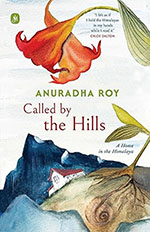
 And she can be subtly piercing: ‘Wild animals don’t believe in long goodbyes: they disappear without a rustle of leaves.’
Against the cruel apathy and connivance of those who would ruin the great mountains to extract their Himalayan ‘resources’ stands the self-effacing work of those who have spent their lives to understand, admire and guard these mountains and their lifeworlds. You are astonished by the dedication and perseverance of Durga C Kala, Chandi Prasad, Shekhar Pathak, Bill Aitken and others, as Roy narrates her encounters with them with her finest acquirements as a novelist.
How does she write? What does she do when she is not writing? How does she feel about writing? A kind of conversation runs through the book until you reach the penultimate chapter, ‘Gently Sideways’. Roy speaks of immersion in the work and social distancing. The completion of a book is followed by moving ‘gently sideways’—a term she borrows from Johnny Depp to describe a condition ‘between inertia, contentment, restlessness and self-doubt’. In her case, this accompanies long walks.
Writing lives in the half-lit zone between faith and incertitude. Should it slide either way fully, it dies. Roy voices this twilit awareness with blazing candour, and goes on to say: ‘I still feel fraudulent when I fill in “writer” in the box next to Occupation.’ The nuanced implications of the confession are obliquely invoked in her admiration for Geoff Dyer’s mixing of ‘unseriousness with profundity’.
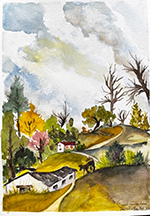
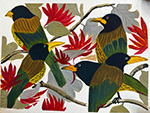
Roy is not a ‘trained’ painter. She is an extraordinary, stunning painter. The book has a number of her water colours, pastels and sketches that you come upon with the wonder-touched delights of a traveller in the mountains. To add to this, the back cover has a pocket in which picture postcards of five of these works of Roy’s art are stashed. My review copy yielded five cards. A real Himalayan generosity to cherish and share.
Critic, essayist and translator, Rajesh Sharma writes in English, Punjabi and Hindi. He has published eleven books. He taught literature in Punjabi University, Patiala.