
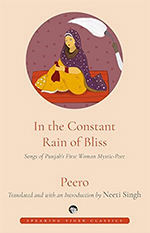
The pantheon of bhakti poetry, which was hitherto limited only to a handful of women poets—namely, Mira, Andal, Akkamahadevi, and Lal Ded—is now expanding exponentially. The women poets who suffered obscurity due to the gendered nature of history and historiography have been discovered and brought into critical limelight through fieldwork, translation, and exegetical annotations. The major initiative in this direction was taken by Arundhathi Subramaniam, who brought out an edited volume, Wild Women, in which the number of women bhakti poets swells to more than fifty. Peero also figures in this book, but with very few verses, translated by Neeti Singh, to support her as a bhakti poet of the Gulabdasi sect. In her book under review, Neeti Singh gives her project a thorough shape as she translates more than 100 verses of the poet across various region-specific genres, viz., Siharfi, Kafi, Baaran Maha, Hori songs and Paintee Akhar.
Right at the beginning, before the formal introduction, Neeti Singh retells the story of ‘Peero Love’ rather creatively in a lyrical prose piece written with exceptional emotional intensity. It lends the book a very dramatic kickstart. Mixing registers of hagiography, history and biography in one torrent of possessive emotion, the writer-translator steps into the inner recesses of Peero, creating in the process her own ‘Peero’. In the subsequent formal extended ‘Introduction’, Peero is heralded as the first Punjabi woman poet, a title which, for the time being, may hold. Still, if the maturity of her verses is any yardstick, it is difficult to believe that she did not have able, woman poet predecessors. Neeti Singh refers to efforts by scholars, historians, and literary critics to compile her verses from scattered sources. But it is for the first time that her verses have been translated into English with such singular attention and sense of ownership.
Neeti Singh approaches Peero as her intimate companion, a part of her questioning and questing self. She does not choose Peero as her subject for translation; rather, it is Peero who chooses Neeti as her translator. And it is this inner compulsive pull that pulses through the book, not even once allowing the reader to cross-check the fidelity or veracity of the translation. The translated verses are protest prayers, love songs, clarion calls and sacred hymns, all in one go, making Peero a poet of myriad moods. Reading Peero in modern idiom, and that too in an alien medium, can be very frustrating. To retain the raciness of Peero’s plunge into the infinite, the translator harnesses all her literary skills to strike affective resonances; she coins hyphenated words, employs alliterated adjectives, and, more significantly, leaves culture-specific words untranslated, unapologetically.
The occasional near-rhymes— ‘mournful door’/‘Mehboob’s threshold’, ‘wealth accrue’/‘pleasures crude’, and ‘Ram’s jharokha’/‘the whole world’—juxtapose the material-spiritual dialectics very strategically. The double-scopic hyphenated words—‘truth-trees’, ‘cot-centre’, ‘Name-opium’, ‘illusion-cloth’, ‘heart-cave’, etc. —conflate difficult conceptual categories. The alliterative expressions—such as ‘The path is stiff, /steep as the steps to a scaffold!’ or ‘In swamps swims the earthly soul’—flow effortlessly as audio-visual tropes to modulate the movement of the self-in-flight. The imagery is predominantly abstract, but the use of alliterative adjectives adds nuance and palpability to the message. However, in a few places, the translator overstretches to alliterate.
The selected verses amply showcase Peero’s experiences of a kanjari (harlot) turned and transformed into a mystic. But what is surprising is the relative absence of erotic register in her poetry. The erotic is suggested but is never articulated in unbridled terms. In her meta-textual interventions in the form of an ‘Introduction’ and ‘Afterword’, Neeti Singh goes on to establish Peero as a poet of modernist transgressions, but the verses included in the book foreground her spiritualist surrender more: ‘Peero, go merge/ in Rabb’. The carnal and the carnivalesque, which are otherwise typical aspects of the poetry of the divine feminine, remain largely under-represented. In the Hori songs, ‘rasa-raga overflows’, but it is the ‘shyness’ that engulfs her. Also in the Hori songs, Peero does not enjoy autonomy or agency of self; she is just a player in ‘the opera of celebration/ scripted and directed by Das Gulab’. Mata Peero overtakes the lover Peero. The translator operates within the default rubric of the sacred inhibiting her from reinventing Peero for a contemporary reader.
From the perspective of Punjabi literary history, the arrival of Peero Preman plugs the gap in understanding the contours of Punjabi feminism, traced as it is, rather spasmodically, from the rebellious qissa heroine Heer down to the Partition poet Amrita Pritam.
Akshaya Kumar is Professor, Department of English and Cultural Studies, Panjab University, Chandigarh.