
The State of Mizoram seems to have made its presence felt on social media. Its practice of cleanliness, disciplined traffic and the generalized policy of no-honking is the subject of several Instagram reels. Perhaps what remains unknown is that the State boasts of one of the highest literacy rates in India or that the Tropic of Cancer runs through it. Mizoram also happens to be the State where an unprecedented bombing by the Indian Air Force of its own people was carried out in Aizawl in 1966 under the orders of the then Prime Minister Indira Gandhi to quell the insurgency led by the Mizo National Front.
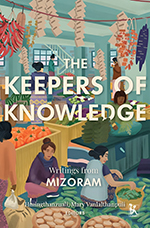
Development of writing from the Northeast of India has been uneven since the time of colonial modernity and while the impact of British colonialism was felt across literatures in various parts of India, in the Northeast, especially in States such as Mizoram, it was responsible for the very introduction of the written script and thus brought about a shift from an oral to a written tradition of literature. Such a shift was significant in paving the way for the preservation of literature of this region for future generations, but this transition also resulted in the loss and erasure of certain oral traditions. Given that orality, historically, has been the preserve of women, Zubaan’s The Keepers of Knowledge: Writings from Mizoram is an important step in the direction of recovering women’s voices from the State and in levelling the gap that persists between writing from this State and those from some other parts of the Northeast.
One of the things that drew my appreciation immediately was the organizing of the content into sections of essays, translations, stories, a section on visual art and so on as it makes the reading experience less confusing for the readers, especially when most are anyway foraying into an unknown territory. The first few essays focus on women’s fashion in Mizoram, early Mizo songs, the gender imbalance in the production and consumption of food, folklore and trailblazing women such as Nuchhungi Renthlei who became the first Mizo to document Mizo folktales in the Serkawn Graded Readers, a reader that has enabled young schoolgoers to become familiar with their own cultural past. The pursuit of this cultural materialist approach is indicative of a growing interest amongst Mizo scholars in both tracing shifts in their culture and understanding how these changes have shaped their identity or influenced their relationship with tradition. What becomes evident from their study is that women’s contributions have been marginalized but, ironically, women are also burdened with the expectation of preserving and continuing traditions.
Much has been written and critiqued about the missionaries’ proselytizing attempts that were in tandem with British colonizer’s political ambitions. The essay titled ‘Women and the Medical Mission in the Colonial Lushai Hills’ by Lalramnghaki Ralte brings to the foreground the use of medicine as a hegemonizing tool, wherein treatment meted out to locals was seen as a means of persuading them to convert to Christianity. Interestingly, the essay also reveals the subversion of such an attempt: the training in nursing that women from the region thus received actually equipped them to deal with basic medical issues independent of help from the missionaries.
Preoccupation with gender and gender issues are predominant concerns of this collection and is reflected in two important essays. One of them looks at the gendered body but through the bodies and perspective of women who have battled cancer, hair loss and mastectomies, and have had to struggle with normative standards of beauty at the same time. The other essay on building a more gender-inclusive society reaffirms the growth of LGBTQ writing in the Northeast but this one examines them through the disturbing lens of discrimination in a predominantly Christian State where such orientations are seen as a sin and those practicing them are viewed as agents that spread HIV and AIDS.
The poems draw on a variety of themes but predominant amongst them as illustrated in ‘The Urban Mizo Girl’s Problem’ is a mapping of distance between the rural and the urban inhabitants, those who live in Mizoram and those who have moved away from home and thus the difference of experience. Such a lens is enlightening as it reflects on the privilege of those who are ‘Happy to be home, but glad to leave too’, and is self-reflexive about representation and a flattening of the Mizo experience. However, the poems that stay with you are those such as ‘Taking it Well’ and ‘A Mother’s Regret’ that examine grief and the expression of it. This dwelling on grief and its manifestation continues to linger on in the stories and the narratives too, with stories such as Hannah Lalhlanpuii’s ‘Holding On’ poignantly evoking the societal yardsticks used to measure grief, especially a woman’s grief, even as she struggles with the practical realities of living with loss. Then there are stories such as ‘The Weight’ that examines the trauma that many sexually assaulted women are compelled to live with, but whose weight they are rarely able to shed.
Many of the narratives also make a resolute attempt at retrieving the past, in narratives such as ‘My Grandmother: Her story’ or through a very interesting strategy of weaving old Mizo folktales into a story and thereby stitching together the past and the present. While some of the narratives touch upon the tumultuous decades of insurgency in Mizoram, known as the Rambuai period, surprisingly, none of the fiction dwells extensively on those days or the ‘mautam’ that led to it. Amongst the translations this collection carries, ‘Long Leave Without Pay’ written by C Lalthlamuani who joined the underground movement during the Rambuai period is perhaps the most noteworthy, shedding light on the dangers those who were part of this movement had to negotiate daily.
The section that I found most enriching were the research papers written by the editors of this anthology. Hmingthanzuali’s essay on the prison writings of B Vanlalzari, the only convicted female prisoner who was sentenced to life imprisonment during Rambuai, is significant in dispelling through Vanlalzari’s memoirs many widely held ‘truths’ about sexual promiscuity and loose character that female prisoners had to fend off even as gender stereotyping dogged them even in their darkest hours.
Mary Vanlalthanpuii’s essay draws upon feminist scholarship that notes how women’s experiences even during insurgency continue to be gendered ones and thus writes about the women volunteers of the Mizo National Front who had been rendered invisible by history. In fact, this conscious marginalization of women, while drawing on their support by insurgent movements who claim to fight on behalf of those oppressed, is deeply ironical and analogous to the experience of women insurgents of the United Liberation Front of Assam who felt trapped between the state and an exploitative organization.
The deep-rooted misogyny that runs through Mizo society could be retraced to disparaging proverbs such as ‘The wisdom of women does not reach beyond the village stream.’ Therefore, the very act of women writing should be seen as an act of resistance, an act highlighted by narratives such as ‘I Have to Write: 28 February’. However, it also translates into resistance of a subdued nature and writing whose content and quality might be rather ordinary in places. One gets the sense of a writing that is still trying to find its voice, one that is a bit tentative about the stories it should tell and how they should be told. This results in a collection that is uneven with certain poems and stories, unfortunately, not offering much to chew on, or a few that are too universal and therefore do not provide readers with a sense of what is unique to a Mizo tradition of women’s writing. But the sheer volume of writing that one comes across in this collection holds the promise of a great future for women’s writings from Mizoram.
Shibani Phukan is Associate Professor, Department of English, ARSD College, University of Delhi, Delhi.