
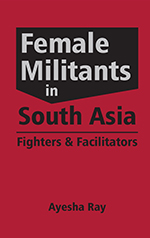
The desire of the discipline of international relations to be perceived as ‘gender-neutral’ produced the image of women being hidden from the stage of world politics (hence, the popular question: ‘Where are the women?’). IR scholars viewed gender as an intra-national problem, and continued their unwavering focus on the ‘high’ politics of war. The voice of women may have been pushed to the margins of the discipline, but their issues continued to remain clearly visible. South Asia, a deeply patriarchal society, has had the largest number of female leaders; the United States of America may never have had a female President but India, Pakistan and Bangladesh have had a female leader of the state. The book applies the feminist lens to explore the role of female militants in the tumultuous region of South Asia vis-à-vis the dynamics of religion, nationalism and violence.
Ayesha Ray’s book explores the motivations driving females to join terror groups and participate in acts of violence. The book focuses on their experiences and chooses five countries from the region of South Asia: India, Pakistan, Nepal, Bangladesh and Sri Lanka. Each chapter is based on a case study of insurgencies in these countries and explores the themes of why their women rebelled, and how they contributed to these movements. Ray categorizes female combatants into three broad categories whose functions may often overlap: fighters, facilitators, and tacit supporters (p. 132). Tacit supporters are hard to identify, and remain an underexamined category: they are neither militants nor members of such an organization, but they encourage and champion the groups’ ideological goals through familial networks and social media platforms, among others (pp. 132-133).
The study discusses the two central discourses employed in framing the general female insurgent narrative: the critical feminist theory and the traditional security approaches; and applies the latter as its central theoretical framework (p. 11). The study has conducted interviews and referred to the autobiographies of former female combatants to supplement its findings. Additionally, comparative analysis has been employed as a method of inquiry, in its last chapter, to map the differences and similarities between the experiences of female insurgents based within and outside of South Asia.
Over 60 per cent of armed rebel groups see active female participation; yet the female militants are taken less seriously than men (p. 1). The latter are portrayed as a homogeneous group stripped of agency, and playing supportive rather than active roles that occupy diverse operational, combat, and leadership roles within insurgent organizations. While analysing a major literature gap in the field regarding the motivations and the rationale for women in joining militant groups, the study has a tendency to return to its central argument: ideology is the main driving force that unites most female combatants across a variety of movements (p. 6). For instance, women might be attracted to the opportunity of fighting state repression and pursuing their emancipation (often guided by their lack of representation, resentment and grief due to the violation of their human rights by the state); this, however, does not explain why women subjected to similar forms of repression and structural discrimination in other contexts do not make comparable choices. This suggests that grievances alone are insufficient to account for female participation in armed insurgencies and must be examined in the context of its organizational and ideational factors. Ray concludes that grievances and repression do not directly produce violence; however, they do make women more susceptible to joining ideological movements that offer them emancipation or a higher sense of purpose (p. 12).
Ray states that the incentives driving the rapidly growing female membership of these militias are different for Islamic militant outfits vis-à-vis the Left-Wing guerrilla movements. This argument is a running theme which Ray unpacks in the subsequent chapters. Her case study designs for Bangladesh and Pakistan represent women’s participation in Islamic militancy, while India, Nepal, and Sri Lanka are run as test cases for their participation in the guerrilla movements (p. 10). As noted in her second chapter, ‘Revolutionary Fighters and Islamic Militants in India’, Ray investigates the ethnonationalist movements in the Northeast, the case of Maoist female revolutionaries, and the category of female militants driven by the religious ideology of Islam, Hinduism and Sikhism. Ray contends that the increase in extremist views among deeply conservative Hindu women, and the type of violent roles they are likely to play in the Hindu radical groups are subjects in dire need of more research (p. 31, p. 34).
The female militants in India wield considerable influence on their groups’ activities as spouses of the male members. Marriage to a fellow fighter brings greater visibility and a means for upward mobility for these women (p. 34). The quest for political liberation in the Northeast led the female insurgents to play the role of a facilitator. They mobilized the masses on issues of socioeconomic exploitation, facilitated the logistics, and trained the new recruits and taught them the teachings of Mao, Lenin and Che (p. 19). The female insurgents were not allowed to fight; most strategic decisions were made by men (p. 20). The Maoist women, in contrast, were trained to be combatants. The idea of gender equality attracted them to the cause; they managed various social awareness campaigns against forced marriages, domestic violence, and police brutality. Ironically, the female Maoist guerrilla fighters remained vulnerable to abuse
and sexual harassment at the hands of their male comrades (p. 24).
Ray’s next chapter, ‘Seeking Martyrdom and Liberation in Pakistan’, highlights the extensive body of evidence on the recruitment of women into militant organizations in Pakistan. The chapter underscores the significance of these cases to assess the state of female suicide bombers in the broader South Asian context (p. 39). It raises the question of what attracts Pakistani women to suicide bombing, whether they exercise any specific agency in dying for a cause or do they just play the role of tactical assets to help gain publicity (pp. 54-55). Militancy in Pakistan is intrinsic to the state and its politics and stems from a variety of factors ranging from geopolitics of the Cold War era to the violence caused by the sectarian Sunni-Shia divide. In this scenario, ideology serves as a unifying force that connects diverse militant movements, drawing legitimacy and support from narratives reinforced through the state policies, educational curricula, political discourse, and the manner in which Pakistan has historically constructed and projected its national identity (p. 40). Ray makes an interesting observation: Islamic militant movements are increasingly recruiting female combatants despite previously having condemned such roles for women. This finding supports Ray’s choice of theoretical framework wherein the strategic contributions of female fighters outweigh the societal maintenance of the traditional gender norms.
Ray continues this analysis in her case study of Bangladesh, as she unpacks whether the Bangladeshi female militants fit the stereotype of a female jihadist, or if it offers an alternative lens to understand and analyse their profiles in these organizations (p. 109). These combatants have been documented as well-educated females from affluent families, making their profiles complex and multifaceted. She groups the motivations for these radical female recruits into three categories: the uniting factor of religious ideology, the narratives of victimhood, and a political choice made to liberate oneself from the patriarchal traditions. They were committed to the roles of recruiters, facilitators, fundraisers, and were even stationed as gatekeepers of patriarchy tasked with promoting gendered policies (p. 112). Like their Pakistani counterparts, these women were also part of several transnational networks that operate outside Bangladesh. Unfortunately, most women are groomed and forced to join militant outfits by their husbands, and are often recruited to fill gaps when the male combatants are jailed or killed in large numbers (p. 123).
Female Militants in South Asia traces the political achievements of non-militant females through the history of the subcontinent as well, providing a comprehensive account of the contributions of the native women. Ray’s account of the insurgency movements in Nepal and Sri Lanka reflects the involvement of female guerrilla fighters. Nepal witnessed a unique transition where its female guerrilla fighters accepted combat roles for the state’s security forces in its phase of political reintegration (p. 63). While the Maoist movement assigned them equal positions as their male counterparts, none of its female combatants were promoted to command a brigade during the conflict for the PLA (p. 71). This gap between ideology and ground reality was more evident when the negotiations with the government (2003) saw minimum female participation. Unlike the male rebels, the female insurgents were not valorized as heroic fighters, and instead faced triple rejections: by their family and community, the political parties, and the ruling government (p. 79). The lack of proper mainstream reintegration resulted in the vulnerability of the former militants to sexual violence committed by the Royal Nepalese Army (p. 76).
The study’s segment on the Tamil Tigers of Sri Lanka notes that the female members of the LTTE did not engage in an active combatant role till the mid-1980s (p. 88). The counter-insurgency operations and the entry of the Indian Peacekeeping Force in the conflict directed the training of female combatants. They joined the outfit with the agenda for the Tamil Eelam, abolition of discrimination based on caste and against the Tamil women, and securing equal political, social and economic rights for women while also aiming to protect them from increasing gender-based violence. Eventually, they gained experience in urban and rural guerrilla warfare, semi-conventional warfare, commando raids, assaulting military camps, clearing mines, and even dealing with anti-tank warfare (pp. 88-89). Like the case of Nepal, women who returned after war were stigmatized and ostracized by their community. The Sri Lankan Government came up with programmes like the 6+1 rehabilitation model to offer women safe spaces to reintegrate with society while also finding a sense of closure to the violence and trauma they encountered in their time as LTTE combatants.
The study’s concluding chapter, ‘Looking Beyond South Asia’, discusses a significant literature gap: of there being a substantial body of research on terrorist organizations in South Asia, while relatively few studies provide a comprehensive analysis focusing exclusively on women involved in these groups (p. 131). The chapter presents a comparative analysis of the ways the female combatants function in different settings across the region, and proceeds to discuss examples beyond South Asia as well. The central takeaway of this study has been to focus on preventing violent extremism (PVE) and countering violent extremism (CVE) among women and assess the probability of doing so successfully (p. 135). The study is a significant and much-needed contribution in the field as it sheds light on the vulnerability of women that motivates them to join these groups. Its emphasis is on identifying women as perpetrators (under the traditional security approaches) and advocates a more equitable system of prosecution in order for PVE to work effectively (p. 137). The tendency to dismiss women’s criminal intent as merely misguided or emotionally driven constitutes a significant gap in both policy and practice, and undermines the sense of accountability for one’s actions.
Reshmi Kazi is Professor, Department of Political Science, Jamia Millia Islamia, New Delhi.