
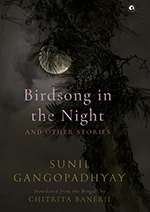
Sunil Gangopadhyay, although primarily known as a poet and novelist, has also written numerous short stories, children’s books, travelogues, and other nonfiction. The present volume under review brings together translation of a dozen of his short stories—stories that reflect many different aspects of the social, political, and cultural life of Bengal/Calcutta in the fascinating period of the 1970s. Discrete elements ground the stories at that time.
The twelve stories in this anthology do not fall within a specific genre. Some of them are based in the city itself that reflect the acute dissatisfaction and frustration of middle-class, educated people, whereas some stories unfold in landscapes far from the city, inhabited by rural and indigenous people. In the very first story ‘The Drought’ we are shown how eight reporters going from the city to report on a particular event for a company promotion are stranded midway in the Chhota Nagpur region when their car breaks down. They put up at a guest house, drink, and lazily while away their time talking and debating endlessly over different issues and have the best rice in that drought-stricken area for lunch. The debate about what they should do with the surplus food makes for interesting reading and the way in which a journalist is grappling with moral fatigue in a drought-stricken land leaves us awestruck. ‘Three Men’ is about a young man whose rebellion at work reveals the impossibility of human dignity within a corrupt system. After a man has been handed a show-cause letter to sack him from his job, Gangopadhyay interestingly narrates three versions of the incident by placing them side by side and shows how the story can be told differently.
A moving story ‘Last Rites’ tells us about the death of Subimal’s father who had fallen into the clutches of an antisocial gang, the members of which were his erstwhile students. When these members take the dead body to the crematorium, Subimal can’t light the pyre and asks the gang members to do so since they were like his children. In ‘Observed from Afar’ the writer protagonist is up in a small room on the terrace and watches things from a distance—a small slum boy killing a blackbird, a young woman who turned into a prostitute and a train accident; he makes all kinds of gestures by himself with no one to watch him.
Sunil Gangopadhyay loved to go to the jungle and several of his stories have the jungle as the background for his remarkable tales. In ‘The Fawn’ we see four people go to Netarhat bungalow and see four young local kids always staring at them. They ogle at their food but stay put with their silent wordless gaze. Later these children chase and kill a fawn with a bow and arrow, and roast it in a makeshift fire in the jungle. In ‘Alone in the Forest’ we find a man who runs away into the jungle after hitting a man. Later he is dejected and almost dying of hunger when he meets two political activists and saves one of their lives when he is bitten by a snake. It makes him feel relieved that he has saved a man’s life that day.
Another remarkable aspect of Gangopadhyay’s writing is the deep empathy expressed for women from different strata of society. For example, the story ‘Incognita’ is about how a doctor meets a prostitute one night on the street and brings her to his chamber to treat her for syphilis and she in return extracts money from him for her time. In ‘A Woman and Some Flowers’ we are on the streets with a man selling stolen flowers from the graveyard at traffic signals while a woman stands there for customers. Unsuccessful in earning sufficient money that evening, while they are on their way home, the man hands the woman a bunch of unsold roses. In ‘Suddenly, a Woman’ the protagonist Proshanto Dutta, the owner of a thriving leather business is stranded in front of a hut when his boat develops a fault. He is enamoured of the woman living in the hut and despite her poverty, tries to abduct her and then sends her back home. Curious to know what her fate would be, he is shocked to find her weeping in the arms of her husband who desperately tries to console her.
In ‘Dreaming of Tehran’, Manisha, an ordinary middle-class wife, bored with the drudgery of life, plans and dreams of going to Tehran and getting a job as a schoolteacher there; through this rather longish narrative the author tells us how those dreams are shattered. In the eponymous story ‘Birdsong in the Night’, young Bachkun, haunted by a horrific memory, is awakened in the dead of night by a mysterious birdsong; she then drifts into a profound meditation on sorrow, trauma, resilience, and the miracle of beauty arriving when least expected. As we read these stories, we tend to identify with these protagonists, however far they may be from our personal reality.
The translation done by Chitrita Banerji is excellent and eloquent. She had earlier translated Sunil Gangopadhyay’s novel Arjun. Her selection of twelve stories from the published four-volume anthology of the writer speaks of an eclectic choice where different perspectives of characters and locale prove once again how powerful a writer Sunil Gangopadhyay was. In each of the stories he brilliantly oscillates from the stark realities of drought and political unrest to the intimate worlds of women navigating love, loss and dignity. This is really a collector’s item.
Somdatta Mandal, critic and translator, is former Professor of English at Visva-Bharati, Santiniketan, West Bengal.