
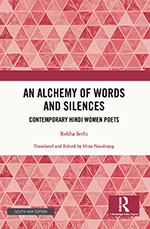
Contemporary women’s literature in Hindi is a rich repository of diverse experiences and expressions. The selected seven women poets in the volume under review give voice to multifarious concerns ranging from lower class, Dalit, Adivasi, city dwellers and village inhabitants to small town subjectivities. Feminist literary theory has also progressed beyond the simple binary of resisting patriarchy; it is rather an investigation into intersections of various fault lines in society along with the existence of multiple patriarchies. The author and translator present seven powerful voices in Hindi literature. Rekha Sethi is a researcher. Her essays in Hindi have been translated by Hina Nandrajog. Rekha Sethi’s original style of eloquent Hindi has been retained and astutely translated. All the poems included in this compilation clearly mention the names of translators as well, moving away from the usual stamp of invisibility or secondary regard to the efforts of the translators.
The book is structured to meet diverse expectations of both researchers and lay readers of contemporary Hindi women poets. The Introduction begins with a discussion on feminism in the Indian context, and then the contributions of women poets in India. Chapter one on women’s literary traditions in India presents a comprehensive background to situate and understand the current selection of poets. Providing a cumulative graph of women’s poetry in Hindi offers a strong foundational premise for the current study.
Segments on each writer begin with a concise bio-note offering a socio-cultural overview of their life trajectory and accomplishments. This is followed by English translations of some of the writer’s significant poetry. The author then delves into a scholarly engagement touching upon multiple vantage points to contextualize the poet’s works and enable a critical appreciation of them.
Gagan Gill writes with a sense of detachment pondering over philosophical and melancholic meanderings of life from a woman’s perspective. She does not declare herself as avowedly feminist; however, her works are in pursuit of peace and truth imbued with the preachings of Buddhism. An activist and a journalist, Katyayani enriches the existing prolific tradition of socio-cultural poetry in Hindi, although with very few women’s voices to boast about. Her commitment to a truly egalitarian society guided by Marxist thoughts examines the practices of structural inequalities along gender lines. The vision of women as autonomous beings with a consciousness of their own is the most important highlight of her oeuvre.
Anamika’s poetry is resolutely feminist and mingles mundane realities with patriarchal underpinnings emphasizing the ultimate resilience of women. Her craft combines intimate tones of conversations with a liberal sprinkling of typical Hindi idioms and proverbs imparting a unique discernible flavour to her works.
An acclaimed academician on gender, Savita Singh identifies herself as a staunch feminist poet. Her poetry sharply interrogates the patriarchal structures both explicit and implicit, confidently asserting the need for reformation. Delving into the themes on body, desire and the feminine self, and examining the range of emotions women experience in relationships, her poetry is appreciated for bringing to the fore a liberating expression.
Neelesh Raghuvanshi presents everyday lived realities, speaking from her experiences as a lower middle-class woman who aspired to achieve her dreams of empowerment through education. Her poetry records the refreshing era of hope and women’s liberation on their own terms. Steering clear of any strict ideological standpoint, she navigates life as a larger social reality, portrayed as a blend of vivid images narrated in simple dialogic tones.
A strong Dalit feminist voice, Sushila Takhbhoure considers poetry as part of a long-awaited social revolution which seeks to overthrow caste oppression. An indomitable figure among Hindi Dalit women writers, she has paved the way for many more with her unabashed depiction of stark caste, class, and gender overlapping realities in unadorned usage of language. An ardent Adivasi voice, Nirmala Putul’s poetry depicts the lives of indigenous people living in accordance with nature and the double-edged sword of development. Poetry becomes a tool to protest and agitate against imposed models of modernization with scant regard for Adivasi lives. From celebrating the heroes of Adivasi resistance to their continuing legacies, Putul puts forward a persuasive account of tribal women and the uplift of the entire community.
This book is an indispensable addition to very scarce resources on Hindi poetry available in English.
Anchala Paliwal is Assistant Professor, Department of English, Vivekananda College, University of Delhi, Delhi. Her research areas include Indian literature and translation.