
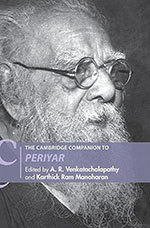
The Cambridge Companion to Periyar edited by AR Venkatachalapathy and Karthick Ram Manoharan offers a comprehensive evaluation of the social, political, and economic dimensions of Periyar’s thought. The volume is organized into five parts. ‘Events That Made Periyar’ examines the impact of the Vaikom Satyagraha (the struggle for Dalit temple entry) and the Poona Pact (the debate between Gandhi and Ambedkar on separate versus reserved electorates for Dalits) on Periyar’s political formation. ‘The Politics of Periyar’ analyses the Dravidian Movement, the role of the Dravida Kazhagam, and the attempts to forge a Dravidian-Tamil nation. ‘Religion, Caste and Identity’ focuses on Periyar’s critique of religion and caste, as well as the reception of his speeches and writings among the Tamil diaspora in Singapore. ‘Women and Culture’ examines his engagement with women’s agency and rights, literature, and cinema. Finally, ‘Labour and Dignity’ explores the subordination of the economic to the social in Periyar’s thought, and his role as a cultural psychologist. This review focuses on a selection of essays that merit further discussion and clarification. Before that let me briefly list the essays that I have not engaged with and their contents.
Part I includes two essays, one by Pazha. Athiyaman, which has been translated from Tamil, discusses the impact that the Vaikom Satyagraha and the Chernmadevi Gurukulam controversy had on Periyar’s political ideology and action, and the other by A Thiruneelakandan is a discussion of the Poona Pact and the support that Periyar and the Self-Respect Movement extended towards Ambedkar’s demand for separate electorates for Dalits. Karthick Ram Manoharan’s essay in Part II titled, ‘Periyar’s Anti-Aryanism: A Genealogy, a Synopsis, and a Critique’ draws parallels between Periyar’s anti-Aryan and anti-Brahmin rhetoric. In another essay titled ‘Periyar, the Women’s Question, and Maniammai’, Karthick Ram Manoharan and Vilasini Ramani discuss Periyar and his wife Maniammai’s critique of the oppressive forces of religion, capitalism and patriarchy in the lives of women. The last section contains two essays. The first one by M Vijayabaskar titled, ‘The Social Subsumes the Economic: Periyar’s Reading of Economic Power’, is a discussion of the economic features of Periyar’s thought that included the nationalization of land and other key sectors, a greater emphasis on urban industrialization and technology, establishing labour unions that would address working class demands and caste disputes and a demand for the equalization of wages across manual and non-manual forms of labour that would give the children of lower caste workers greater access to education and employment. And the second essay by Ramaswami Mahalingam titled, ‘Liberation Notes, Dignity, and Periyar: A Radical Cultural Psychology Perspective’ is an analysis of Periyar’s rationalist thought as a cultural psychologist who through his compassion urged people to have a more expansive sense of self that went beyond social and economic vectors of identity.
In what I believe is the most conceptually grounded chapter in the volume, ‘EVR’s Non-Brahmin Cosmopolitanism, Periyar’s Dravidian Nationalism, and the Appearance of Humankind’, Matthew H Baxter identifies a tension between two facets of the same anti-caste thinker and the symbolic and rhetorical differences they indexed. EVR’s discourse from the 1910s onwards, Baxter argues, privileged self-respect over self-rule in a context where nationalism was already an ideology of elite Brahminical power. By contrast, Periyar’s demand from the 1940s for a Dravida Nadu represents not a rejection but a co-option of the nation and nationalism. While EVR’s Non-Brahmin project is described as ‘phenomenal’, premised on an enacted absence of hierarchy and a commitment to equality, Periyar’s Dravida Nadu-for-Dravidians is presented as a ‘noumenal’ project grounded in racialized biological identity and the independence of ‘human kinds’. As Baxter rightly notes, the Dravidian did not supersede the Non-Brahmin; rather, it challenged EVR’s emphasis on equality and sustained critique of authority. This raises important questions: does difference inevitably produce hierarchy? Under what conditions does difference harden into hierarchy, and are hierarchy and authority inherently objectionable? If EVR’s concern was with how to rule rather than who should rule, this conflicted with Periyar’s ethnolinguistic imagination of the Dravidian nation. How did he imagine the polity of the Dravidian nation?
Vighnesh Karthik’s essay, ‘Periyar and the Forging of a Horizontal Dravidian-Tamil Solidarity’ argues that Periyar sought to forge a horizontal alliance among Non-Brahmin castes that accommodated and negotiated difference. However, the essay would benefit from greater empirical illustration of this claim, particularly through an analysis of how Periyar negotiated caste solidarity and hierarchy in relation to religion, class, and gender.
AR Venkatachalapathy’s essay, ‘The Double-Barrelled Gun’, invites further interrogation of Periyar’s dismissal of cinema and the arts, with the partial exception of propagandist theatre. While Periyar viewed theatre as an immediate and effective medium for disseminating Dravida Kazhagam ideals, it remains unclear whether he seriously considered the political potential of cinema, particularly given its expanding reach. If theatre was privileged for its immediacy, it was nonetheless susceptible, in Periyar’s own terms, to generating ‘false consciousness’. This raises a more fundamental question regarding Periyar’s rationalism: can rationalist critique be meaningfully separated from the aesthetic? Aesthetic forms often offer nuanced critiques of social life through irony and ambiguity without reproducing rigid binaries such as justice and injustice, good and evil, or the rational and the irrational, where superstition is reduced to the sole marker of irrationality.
Periyar’s sustained attacks on religion, spirituality, and the arts, even outside formal electoral politics, alienated sections of his following. While these attacks were justified insofar as they targeted practices that sanctioned irrationality and oppression, they also rested on the assumption that religion and artistic creativity were inherently antithetical to rational thought and emancipatory action—an assumption that arguably foreclosed alternative modes of critique and engagement.
‘The Rationale for Reason: Periyar on Religion’ by Sundar Kaali examines Periyar’s radical critique of religion as a system that ossifies belief, custom, and caste hierarchy. Kaali disputes Paula Richman’s claim that Periyar’s critique of the Ramayana rests on a literalist reading aimed at the masses rather than scholars, arguing instead that Periyar upheld a historically contingent, empirical-ethical reason grounded in equality and fraternity. This intervention, however, does not undermine Richman’s argument. Periyar’s Enlightenment-derived secularism—premised on a strict separation of religion and state and the privatization of faith—may not adequately account for and engage with the intimate entanglement of religion and governance in South Asia. Moreover, the ethical and aesthetic power of faith, particularly as articulated in devotional poetry, remains unaddressed. Periyar’s inability to eradicate religion from public life itself attests to its enduring significance. As Richman suggests, his reading of the Ramayana is often literal and anachronistic, uncritically imposing Enlightenment rationality onto premodern texts.
Similar concerns arise in Anthony Arul Valan’s ‘Periyar’s Engagement with Literature’. The chapter examines Periyar’s readings of classical Tamil texts, which critics such as MP Sivagnanam have described as hyper-literal and inattentive to textual unity. Arul Valan argues that Periyar’s readings were strategic and polemical, aimed at demythologization and satire in order to provoke shock and ethical reflection. While such a strategy may compel readers to question unjust ideologies, it also presumes a direct correspondence between authorial intention and textual meaning, treats readers as passive recipients, and assumes that texts function as literal, binary representations of justice and injustice rather than as metaphorical or ironic forms. This raises the question of where Periyar, if at all, distinguishes between a prejudiced text and a text that represents prejudice.
Darinee Alagirisamy’s ‘Periyar in Singapore: Transnationalism and Decolonization’ is a distinctive contribution that foregrounds the transnational significance of Periyar’s self-respect ideology among the Tamil diaspora in Singapore and Malaysia prior to decolonization. Alagirisamy shows how Tamil reform organizations drew on existing traditions of Tamil devotionalism to articulate a caste-transcendent, progressive Tamil identity, distinct from the politicization of caste in Tamil Nadu. Despite upper-caste resistance to Periyar’s visit, he found support among working-class and lower-caste migrants. However, the claim that Tamil identity politics produced a distinct Malayan national consciousness among Tamils remains underdeveloped. The political emergence of pan-Malayan identity appears abrupt and largely driven by Periyar’s exhortations to adopt Malayan citizenship. Greater clarity is required on how self-respect values were adapted to facilitate national belonging amid political marginalization, intra-Tamil conflict, and caste divisions, and the role that the Malaya state, Tamil press and literature played in the process. It is also noteworthy that while Periyar critiqued Tamil linguistic communalism and sacralized notions of Tamil in Tamil Nadu, Tamil language politics became central to migrant mobilization in Malaysia and Singapore. How the diaspora reconciled this tension warrants further examination.
Swarnavel Eswaran’s ‘Periyar, Art and Cinema’ analyses Periyar’s suspicion of art and cinema as media capable of indoctrination, obscenity, and the erosion of rational thought. While Dravidian cinema functioned as a powerful vehicle for ideological dissemination and nationalist sentiment—sometimes circumventing colonial censorship—its practitioners often moderated critiques of religion and sexism to avoid alienating audiences. Without a fuller account of audience reception, it is difficult to assume that viewers engaged with cinema solely for its reformist content rather than for pleasure. This raises further questions about Periyar’s comparative valuation of theatre, which he regarded as a more immediate and progressive medium. Was theatre not similarly constrained by social norms, patronage, and audience expectations? Did it necessarily cultivate more progressive publics?
What emerges from a reading of the book is the figure of a radical activist whose thought and performative actions were shaped by the historical and political exigencies of the moment.
Kiran Keshavamurthy is a scholar of modern Tamil literature. He teaches English at IIT Guwahati and his interests include modern Indian literatures, with a focus on gender, sexuality and caste.