
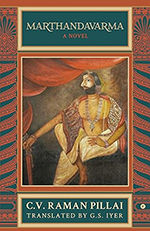
The contemporary reader of this landmark early Malayalam novel will find it intriguing that the eponymous hero, though the King’s nephew and not his son, is the successor to the throne of Travancore. Set in the eighteenth century when the matrilineal system ruled, the plot dynamics of the novel then comes from tradition itself. The challenger to the tradition is cast as a usurper. But Marthandavarma, the Prince, and Padmanabhan Thampi, the adversary, are not simply cardboard cut-outs playing out their designated parts. Their individual dispositions and moral conduct also go into determining who is the fittest to rule.
Marthandavarma announces itself as a novel with its grippingly dramatic opening. A young man of seemingly royal mien has been brutally attacked and left for dead in a sparsely wooded area. Just when he is about to embrace death, help comes unexpectedly in the form of a travelling party of four men who take him away in order to save him. The party of four turns out to be Pathans who play their part in reinforcing the novel’s commitment to a plural ethos.
The opening scene invites comparison with that of two early novels in Odia, also designated as historical novels. One is Padmamali (1888) by Umesh Chandra Sarcar. Considered the first novel in Odia, it preceded Marthandavarma by three years. The second is Lachhama (1901) by Fakir Mohan Senapati, which came ten years after the Malayalam novel. Taking the content of the opening scene into account, Lachhama seems closer to Marthandavarma. And this is not the only resemblance. There is the revenge motif in both, with the victims getting even with their attackers.
The young man who is attacked is neither named nor identified. Only a faint clue in the form of the sound ‘p’ uttered by the young man is thrown in together with the idea that the attack could be over the love of a woman. This could point to the woman at the centre of the novel, Parukutty.
Two leading women, Parukutty and Subhadra, make for a fascinating study in contrast and analogy. The presentation is nuanced, but there is no mistaking that it is structured around the love-lust binary, just as Victorian fiction casts the woman in terms of the angel-whore binary. Parukutty is the cherished object of love, while Subhadra, portrayed as the loose woman, deserted by her husband, is the coveted object of lust; the item girl. But even the angelic Parukutty is not spared the male gaze. Admired for her mind for the most part, we see her in possession of a ravishing body when the lens of her suitor-luster is turned on her. By a sly and indirect device of reportage Parukutty is subtly sexualized, although the scandal is contained through its framing by the lustful eye of Thampi. The same thing happens with Subhadra later, who is sexualized, nay vulgarized, by being seen through the same lustful eyes.
Parukutty and Subhadra do, of course, have an identity above and beyond the male gaze. They are both what we would call today ‘women of substance’. They are the still point of the turning royal world of intrigue, conspiracy and nasty power grabs. As such, they alert us to the alliance of royal and moral virtues in a person of character. Parukutty emphatically points out this lack of character in Padmanabhan Thampi when her mother Katyayani Amma pressures her into marrying him.
The moral compass of the novel, expressed in the word ‘qualities’, is the key to differentiating Parukutty’s prince-like lover, presumed dead, and Padmanabhan Thampi, who is wooing her. This takes us beyond the legalistic question of who the rightful successor to the throne should be. Had Thampi been that person, he would still be deemed unworthy in the moral scheme that the novel upholds. In this sense, Marthandavarma is a profoundly moral novel. It has political framing, but focuses on the humane qualities such as loyalty, friendship and constancy in love that transcend political expediency. If I have not said a word about Anantapadmanabhan, the primum mobile in the novel, it is to save the reader from the spoilers.
The work in translation is a remarkable rendering. The translator has tried to fit the style to a story of epic intensity. There are, however, ways of making it grand. One could use archaisms, Victorianisms or Johnsonese or one could use a formal register of English that nevertheless rings modern to contemporary ears. GS Iyer has chosen the latter.
The compact descriptive passage in the opening is a case in point. The place where the attack happens is a nondescript area known by the grand name of Panchavan forest. Yet the scene is transformed by a figurative style packed with personifications and hyperboles into something extraordinary that may indeed evoke the Panchavan, maybe Panchavati forest: ‘tall wide palm trees stand erect like men in green parasols, marching in the ceremonial parade of some forest spirit’ (p. 1). This is the style used in descriptive and narrative passages which predominate in the novel. The translator has opted for the present, thus making the scene feel lively and ongoing.
The dialogues, however, are given in a conversational style, for which informal and familiar diction suiting a fast tempo is used. In the same vein we can think of ‘mollycoddle’ (‘Sit the prince on your lap, mollycoddle him, by all means’, p. 78) or that ‘It is the way of the world to support a big backside’ (p. 73). But by and large it is the grand and heroic style, made up of complex constructions and high-end words that hold sway. It is used to mediate to us the lost world charm of eighteenth-century Princely State of Travancore and its society.
I wish that such a splendid translation was completely free of typos (‘these the bad tidings’, p. 223; ‘recieved’, p. 251). I also tripped on the reference to Abhimanyu trapped in ‘Padmavyuha’ (p. 65) rather than Chakravyuha. Be that as it may, Marthandavarma is a richly rewarding read. We may trace here the fictional qualities that breathe life into the dry bones of history.
Himansu S Mohapatra is former Professor of English, Utkal University, Odisha, and a translator.