
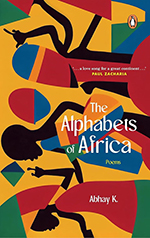
THE ALPHABETS OF AFRICA
By Abhay K.
Penguin/Random House, 2026, pp. 249, ₹ 499.00
The books that came my way this time have filled me with a sense of hope that Indian poetry in English continues to ask difficult questions and has been able to resist the silencing of voices that one increasingly witnesses. It is not easy to write in an environment where one begins to feel stifled; and maybe it is in such moments in history that poets have emerged with renewed urgency. The collections included in this combined review range from coming down hard on rigid ideas to entering a world of nostalgia and softness, from confronting the forces that threaten to unmake us as a people, to grappling with issues of identity and one’s place in the larger world.
We grow into clichés or time delivers us quickly into t

 heir sanctity.
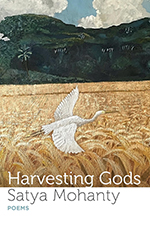
The reality checks that Mohanty’s poems offer in this new collection raise questions pertaining not just to religion, but of facing the desire that underlies human relationships. The book compels one to ask how desire should be understood in the face of changing, rather, fluctuating dynamics; how memory is shaped by what we understand as real; and whether the realities that we inhabit are, in part, constructions that help us to live with the past.
What if our present looks violated, in the crowded halls of arrivals and departures of social media, we would finally be brewing the elixir of the past for concocting the future.
Nostalgia comes under close scrutiny in the book, including the patterns and narratives that a mind is capable of creating. Institutions that uphold a society emerge as double-edged swords; while they provide standards for a society to organize itself, they are capable of becoming instruments of injustice; a means to justify violence and suffering.
If the very nature of reality and its constructs are looked at by Mohanty, then Kottoor’s poems take a turn inwards to reside in those remembered worlds.
All distances have evaporated. There by the tree stump the last poet recites his poem.
He is drunk, but the poetry escapes, turns landscape, becomes treescape…
Memory and longing intermingle and create a sense of quietude that seems to pervade the whole book. The slow realization that memory can turn into a force to be reckoned with seeps through the pages of this slim volume. However, the sadness that accompanies these recollections stands out, as one slowly navigates not just one’s childhood, but also the passages of growing up and growing old.
If a post box only knew of the secrets in its womb,
Waiting all night for the post man to come;
all those tremors of the writing hand,
the quiet, secret burial of words in neat folds…
The never-ending struggle with life and with the memories strewn around, one slowly learns to wade through them without getting drowned in them. The book takes you through people and presences that have shaped these lived experiences.
If Kottoor’s poems are an ode to memory and longing, then Jayshree’s poems are an ode to women and the power of the feminine. She neither avoids nor overlooks the fear that accompanies being a woman; or the daily negotiations that it demands, both with oneself and with the outside world.
…I lower my eyes, sink into the soft sofa, inhale, my life now safe in confined space. Anger swells for always Being two steps behind.
The tensions between ghare and bhaire emerge through conversations, along with the subtle negotiations that one learns in order to survive. For this is not just an account or a collection of the fears, happiness, sadness, loss and suffering of a single woman; it resonates with what the collective feels and often remains unarticulated.
I have conjoined the pieces into a throbbing whole; my heart split down the middle, a part half-twisted upwards by you, many years ago; yet I live on—to display this lop- sided part of me, yet somehow still straight—myself, truly me.
It is that self that gets repeatedly destroyed, repaired, revived, and once again collapses under the pressure of the society and its expectations.
This hunger for freedom acts as a bridge to the next book, where hunger is looked at in its immediate and material forms.
An anchor rooted in the riverbed of hunger has bound their desires. The boat must have enough food to sail before nightfall.
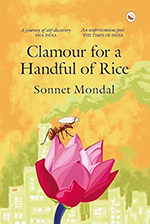
Mondal through his book opens up a space to discuss hunger in its truest and most visceral sense. He does not hold back. Rather, he foregrounds through his powerful voice the origin of many of the conditions which we are surrounded by—Hunger. Not just for food, but it percolates down in its various definitions in this collection of poems. The hunger for sustenance, for peace, for preservation and for dignity.
Back home from the streetI touched the four walls of my bedroom. The open roadwas sturdier than these walls.
War enters once again but in a literal sense through the book and brings along with it various forms of suffering which the poet captures with remarkable force.
And if hunger becomes a source of going inwards to understand the very idea, Abhay K’s book travels further behind to questions of belonging, origins and the beginning of human civilization. Africa, regarded as the cradle of humankind and the place from where Homo sapiens emerged, becomes the focus of this collection.
Light aspires to pierce
through the darkness
of hatred and ignorance.
Learn about Africa…
Through the letters A to Z, the poet traces histories, landscapes and figures that have shaped the African continent. The rich and vibrant tapestry of this continent comes alive in the collection which stands as an ode to this beautiful space.
…boulders, outcrops, rock shelters
teeming with rock art
remains of nations
that once flourished here
engravings of the Messak plateau
strange mythical beings, enigmatic symbols…
Just as the poet reminds us, one must often return to the roots in order to understand the strength and the expanse of a mighty tree.
Taken together, these poets remind us that poetry continues to be a space where difficult conversations are possible. They refuse to provide easy answers or comfortable silences. Instead, they make us, the readers, look closely at ourselves and at the worlds that we inhabit.
Semeen Ali is the author of four poetry collections and co-editor of five poetry/prose anthologies. Her work has appeared in several national and international journals and anthologies. She is the Poetry Editor at Muse India and on the editorial team of Red River.