
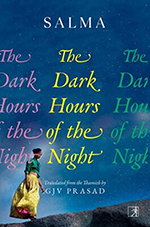
‘Everyday life weighs heaviest on women. Some are bogged down by its peculiar cloying substance, while others escape into make-believe…They are the subject of everyday life and its victims,’ writes Henri Lefebvre (1984:73). The Dark Hours of the Night by Salma is an epic narrative of the burden of the everyday and its make-believe recasting experienced by women. Over the years, Rajathi Salma has emerged as one of the finest chroniclers of Muslim women’s lives—her accounts, steeped in the quotidian, lived experiences of Muslim women in the hinterlands of South India, are not framed by stereotypical assumptions of the global Western imagination, which she refuses to feed through undue sensationalism. Some of her finest stories capture the traces of the extraordinary in the chaotic flux of the quotidian. Irandaam Jaamangalin Kathai (2004), the writer’s much-acclaimed debut novel, was first translated by Lakshmi Holmstrom in 2005.
The new translation by GJV Prasad seeks, as he notes, to bring the novel to ‘newer generation of readers’—and in doing so, it preserves its searing intensity, lyrical cadences, and political urgency.
The story of Rabia, the protagonist of the novel, echoes the story of her creator. Salma defied norms, struggled against odds, denials and degradation. From her confined life after marriage, when she was denied access to pen and paper, Salma has carved out a name for herself as a writer (not to forget that her earliest poems were scribbled in the privacy of the toilet and smuggled out to the publishers through her mother), an activist and now a Rajya Sabha member. These autobiographical traces amplify the novel’s political urgency, social relevance, and activist edge.
Rabia’s coming-of-age narrative is intertwined with the narratives of women in her close and extended families and her circle of friends and neighbourhood—all trapped in claustrophobic structures of patriarchy and devising their own ways of navigating it to reclaim their agency. Her mother, Zohra, is gentle, obedient, and conservative. Her steadfast devotion to her husband’s authority renders her incapable of crossing the boundaries drawn by patriarchy. But all women in Rabia’s familial network do not belong to the same category; some openly rebel, while others find subtler ways of defiance. Through Rabia’s gaze and the polyphony of voices that surround her, Salma constructs a vivid theatre of women, living and dying; of women who, though confined to their cloistered lives, are dreamers and rebels, defiant survivors and victims, tragic sufferers and filled with laughter and gaiety, all at the same time. The story of Rabia’s aunt and Zohra’s sister, Firdaus, who is forced to marry an older man, is a case in point. Married off to a rich man to relieve the poverty of the family, Firdaus complies, but on the wedding night, she boldly rejects him, asking him not to touch her, as she is repulsed by his sickly body. Firdaus’s story however ends in tragedy when her mother, Amina, on learning of her affair with a married man, forces her to drink poison to save the family honour.
Much like Firdaus, Fatima is banished from the village, and her mother, Nuramma, is excommunicated when the villagers learn of Fatima’s elopement with Murugan. Nuramma questions the villagers by asking if they can show a single man who hasn’t slept with one of the Hindu worker women.
There are other women in the novel like Rahima who, despite her conservative husband Kader’s injunctions, follows the doctor’s advice and goes in for sterilization; Nafisa, who much as she respects her elderly husband Bashir, cannot undermine her own desires and carries on a secret liaison with her lover Aziz; Rabia’s cousin Wahida, who is disgusted with the predatory behaviour of her father-in-law and her husband Sikandar; Farida who carries on a romantic affair with driver Mutthu; and Mumtaz who is unable to bear a child and is threatened by her husband Suleiman and her mother-in-law. Their stories constitute the multivocal frame of the novel through which the novelist dismisses the notion of a unified category of Muslim women as victims of Muslim patriarchy. Women like Mariyayi, a Dalit Hindu domestic help at Zohra’s house who is sexually exploited by Zohra’s husband, Karim, add a caste angle to the gendered exploitation of women in patriarchal societies.
Men like Suleiman, who campaign for the domestic incarceration of women in the name of the honour of community and religion; Karim, who keeps a Dalit mistress; Hazrat at the Madrasa who pinches young girls on the thighs when they mispronounce words; Wahida’s husband Sikandar, and her father-in-law are exemplars of sexual hypocrisy. They manifest how, by attempting to contain the assemblage of a reproductive body, the religious patriarchy desires to integrate the ‘flesh’ and the ‘spirit’ of women into subsumption through the forms of performative, sexual services.
On the other hand, women like Zohra, who feels deeply upset when she scolds her daughter Rabia for going to the cinema, or Amina, who suffers even as she serves poison to her daughter in the same mug in which she had always served her milk, poignantly capture the helplessness and tragic fate of girls’ mothers in societies governed by the architectonics of patriarchy. But, more importantly, the novel asserts that despite the exploitative structures of patriarchy, women are not always voiceless, silent victims.
They manipulate and reclaim agency through their own networks of female solidarity, where they can laugh at the sexual performance of their men, indulge in raw, coarse, sexually explicit conversations, and rid themselves of their angst in everyday rituals and food. If the everydayness of the interactions in the novel exacerbates the insidiousness of the collusions of patriarchy, religion, and gender, resulting in many forms of gender-based violence against women (GBVAW), the novel, through a network of many stories of many lives, all entangled in a complex web of kinship, social obligations, and community, unfolds women’s strategies of survival.
Prasad’s translational choices in carrying the Thamizh rhythm of everyday life to English justify the retranslation of the text. His choice of registers is attuned to the tonal range of women’s conversations and captures the bare rhythms of everyday speech, domestic chatter, whispered conspiracies, and the occasional defiance. His choice to retain Thamizh kinship terms and terms for dress and food further reinforces his inclination to inflect English with Thamizh rhythm.
Inasmuch as women are seen as the extension and the quintessential representatives of the quotidian, they have been deemed as victims of everyday life. In recovering the everyday lives of these women in all their rawness and ambiguity, Salma’s novel lays bare a polyphony inherent in the homogenized image of Muslim women and exposes how structures of patriarchy that permeate religion and state often fail to control the teeming, chaotic everyday lifeworld of women. Usually dismissed as residual and beyond the scope of theory, it is from here that a more realistic picture of the world of Muslim women will emerge, the novel affirms, and herein lies its activist edge.
Nishat Zaidi is Professor of English and former Chair, Jamia Millia Islamia, Delhi.