
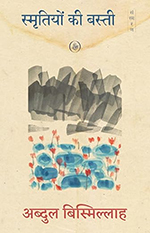
Most memoirs are not merely accounts of a writer’s life but also shed light on the times they lived in, giving readers a glimpse of the world as it was then. Such forays into the past are mesmerizing because we often forget what we were like and how we’ve changed. Smritiyon ki Basti, the memoir of Abdul Bismillah (former Professor of Hindi at Jamia Millia Islamia) is slightly different in that he doesn’t write about himself but about renowned Hindi writers he met over the years in Allahabad and Banaras, two cities he lived in and knew well.
Born in Balapur village in Allahabad district in 1949, Bismillah did his BA in Mirzapur in 1970, then came to Allahabad University for his MA. He wanted to study Sanskrit but was advised to study Hindi instead (‘You won’t get Sanskrit because you’re a Musalman’). He stayed on in Allahabad till 1974 when he left for Banaras. He lived there for a decade, and people began thinking of him as a true-blue Banarasi. But Allahabad is the city that remains close to his heart, and he has a closing chapter in the book titled ‘Allahabad Ke Ve Din’. The literary crown had passed to Allahabad—famed writers of Banaras like Premchand and Jaishankar Prasad had passed away but Allahabad was still buzzing with literary talent, from Mahadevi Varma and Sumitranandan Pant to Upendranath Ashk, Amarkant, Firaq Gorakhpuri and many others.
Bismillah’s friends were deeply literary minded too. They critiqued each other’s works and even if some uncomplimentary remarks were made, the friendships did not break. Bismillah recalls that when he dismissed a short story by his friend Buddhisen Sharma, the latter stopped talking to him. But when Bismillah was down and out, Buddhisen Sharma got him a job in a newspaper, paid for his food, taught him proofreading—all without saying a word to him. ‘Agar ve yaar na hote toh main bhi nahin hota’ (‘If it wasn’t for such friends, I wouldn’t exist, I wouldn’t be there either’), writes Bismillah.
Allahabad was brimming with literary heavyweights, but rookies like Bismillah tried to make a place for themselves. At one particular literary gathering, when he was rudely ushered off the stage after speaking for only seven minutes, he paused long enough to say, ‘Bolne ko rokna likhne ko rokne se zyada khatarnak hota hai’ (‘Silencing speech is more dangerous than stopping someone from writing’).
Among the thirteen writers Bismillah writes about, his fondest memories are of Amarkant (1925-2014), to whom he devotes two full chapters (the other writer he honours thus is Trilochan). Bismillah first met Amarkant in the early seventies when he was doing his MA and the latter was an established writer (he had written acclaimed short stories such as ‘Dopahar ka Bhojan’, ‘Zindagi aur Jonk’, ‘Dipty Collectori’, ‘Hatyare’). Bismillah recalls that when he saw Amarkant for the first time in the evening light, wearing a bush shirt and pyjamas, smoking a cigarette, he reminded him of an Ashok tree. And like a sheltering tree, Amarkant helped Bismillah get a job in Allahabad’s Mitra Prakashan when he was unemployed, comforted him when he was going through an emotional crisis, advised him on his career, shaped his thought process by encouraging him to read Karl Marx and continued to be a friend and mentor even after Bismillah left for Banaras in 1974. Missing the charms of Allahabad, he complained to Amarkant, ‘Kashi mein kuchh nahin hai’ (‘There’s nothing in Kashi’). Irritated, Amarkant replied, ‘Kashi mein jab “Kashi” hai toh yeh kaise ho sakta hai ki vahan kuchh na ho’ (‘When Kashi has “Kashi”, how can you say it has nothing?’).
Amarkant was referring to writer Kashinath Singh who Bismillah did meet in due course, after he’d been in Banaras for about five or six years. Pappu ki Dukan was Kashinath Singh’s favourite hangout where he would gather with friends from the mohallas of Lolark Kund, Assi and Bhadaini to drink tea and talk. Later, Bismillah got to know that all the people around Kashi bhai (as he refers to him) were known as ‘Kashi ki mandli’. He himself was introduced to Banarasi friends as part of this mandli by Kashinath Singh’s brother, noted Hindi critic, Namvar Singh. Kashinath Singh made a small but important contribution to Bismillah’s life as an author. He had been writing a novel on the lives of the city’s weavers (which was published in 1986 and went on to win the Soviet Land Nehru Award in 1987). But he couldn’t think of a title for the book. The problem was solved when he went to visit Kashinath Singh on a monsoon evening. The celebrated Banarasi writer, standing under a jamun tree, gave him the title: Jheeni-Jheeni Beeni Chadarya.
Even when it comes to writers he met just once or a couple of times, Bismillah’s accounts are engaging and often quite funny. His description of the one and only time he met poet Harivanshrai Bachchan is one of the memorable chapters in the book, for quite a different reason! After Bismillah moved to Delhi in 1984, he received an invitation to visit Bachchan in his Gulmohar Park home. Bismillah turned up on the appointed day and time (in February 1985, he remembers) only to be stopped by two security guards who made him fill out a form (one of the questions he had to answer was—‘Which Bachchan do you want to meet?’), went into the house and came back to tell him that sahib wasn’t feeling well and was unable to meet anyone. Bismillah was dumbfounded and furious. He finally did meet Bachchan in the same house—the one and only time he met the poet but never forgot that first encounter.
Bismillah gives the reader many other enjoyable tidbits (Firaq Gorakhpuri’s antipathy towards Hindi, Amritlal Nagar’s habit of eating paan the way a chain smoker smokes cigarettes, Hazariprasad Dwivedi’s fondness for Surti zarda—and much more). But he also shares the darker stories of writers’ lives, of acute financial insecurity or plain poverty, of mental anguish and bleak prospects. Poet and wordsmith Trilochan spent his early days in Banaras subsisting on chana before doing the rounds of offices looking for work. Sometimes, he would count the chana to make sure it lasted him throughout the day. Amarkant was an established writer in the seventies but still lived in a one-room house in Allahabad with his family of five. Later in his life, he fell seriously ill but didn’t have the money to get himself treated. When Bismillah went to meet Harishankar Parsai in Jabalpur, he found the great satirist almost bedridden (he was afflicted with sciatica). But his writing was the only source of income, and he had to take care of his siblings (the reason he never married), so there was no respite for him.
Though Bismillah has kept himself in the background, bits of his own life and personality do trickle through. I was moved by his admission of how upset and humiliated he feels when he’s described as a ‘Hindi ka Musalman lekhak’.
I hope he will write a sequel on the writers he met in Delhi, keeping the same easy, engaging style which makes this book such an engrossing read. Above everything else, Smritiyon ki Basti is a valuable contribution to Hindi literary history.
Poonam Saxena, journalist, writer and translator launched and edited the Hindustan Times Sunday magazine, Brunch, for over ten years. She has written extensively on popular culture, film, television and literature. Some of her translations from Hindi into English include Dharamvir Bharati’s Gunahon ka Devta (Penguin) and The Greatest Hindi Stories Ever Told (Aleph).