
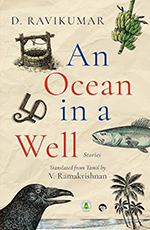
The ten short stories in D Ravikumar’s An Ocean in a Well are connected less by subject matter and more by a shared aesthetic commitment. They are written deliberately in magical realism, blending the impossible with the everyday until the two become indistinguishable in tone, and it also criticizes the misuse of magical realism. D Ravikumar is a prominent anti-caste thinker of the Dalit movement (later turned politician), whose critical and journalistic writing addresses the social contradictions of contemporary Tamil society. Here the protagonists are mostly unnamed, drawn without explicit Dalit markers, and the stories are built to unsettle the expectations readers bring to Dalit literature rather than confirm them.
Subaltern literature, whatever the condition of marginalization, privileges the voice of testimony over art, its formal choices naturally treated as incidental to its content. African and African-American writing has long been received as reportage on colonialism before it began to be appreciated for its craft; women writers were pushed toward pseudonyms because the literary establishment could not reconcile formal sophistication with gendered authorship; Dalit writing, born of testimony against caste violence, inherits the same reflex. It is against this pattern that Ravikumar’s fiction pushes back, and this refusal to endorse stereotypes continues in his politics. His stories seem to insist that literature from the margins reduced to evidence, appreciated for violence, devoid of artistic merit, is itself a form of the marginalization the literature addresses.
Ravikumar’s withholding of names is a clear sign of this refusal. Most protagonists go unnamed, and the anonymity reads not as omission but as argument: that anonymity forced on people at the margins becomes, in his hands, a narrative device rather than a mere social fact. The opening story ‘Thambi’ states this plainly. An itinerant salesman befriends a homeless young man, shares a meal with him, and is repaid in an unsettling way; nothing is named beyond the way of addressing the kinship as found in the title. It is a form of address promising an intimacy the story withholds.
The title story pushes further, and it is here that the collection’s magical element works best. The unnamed narrator recalls a night when dead sparrows fell from the sky while his mother walked through them, pushing birds aside with a pole, carrying an infant; he wakes up to find snakes falling from a neem tree, a dog’s howl like an old man’s cry, stars collapsing toward him when he stares. What makes this magical, an extension of realism rather than fantasy is its tone: Ravikumar narrates the impossible in the same flat, declarative register he uses to describe a borrowed room or a bus stop, offering no signal that anything is unusual. The same flattening governs his mother, who rarely speaks; instead she controls him with her eyes ‘like a magician’, each glance an instruction. The one exchange of speech Ravikumar grants his parents is just as compressed, the mother’s recurring demand that her husband return her jewels ‘if you are a real man’, met each time by mild deflection before he leaves again for months, two repeated sentences carrying an entire marriage’s weight.
The well that gives the book its title works the same way, at greater scale. Searching for his mother, expecting the ocean, the narrator finds instead a disused well behind a borrowed house, where a previous tenant drowned, and hears her voice rise with the water in the well. A realist novel would render this as haunted, symbolic, spoken of in warnings. Ravikumar rejects the metaphoric mode outright: the well is simply where the dead can be heard, and the living called, an actual point of contact rather than a figure for one. That refusal to let the marvellous collapse into a symbol is what separates the story from a ghost tale or an allegory.
The same principle extends outward. In ‘Un-Timely’, a woman who is granted one final day with her lover before death separates them, treats mortality as a boundary briefly permeable to grief, and this is narrated as a matter of fact rather than as fantasy. ‘Zha, the Unique Letter’ turns the device toward the state, imagining a government banning a Tamil letter outright, its bureaucratic plainness exposing how power echoes through speech. The translator clarifies in a note that the letter ‘zha’, which once alluded to the liberation struggle for eezham in Sri Lanka, now refers to Tamizhs in the Indian context. Against these stories, ‘Fact Finding’ and ‘A Death and Some More’ remain within a documentary mode. They address caste violence directly, a contrast that shows Ravikumar deploying the marvellous selectively, reserving it for exactly the points where direct statement would diminish what needs saying.
Ramakrishnan’s translation is alert to this distinction. English renderings of the source prose style default easily to an explanatory register that would be fatal here, since magical realism depends on withholding the glosses that make the impossible legible as metaphor. Ramakrishnan resists that impulse; the well is never translated into a metaphor for grief, the letter ‘zha’ never into an allegory, and the resulting prose, plain and restrained, occasionally betraying its passage from Tamil in a slightly formal cadence, lets that reality stand undisturbed.
An Ocean in a Well succeeds in its aim to challenge the stereotypes of Dalit literature because it refuses to be read only as testimony. Ravikumar’s politics, his life as an Ambedkarite activist and Member of Parliament, inevitably inform the collection’s concerns, but the marvellous, not the message, is where those concerns find their most exact fictional form. A mother speaking through her eyes, a voice rising from a well, a letter erased from speech: these are not illustrations of an argument but stand for the very argument itself, made in the only terms fiction can properly make it. The stories seek to be read first as fiction and, in doing so, make their own case against the stereotype they set out to dismantle.
K Samuel Moses Srinivas is Assistant Professor of English and Head-in-charge (SFS), Madras Christian College, Chennai.