
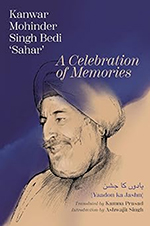
Kanwar Mohinder Singh Bedi’s (1909-1992) autobiography is a fascinating account of life in colonial and postcolonial India from the perspective of one born to privilege and yet extremely humble and dedicated to the values of humanitarianism, secularism and social harmony. The seventeenth descendant of Hazrat Baba Guru Nanak Dev Ji, Urdu poet, impresario, promoter of sports, magistrate and civil servant, Bedi had unfettered access to Prime Ministers and Presidents and socialized with the foremost poets and artists of the day. The book is in two parts: ‘My Life and Career’ and ‘My World’.
Born in a landowning family from Montgomery (now Sahiwal in Pakistan) that owned 25,000 acres before the Partition in Chak Bedi near Pakpattan, Bedi was educated at Mission High School in Rawalpindi before joining Chiefs College and subsequently Government College Lahore. However, in 1934, he was appointed Extra Assistant Commissioner in Lyallpur and entered the civil services in 1957 from which he retired in 1967 with a record of distinguished service.
While the Bedi family, like many others, suffered major losses during the Partition, Mohinder Singh never became bitter or anti-Muslim. He regretted the breakdown of the camaraderie and harmony but always continued to believe in and work towards a peaceful coexistence of not just Hindus, Muslims and Sikhs but also of India and Pakistan. And yet in his own inimitably honest submission, he did regret in a small corner of his heart the grandeur of a lavish life before the Partition. He writes with a degree of pride about his menagerie—the fearless pet elephant Benazir, his silvery mare, the hunting birds, the family hunting expeditions, his personal motorcycles, the motor cars, the large retinue of servants, and daily meals for hundreds. Though he wore his privilege lightly, he regarded the abolition of zamindari as ‘a mistake’, an ‘unjust’ and ‘wanton’ act, a view, perhaps more in conformity with his class at that time.
As an Urdu poet, he was the life of mehfils and mushairas, wherever he was posted. Along with Gulzar and Rajinder Singh Bedi, he represented a small section of Sikh Urdu writers, who were a part of the larger community of Punjabi-speaking Urdu poets, both Muslim and Hindu. When Delhi had still not recovered from the violence of Partition, Jawaharlal Nehru appointed him City Magistrate in October 1947, largely because of his clean image as a fair and unbiased judicial officer. Apart from his official work, he began organizing events for Delhi’s citizens so that people of all faiths ‘might once again come together in a spirit of recreation’ and the wounds of the violence might begin to heal.
Bedi’s stint in Delhi from October 1947 to July 1953 involved working towards the welfare of refugees and their rehabilitation apart from normal judicial duties. Entrusted with the task of bringing back Muslims from the Purana Qila camp to their homes that had been occupied by Hindu and Sikh refugees, Bedi along with some important citizens and police officials went from door to door, requesting the occupants to vacate the premises. Several members of the committee, unable to tolerate the abuses hurled at them, gave up, but Bedi with two others persisted and, in a few months, ‘almost all the residential houses were vacated’. A second incident involved someone who had fled his home in Karol Bagh during the riots and wanted to recover the valuables he had left behind. Bedi accompanied him to his house which was then occupied by a Sikh refugee. On being apprised of the matter, the Sikh immediately called his family out and told the claimant: ‘The house is yours.’ The latter found his jewellery and money exactly where he had hidden it and offered the Sikh a thousand rupees as a token of his gratitude which was refused. The latter recounted that it was his Muslim neighbours and friends who had secured the safe passage for his family to the border.
Bedi’s account of his life in Delhi paints the picture of a world in which despite the pain of Partition, political leaders, businessmen, bureaucrats and writers were engaged with cultural activities, an appreciation of Urdu poetry and a genuine spirit of generosity towards the disadvantaged.
Bedi’s Urdu poetry collection Tulu-e-Sahar was published in 1962 and Jagjit Singh, the ghazal singer, produced an album of his ghazals and nazms titled Forget Me Not. His poetry carried the message of universal love, harmony and respect for all faiths. His faith in God is tempered by reason; while accepting the reality of Biblical and Quranic figures and events, he nevertheless writes: Yeh sabhi kuch hai magar sach to ye hai Parwardigar/ Kuch mera husn-e-aqidat kuch teri zat-e-Jamil (All these are real, yet the truth, O Lord, is this,/ partly the beauty of my devotion, partly the beauty of Your Being.) His social commitment finds evocative expression: Jang karni hai karein hum mil ke bekari se jang/ Bughz se, kine se, nafrat se, dil-azari se jang… (If we must, let us wage a war against unemployment;/ a war against malice, rancour, hatred, and hurting hearts). One of his couplets that won him many admirers around the world was: Ishq ho jaye kisi se koi chara to nahin/ Sirf Muslim ka Muhammad pe ijara to nahin (Love admits no command; one may fall for anyone./ Is Muhammad the preserve of Muslims alone?). On Josh, he mentions several interesting meetings that the poet had with Nehru and the high esteem in which he was held by the PM, and expresses his disappointment when Josh decided to leave for Pakistan.
Bedi had close friends like Dilip Kumar and Mohammad Rafi and produced three films in Punjabi, and two in Urdu. Bedi’s grandson recalls that Mohammad Rafi willingly performed at all their family functions. Meena Kumari played the record of his ghazals in her own voice when Bedi visited her in her last days. She signed the record and gifted it to him in the hope that it would remind him of her.
Bedi visited Pakistan several times and was always received with great warmth and affection. On one of his visits, a couple of men approached him carrying the Guru Granth Sahib with their heads covered. They wanted to entrust the Granth which had belonged to a Sikh whose house had been ransacked, to Bedi. In 1982 he was invited to Karachi to participate in a commemorative mushaira for Josh.
Kamna Prasad’s translation is extremely readable. Both original Urdu version and English translations of Bedi’s poetry without any detailed notes ensure a smooth reading experience. The photo album itself tells a story and adds to the value of the book.
Bodh Prakash, former Professor of English, is a critic and translator.