
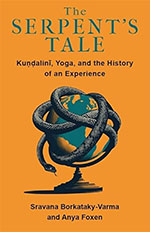
In The Serpent’s Tale: Kuṇḍalinī, Yoga, and the History of an Experience, Sravana Borkataky-Varma and Anya Foxen undertake an intellectually ambitious and methodologically sophisticated inquiry into one of the most elusive concepts in the history of South Asian religious thought, namely, the experience of kuṇḍalinī. The book’s central contribution lies not merely in cataloguing the diverse historical references to this serpentine energy, but in constructing a genealogy of the very idea of ‘experience’, as it has been invoked by practitioners, interpreters, and scholars across centuries. The authors reframe kuṇḍalinī not only as a metaphysical construct, but as a dynamic, historically variable, and culturally mediated phenomenon whose contours reflect broader shifts in Indian religiosity, colonial modernity, and global spiritual culture.
The introduction sets the intellectual stakes with admirable clarity. The authors contend here that modern popular understandings of kuṇḍalinī, seen widely in global yoga culture as an inner energy awaiting awakening through meditative practice, are profoundly shaped by the post-nineteenth century reconstructions, rather than premodern textual traditions alone. The book, thus, positions itself against both romantic perennialism and narrow textualism, instead foregrounding a historiographical approach attentive to the circulation, transformation, and reinterpretation of experiential claims. This choice immediately marks The Serpent’s Tale as a work operating within the critical historiography of religion, echoing methodological debates in the study of mysticism, embodiment, and the phenomenology of religious experience.
In ‘South Asian Roots: Serpents, Fire, and the Ascent of Kuṇḍalinī’ the authors articulate the conceptual scaffolding that historically sustained kuṇḍalinī theories, through close readings of seminal texts, including, Śaiva and Śākta tantras, Haṭha Yoga manuals, and later commentarial traditions. Particularly illuminating is the argument that premodern representations of kuṇḍalinī were neither uniform nor necessarily centred on subjective experience. Instead, they were embedded in ritual cosmologies, metaphysical anatomies, and soteriological systems. Kuṇḍalinī is, thus, shown as an interpretive node that integrates metaphors of serpents, subtle physiology, divine power (śakti), and ritual performance.
One of the book’s most striking contributions of the book is its challenge to the widespread assumption that kuṇḍalinī awakening was always framed as an interior, ineffable event. The authors demonstrate that earlier traditions often conceptualized the movement of kuṇḍalinī less as a subjective experience, and more as a doctrinal mechanism that explained the transformation of the practitioner’s subtle body. Premodern yogic texts, according to the two scholars, treat kuṇḍalinī as a theoretical entity whose movement is inferred, rather than directly attested by the practitioner. The book’s analysis of the Haṭha Yoga Pradīpikā and the Śiva Saṁhita underscores this point effectively. In these texts, the authors argue, experiential language is sparse, and it is only with later vernacular and hagiographical materials that more phenomenological dimensions begin to emerge.
‘South Asian Roots: Serpents, Fire, and the Ascent of Kuṇḍalinī’ and ‘Western Roots: Subtle Bodies, Mystical Ascents, and Assorted Serpents’ are two chapters dedicated to the colonial and early modern periods, where Varma and Foxen identify a profound epistemic shift. The encounter between Indian religious practitioners and Western orientalist scholars, Theosophists, and later transnational yoga teachers generated a novel discourse in which kuṇḍalinī was reconfigured as a personal, transformative, and experiential reality. This reframing, the authors argue, was catalysed by the modern valorization of inner subjectivity, the rise of scientific-discursive metaphors such as ‘energy’, ‘electricity’, and ‘vibrations’, to name a few, and the global circulation of esoteric ideas. The analysis of Sir John Woodroffe (also known as Arthur Avalon) is especially incisive in ‘Western Roots: Subtle Bodies, Mystical Ascents, and Assorted Serpents’; Woodroffe’s translation project not only disseminated Tantric ideas but also reinterpreted kuṇḍalinī through a lens that harmonized Brahmanical metaphysics with the emerging vocabulary of psycho-physiology. The authors’ careful tracing of Woodroffe’s intellectual milieu, including his interactions with Indian reformers and Western esotericists, adds significant depth to the historical narrative.
Equally compelling is the discussion of the twentieth century global yoga renaissance in ‘East Meets West: Kuṇḍalinī and the Evolution of Modern Yoga’ in which gurus such as Swami Sivananda, Gopi Krishna, and later transnational figures like Yogananda and Muktananda, popularized kuṇḍalinī as a dramatically experiential event. Especially noteworthy is the book’s critical engagement with Gopi Krishna’s autobiographical writings in ‘When Serpent Rises: What Happened to Gopi Krishna?’ Krishna’s often ecstatic, sometimes harrowing descriptions of kuṇḍalinī activation are presented as personal testimonies, as well as cultural texts shaped by modern idioms of psychology, pathology, and self-expression. The scholars argue convincingly that these narratives helped cement the association of kuṇḍalinī with intense somatic and emotional transformations in the global imagination.
The strength of The Serpent’s Tale lies in its analytical agility. It moves seamlessly between textual scholarship, intellectual history, anthropology of religion, and critical theory. ‘The Serpent in the Melting Pot: Kuṇḍalinī in North American Counterculture’ examining the concept of ‘experience’ is perhaps the most theoretically sophisticated and engaging. Drawing on thinkers such as William James, Michel Foucault, and Talal Asad, the section contends that religious experiences are not raw, unmediated phenomena. Instead, they are always articulated within particular discursive frameworks. Kuṇḍalinī, therefore, becomes a case study in the historicity of interiority itself. Again, the nuanced approach of Sravana Borkataky-Varma and Anya Foxen shows how shifts in religious authority, viz., from guru-centred traditions to individualistic spiritual seekers, transform not only the interpretations of kuṇḍalinī, but also the phenomenology of the experiences reported.
Focussing on embodiment, the two writers offer an interdisciplinary reading of the subtle body (sūkṣma śarīra) as a conceptual construct that has traversed ritual, philosophical, medical, and now neuro-scientific contexts. They critically interrogate contemporary attempts to map kuṇḍalinī onto neuro-anatomical structures, arguing that such translations, while culturally influential, often erase the historical cosmologies that gave kundalini its original meanin
The final chapter, aptly titled ‘The Serpent in the Web: Contemporary Interweavings’, brings the narrative into the present, exploring the place of kuṇḍalinī in twenty-first-century global spirituality, wellness culture, and digital communities. Sravana Borkataky-Varma and Anya Foxen’s ethnographic insights, drawn largely from interviews with practitioners, observations of yoga studios, and analysis of online discourse, demonstrate how kuṇḍalinī has increasingly become a mutable and portable symbol within the marketplace of contemporary spirituality. While some practitioners continue to draw on traditional Tantric frameworks, many others incorporate neuroscientific metaphors, psychological growth narratives, or eclectic spiritual vocabularies. The study, thus, portrays kuṇḍalinī as a paradigmatic example of how religious symbols are continually reconstructed in response to changing social imaginaries.
A major achievement of The Serpent’s Tale is its balanced sensibility. The authors neither endorse nor dismiss the reality of kuṇḍalinī experiences. Instead, they treat experiential claims as historically situated data, which reveals how individuals conceptualize the self, the body, and the transcendent. This methodological neutrality allows for a richer understanding of the phenomenon and avoids the pitfalls of both reductionism and credulity.
Nevertheless, the book’s very ambition occasionally strains its narrative cohesion. The breadth of material, spanning ancient scriptures to YouTube testimonials, sometimes leads to abrupt transitions. Readers unfamiliar with the technical vocabulary of Tantric cosmology may also find certain sections dense, though the authors generally provide clear explanations. These minor challenges do not, however, diminish the overall scholarly excellence of the work.
By demonstrating that kuṇḍalinī is not a timeless essence but a historically evolving discourse, the work offers a model for how scholars might approach other experiential claims within global religious traditions. The volume’s elegant prose and analytical depth ensure its enduring relevance in academic conversations about religious experience, making it a vital contribution to contemporary scholarship on yoga and spiritual practice.
Amol Saghar is an independent historian.