
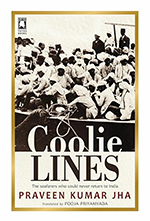
Most of the diaspora stories that make it to the bookshelves or the screens seem to share a common wound, the idea of ‘home’, yet no two stories carry that wound in the same way. For some, home remains a place that one can book a flight to, even though the land no longer recognizes you, and you no longer recognize it either. For others, it is a place lost to cartographic adjustments, surviving only in memories and mother tongues, slowly fading away in a foreign land. Irrespective of the particular condition of home that popular diaspora stories evoke, what binds them together is that these migrations carried their storytellers along with them. Someone was there to narrate their leaving, to describe what followed, whether in their own or borrowed tongues, in their own time. Be it the literature of exile or the literature of Partition, there is always a ‘voice’ that negotiates the idea of home. If you take the voice away, the story simply does not get told, sometimes for the better part of two centuries. Praveen Kumar Jha’s book under review picks up precisely where that voice went silent.
Originally published in Hindi in 2019, Jha’s Coolie Lines brings to light the forgotten history of one of the greatest migrations from India, a history buried in colonial archives and ledgers, folksongs, personal letters, and scattered memories of descendants. With the abolition of the slave trade in 1807 and the formal passing of the Slavery Abolition Act in 1833, it became unlawful to acquire unpaid labour across the British Empire. Since muscle was no longer free, the ever-resourceful empire simply went shopping for a replacement across the subcontinent it already owned. Thus was born indentured labour, a new system of slavery wearing the paperwork of a contract, thereby becoming a purely legal endeavour. It is this history that Coolie Lines sets out to reconstruct. From 1826 onward, ships began leaving Indian shores carrying illiterate men and women who had thumb-printed a girmit, an agreement, sailing first to Reunion Island, followed by Mauritius, Fiji, Guyana, the Caribbean Islands, Suriname, Netherlands, Zanzibar, Uganda, South Africa, Canada, and eventually Myanmar and Malaysia. These ships didn’t just carry labour; they were quietly building an entire scaffolding of a future diaspora that nobody wanted but which millions now call home. ‘Diaspora’ is in fact a polite word, poor indemnity for the insatiable greed of an amoral empire.
Jha explains that these indentured labourers came to be called girmitiyas, a word that carries the history of its own distortion. The English word ‘agreement’ warped first into girmit and subsequently into girmitiya on the local tongue. It is a small but telling distortion; one forgets where the word came from, much like the people it came to name. The agreements themselves were drawn up in English and translated into Hindi or Urdu. Despite being detailed, the agreements meant very little to the workers, most of whom were illiterate and had no real way of knowing what they were agreeing to. Most agreements had four main clauses: both parties were to sign before a British Government officer; the period of indenture was five years, extendable by another five; on completion, the labourer was to be returned to Calcutta; and the ship carrying them was required to provide food, sanitation and a doctor. The machinery that fed this system was no less corrupt than the contracts it produced. Jha traces the role of the arkaati, the local recruiting agents who frequented the villages of Bihar and Awadh, luring poor and desperate men and women with tall promises of jobs and prosperity. From there the recruits were taken to the Calcutta depot, where the arkaati threatened, abused, and robbed those who wished to return to their villages, leaving them with nothing to go back to and no choice but to thumbprint the girmit. Awaiting the girmitiyas on the islands was a ten-by-seven shed, without a proper floor, barracks that came to be called the ‘Coolie Lines’. Driven by muscle and labour, it was the Coolie Lines that fuelled the mighty British empire.
Praveen Jha takes us through the lives of the girmitiyas across the islands, each with its own particular share of suffering and survival. While the migrants carried their caste, gender, and religion across the kala pani, they also reshaped themselves under new challenges and pressures. Coolie Lines maps the world these girmitiyas built on faraway shores, the bonds they forged in the barracks, the friction with African and Chinese labourers who were thrown into the same colonial exploitative arrangement, the inter-racial unions, and the little financial triumphs that a few managed to gain. As the book ends with visual evidences of embarkation certificates, personal letters, and recruitment posters, it brings to light a world that was never meant to be remembered.
What makes Coolie Lines an important text is not that it tells the story of the greatest orchestrated migration of colonial times, but that it does so in Hindi. This is where translation delivers, and it works in two different directions at once.
Writing a history of Indian indenture in Hindi is itself an act of translation, since the material mostly exists in colonial archives and academic monographs. By writing the story in Hindi, Jha gives the descendants of the girmitiyas left behind in India something they never had; the story of their own great-grandfathers, in their own language. The second direction is more obvious. Pooja Priyamvada’s English translation sends the story back across the same waters the girmitiyas once crossed. This time toward the grand-children, the diaspora, who can no longer read the Hindi their ancestors carried with them to the islands. The translated book sends an echo of it back to a home that now exists on both sides of the ocean.
S Deepika teaches English at Utkal University, Bhubaneswar, Odisha.