
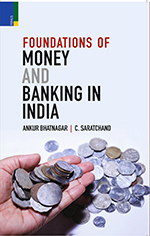
Foundations of Money and Banking in India by Ankur Bhatnagar and C Saratchand is a comprehensive textbook that explores the theories and practices of money and banking in India. The volume has sixteen chapters organized into five sections covering money, financial systems, interest rates, banking, and monetary policy.
The authors are Professors at Satyawati College, University of Delhi, and are alumni of the Delhi School of Economics. They had earlier co-edited Analytical Perspectives on the Indian Economy (2019), which brought together essays on inflation, agrarian issues, labour, gender and education, and have also contributed separately and jointly to academic journals.
The first section discusses the evolution of theories and concepts relating to money in two chapters (‘Concepts of Money’ and ‘Theories of Money Stock’). The authors discuss the classical, Keynesian, and modern views on how the measurement of the money stock and the demand for money are shaped by income, interest rates, and expectations about their future trajectories. They provide detailed discussions on aggregates like M1, M2, and M3, and ‘Money in India’ before moving on to discuss demonetization in India (2016). They devote a full chapter to discussing its impact on households, firms, and informal markets. This detailed opening section helps communicate that money is not merely a neutral tool but a social institution shaped by politics and policy. By linking theory with India’s lived experience, the authors are able to make abstract concepts tangible. A detailed appendix is also contained within this section to discuss the Euro, tracing its creation and showing how a common currency changes the way monetary policy is carried out in otherwise sovereign countries.
The second section, ‘Financial Systems’, examines India’s financial architecture through four themes in three chapters, supported by a detailed appendix on Financial Innovations and Basel III regulations. A detailed description of money markets, capital markets, and foreign exchange markets is provided, explaining how they mobilize savings and allocate resources.
Similarly, commercial banks, cooperative banks, NBFCs, and development finance institutions are well discussed, highlighting their interconnected roles. Thereafter, the authors introduce bonds, equities, derivatives, and newer innovations that facilitate transactions and risk management as well as discuss domestic and global crises, showing how shocks spread through India’s system, while ‘Regulation and Supervision’ discusses frameworks like Basel III and the Reserve Bank of India’s supervisory role. This section provides an overview of how India’s financial system operates, evolves, and sometimes falters, and it highlights the dual challenge of deepening financial inclusion while maintaining stability in a liberalizing economy.
The third section explains ‘interest rates’ in three chapters, with a supporting appendix. It takes readers through the classical theories, including the loanable funds theory and Keynes’s liquidity preference theory, and their divergence from the classical view, before elaborating on modern theories that combine elements of both. There is a detailed discussion on India’s experience with interest rate deregulation, the shift from administered rates to market-determined rates, how lending and deposit rates changed when controls were lifted, and how these changes in rates influence changes in borrowing, saving, and investment decisions. This section ties theory to practice by showing how interest rate policies influence economic activity, growth and stability.
The fourth section on banking provides the reader with a detailed historical backdrop and evolution of banking in India up to recent times in three chapters. This includes details of the origins of commercial banks during colonial times, the bank nationalization of 1969 and its impact on credit markets, the liberalization era of the 1990s and the rise of private banks. The authors have elaborately covered cooperative banks and regional rural banks, explaining their role in financial inclusion, highlighting and discussing the tension between profitability and social responsibility. There is a detailed discussion of the current structure of the banking system, including public sector banks, private banks, and foreign banks. There is a separate appendix on employment in the banking sector discussing how reforms have changed the workforce.
The fifth section, ‘Monetary Policy’, has four chapters and ties together the earlier discussions by focusing on the role of the Reserve Bank of India. It begins with a chapter on the instruments available to the Reserve Bank of India, such as repo rates, cash reserve ratios, and open market operations. The authors then move on to explain the targets of policy, including inflation control and growth support. A separate chapter looks at the RBI in an open economy, where global capital flows and exchange rates influence domestic policy. The section ends by discussing different approaches to monetary policy, including inflation targeting and broader developmental goals. A separate appendix exists to evaluate the COVID-19 response, discussing the measures the RBI took and why those measures had a limited impact without stronger fiscal support.
Across these sections, the book includes case studies, student projects, and suggested readings. For example, the demonetization case study asks students to consider distributional impacts, while the Basel III discussion raises questions about the suitability of global rules for local economies. The COVID-19 chapter asks readers to think about the limits of monetary policy in the absence of fiscal support.
Taken together, the book succeeds in offering a pluralistic and comprehensive view of India’s monetary and financial landscape. Its greatest strength is the way it combines abstract theory with real-world events—such as demonetization, financial crises, and the pandemic—making complex ideas the subject matter, both rigorous and relatable. The sequential structure ensures clarity, guiding readers from basic concepts of money to complex issues of policy. The inclusion of chapter-level detail and appendices enriches the text, making it suitable for students, teachers, and policymakers alike.
However, the book’s breadth can sometimes feel overwhelming. Covering multiple perspectives—mainstream, Keynesian, and post-Keynesian—adds richness but occasionally sacrifices depth. Some chapters, especially those on financial instruments and crises, could benefit from more case studies or empirical data, though admittedly, the book length would increase further.
All in all, Foundations of Money and Banking in India can be a useful resource for anyone seeking to understand India’s financial system, as it not only explains how it works but also encourages readers to think critically about its strengths, weaknesses, and future directions.
TCA Ranganathan, former CMD of Export Import Bank of India and former Non-Executive Chairman of Indian Overseas Bank, is the co-author of All the Wrong Turns: Perspectives on the Indian Economy (Westland 2019).