
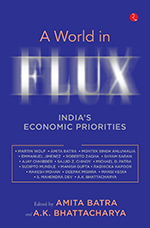
Dr Shankar Acharya, a venerable economist and former Chief Economic Adviser of India, has been closely involved with India’s growth trajectory. His tenure bridged the radical reforms of the early 1990s with the high-growth trajectory of the early 2000s. Acharya was an integral part of the design and implementation of the country’s economic reforms package in the nineties. A World in Flux is a festschrift in honour of Dr Acharya edited by Professor Amita Batra and economic journalist AK Bhattacharya, with a galaxy of leading voices.
All the contributors to the volume have either worked with Acharya or developed a long professional association with him over the years. They use his legacy and their association with him as a springboard to interrogate India’s future, covering most aspects of the Indian economy, including trade, monetary policy, agriculture, and globalization. The book offers clear, data-driven guidance for policymakers and readers alike. The focus is on India’s economic priorities in a volatile world marked by record-high uncertainty. The book is structured around a daunting question: How does India become a developed nation (Viksit Bharat) by 2047 in a global order that is currently coming apart at the seams?
The first section of the book addresses global disruptions in trade and geopolitics, i.e., the ‘Flux’ mentioned in the title. Amita Batra sets the stage by analysing the erosion of the multilateral trading system. The consensus-based WTO era has been replaced by protectionism and ‘strategic autonomy’.
The contributors argue that India must brace for rising protectionism and ‘green’ trade barriers, such as the EU’s Carbon Border Adjustment Mechanism (CBAM). The global tailwinds that propelled East Asian Tigers to prosperity have turned into headwinds. Still, the authors argue that India cannot afford to turn inward. While ‘Atmanirbhar Bharat’ (Self-Reliant India) is a political necessity, the contributors stress that the country must not devolve into 1970s-style import substitution.
Instead, the way forward is deepening integration with regional blocs while aggressively negotiating bilateral FTAs to bypass the gridlocked WTO. Ajay Chhibber discusses the relevance and future of multilateral institutions. Shyam Saran examines the issue of participating in China-led financial initiatives for creating a parallel payments system in the regional context.
Sajjid Z Chinoy emphasizes that India should not turn its back on globalization and instead seize opportunities by engaging with global markets, noting that export success has been a common factor among high-growth economies. Additionally, he has underscored the importance of institutionalizing macroeconomic stability through inflation targeting and robust fiscal frameworks. Rakesh Mohan, criticizing India’s excessive focus on the West, emphasizes the importance of the East’s demand-rich markets. He challenges the prevailing caution regarding investment from China. Additionally, India should be more competitive given its lower wage rates compared to the newly emerging manufacturing hubs such as Vietnam.
Focusing on monetary policy issues during COVID times, Michael Patra argues that India’s temporary, calibrated, and self-limiting liquidity infusion facilitated a smoother pandemic recovery and was much better than the monetary policies of the Western bloc. He has argued that maintaining price stability and strategic restraint in interest rates are crucial for long-term growth, and a robust foreign exchange reserve is required as safety net against global volatility.
AK Bhattacharya argues that India’s economic reforms are consistently driven by crises rather than proactive planning, often stalling once stability is achieved due to a political preference for the ‘comfort zone’. Essays by AK Bhattacharya and Vijay Kelkar stress the importance of fiscal prudence—echoing a core tenet of Shankar Acharya’s own philosophy. According to them, post-pandemic, India’s debt-to-GDP ratio remains elevated. While capital expenditure has increased, the overall quality of spending remains a concern, especially at the State level. They underscore the importance of a strict Fiscal Responsibility and Budget Management (FRBM) framework. The suggestion of the ‘Second Generation’ of fiscal federalism, empowering the Finance Commission to create a better incentive structure for the States, is highly appealing. Whether it can generate the required political support remains to be seen.
In this regard, Sudipto Mundle has a different take. He argues that India’s fiscal state exhibits characteristics of a soft state. Fiscal discipline is compromised by a lack of hard commitments and an inability to enforce policy. He emphasizes that while fiscal consolidation is necessary, it often comes at the cost of compressed social spending and the inability to address jobless growth, while the high GDP growth has not generated sufficient employment.
As for the structural issues, the book addresses the ‘missing middle’ of the Indian economy. An overwhelming majority of India’s manufacturing and service sectors landscape consists of Own Account Manufacturing Enterprises. The subsistence enterprises that operate without hired labour rarely transition to larger sizes, let alone become engines of high-quality and productive job creation.
Poonam Gupta and Radhicka Kapoor’s contributions provide an analysis of why India is experiencing premature de-industrialization. The economy has struggled to create mass-scale manufacturing jobs. Service-led growth has created wealth at the top, but economic growth has failed to pull labour out of agriculture into high-productivity manufacturing. Furthermore, the rise of Automation and AI threatens to make traditional low-skill assembly lines obsolete before India can even build them. They call for reducing regulatory ‘fear’ among corporate and Micro, Small, and Medium-Sized Enterprises, a massive overhaul of the vocational training system to prepare the youth for ‘Industry 4.0’, and increasing women’s participation, which requires targeted policy support, including measures to improve urban transport safety and decentralized childcare hubs. However, Kapoor is not in favour of shielding small units from competition, as it can encourage inefficient production modes under the guise of employment generation.
Deepak Mishra and Mansi Kedia identify digitalization as a core pillar of development, focusing on improving public service efficiency through the India Stack and Direct Benefit Transfers. The chapter highlights increased financial inclusion via UPI, economic formalization, and improved productivity through digital business models as key developmental drivers, but warns against complacency. The concentration of data power, a global public good in a few hands remains a regulatory challenge. The authors make a persuasive case for why and how India should lead the Global South in setting standards for data privacy and algorithmic transparency.
India must navigate a world in flux while addressing the serious implications of climate change. India is one of the most climate-vulnerable nations. The energy transition requires trillions of dollars which the domestic banking system alone cannot provide. The essays here transition from viewing climate action as a ‘burden’ to a ‘competitive advantage’. The essays on this subject call for a National Green Finance Strategy. Montek Singh Ahluwalia has suggested that while objectives like Net Zero by 2070 are widely agreed upon, the challenge lies in the execution, making a strong case for specific, alternative policy pathways rather than just broad targets.
Outlining the key priorities for transforming Indian agriculture, S Mahendra Dev has argued that the sector cannot be sustained solely through short-term subsidies, and requires deep structural reforms. His list of priorities includes: centre-State coordination, since agriculture is a State subject; a shift in focus from increasing output to improving overall resource productivity; and modernizing agricultural marketing. He provides a roadmap for leveraging technology and market mechanisms to enable farmers to access broader markets and receive fairer prices.
What unites the multiple essays on disparate topics is the case for pragmatism over ideology and for structural reforms over quick-fix populist measures. The essays collectively advocate what can be described as the ‘Shankarite’ approach to economics, repeatedly reminding us that economic reform is not a one-time event but a continuous process of institutional change combined with capacity-building among regulators and policymakers.
Overall, the volume presents India as a nation with the tools to succeed but operating in a challenging world with an impractical approach. The message is clear: India’s path to 2047 must be guided by an agile, data-driven, and fiscally disciplined policy approach. The volume is emphatic in its recommendations on the three key priorities for India. On reforming multilateral institutions, it advocates a new and practical approach to international governance. As to the leadership of the Global South, it suggests that India must secure a place at the high table to define global contours for the next century while representing the interests of the Global South. All this has to be achieved while maintaining high growth to ensure that the economy supports every section of society. These goals are riddled with multiple challenges.
The volume lacks a deep dive into important issues, including expanding the tax base to fund public goods and achieving energy and critical minerals self-sufficiency, vital in today’s protectionist world. Similarly, the issue of informality in production and employment, despite decades of growth, requires deeper analysis. Besides, some chapters exude technocratic optimism and seem to underestimate the political-economic challenges of implementing the sweeping reforms they advocate. AK Bhattacharya is spot on in warning that the lack of risk-taking and the failure to implement structural changes can threaten long-term goals such as ‘Viksit Bharat 2047’ and the adequate addressing of the issue of inequality.
All things considered, A World in Flux is an invaluable read for anyone trying to understand whether the twenty-second century can be the Indian century and how to get there.
Ram Singh is Director and Professor, Delhi School of Economics, University of Delhi, Delhi.