
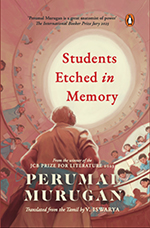
Perumal Murugan is prominently known for his Tamil novels. The English-reading public might not recognize him as a teacher of Tamil language and literature at college and university. The writer sets the record straight in Students Etched in Memory, which has been admirably translated from Tamil into English by V Iswarya. In this compilation of forty short essays previously published as bite-size newspaper articles, Murugan reminisces on his students, revealing a great deal about them—and himself—in addition to the social milieu of higher education in Tamil Nadu in the post-1990s. However, his pithy commentary and perceptive observation resonate across the Indian State boundaries and the specificity of its time period.
Murugan dedicates the book to the first-generation students who made their way into the government colleges, which appropriately sets the frame for his essays. Each essay pivots around a student who hails from marginalized socio-economic and rural background in Tamil Nadu. The students pin their high hopes on State-funded colleges as a rare ladder for a better life.
Many of them engage in a variety of part-time menial jobs for a pittance to financially support themselves; some students also provide for their families from their meagre earnings. They toil in yam mills that produce sago at night; in the parking lot at bus stands; in textile showrooms; in spinning mills, at small eateries making parotta; and in grocery stores and poultry farms. Unsurprisingly, they struggle to reconcile their student life at college with the precarious labouring life. One of his students, Surendran, travels 20 miles on his bicycle every day to college. With their mettle and Murugan’s much-needed support (academic but also occasionally financial), some of them make it to secure jobs, such as school teachers. Some join the police service. Murugan’s random meeting with a stranger on the road, on the bus, at a restaurant, or an abrupt phone call opens the floodgates of memory, reconnecting the teacher to his students. In this way, the spontaneity of everyday life promptly revives sedimented memory in the teacher.
The teacher shares an emotive bond with his students although it is not always conspicuous. Murugan identifies with them because he grew up in a rural area with open skies, huts with thatched roof and goat pens. Such a setting recurs in his novels. Many of his students hail from the ‘rock bottom of society’ (p. 108) with non-literate parents for whom making ends meet takes urgent precedence over getting higher education. Fear of the English language haunts many of his students. Their inadequate command over it seems insurmountable to them because the department of English in colleges is either under-staffed or lacks well-trained teaching staff. The instance illustrates the shortcoming of ethno-centric medium of instruction in Tamil Nadu but also resembles various linguistic contexts where asmita (identity) built on the so-called first language—such as Odia—stymies the mobility of the disadvantaged students in a globalized world. Institutional failure to provide resources for competency in the English language reinforces caste, class and (rural) regional disadvantages of the students. Likewise, a kabaddi coach or an opportunity in singing and acting could have led some students on a remarkable path, building on their talents and interests. Instead, many of them end up marrying early and becoming parents, which might find an echo in many States in India. Yet the hope for a better future endures as they seek Murugan’s advice on their children’s education.
Like in his novels, Murugan shines a scathing light on social relations undergirded by caste which bares its naked fangs when it comes to romantic relationship or marriages. In the most memorable story, Balamurugan, who worked at a spinning mill, fell in love with a fellow worker. But their relationship ended because of caste, and he died by consuming pesticide. Murugan is devastated by remorse: ‘Can a teacher not be a friendly companion and confidant to his students? […] To this day, I have not been able to live down my guilt over this incident’ (p. 90). He attends the funeral on the bank of the idyllic Gomukhi river full of silent pebbles. Murugan brings a pebble in memory of Balamurugan which sits quietly at his table today. At a time when higher education institutions in India recurrently witness death of students, some genuine support and guidance—individual and institutional—with a bit of kindness can provide a lifeline to students during a critical phase of their life. Murugan ruminates with a hint of melancholy that life offers so much apart from romantic love.
The last story, fittingly titled ‘Towering over All’, ends on a happy note where two researchers from dominant and oppressed castes marry despite familial disapproval. Murugan is caught by surprise at the couple’s bold decision but elated at the wedding invitation he receives from them. It is worth recalling that his acclaimed novel Pyre pivots around inter-caste love that meets a tragic end. The crisp essays of Students Etched in Memory offer a mixed bag of earnest commentary, conviviality, and harmless mischief about namesakes, cooking and eating of food, and unconventional hair and dressing styles of his students. They also reveal the humorous facets of a writer known for his serious novels. Murugan brims with a sense of fulfilment when he bumps into his students doing well in their life. He shows us that a teacher’s role does not conclude in delivering a subject-specific lesson in the classroom. The ethics of teaching demands enriching engagement with students beyond the confines of the classroom, chalk and duster.
At a time when education is increasingly truncated into a degree that is sold in the market like a commodity by the mushrooming private colleges and universities, the book emphasizes the indispensability of public-funded education which keeps the aspiration alive for the vast sea of marginalized and disadvantaged students across India. Perumal Murugan, the novelist and social commentator, speaks with ethical—and political—vigour that higher education cannot be the exclusive preserve of those with deep pockets.
Purnachandra Naik teaches in the Centre for Comparative Literature (CCL), School of Humanities at the University of Hyderabad (UoH), Hyderabad.